Book summary
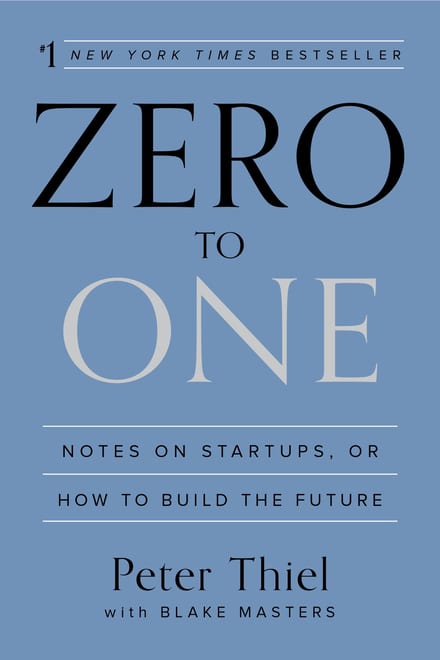
Zero to One: Notes on Startups, or How to Build the Future
The full book runs ~253 pages — roughly 5 hours of reading. You get the key ideas here in 4 minutes.
The key ideas
- Create vertical progress: build zero to one, not one to n
- Escape competition; monopolies fund research and long-term thinking
- Dominate a tiny market first, then expand outward
- Build on a secret others don't see or believe
- Choose founders with both skills and real relationships
- Answer all seven questions before you launch
The summary
The most valuable companies aren’t built by copying what already works. Peter Thiel draws a hard line between two kinds of progress: horizontal progress, going from one to n by spreading existing ideas, and vertical progress, going from zero to one by making something that never existed before. Manufacturing more smartphones is horizontal. Inventing the smartphone is vertical. The first is easy to picture and easy to copy; the second is hard precisely because you have to see what almost no one else can. Real value, Thiel argues, comes from that second kind — and the reward for it is monopoly.
That word usually sounds like a threat, but Thiel means something specific: a business so much better at what it does that no competitor can survive against it. Escaping competition is the whole point, because competition destroys profit. In 2012 the fiercely competitive airline industry earned all of 37 cents of profit per passenger, while Google, a near-monopoly in search, kept more than 25 percent of its revenue. When your product is interchangeable with everyone else’s, you compete on price until the margin is gone. When you’re the only one who can do what you do, you set the price.
Monopoly is the prize
Far from being bad for the world, Thiel says, monopolies are engines of progress. Because a monopolist isn’t scrambling to undercut rivals, it can afford to invest in research, think years ahead, and keep improving the product its customers already depend on. Hewlett-Packard thrived in the 1990s by inventing genuinely new products; when it stopped inventing and started imitating, it lost half its value.
Durable monopolies tend to share four traits: proprietary technology that’s dramatically better than the alternatives — think ten times better, not ten percent; network effects that make the product more valuable as more people use it, the way Facebook does; economies of scale, so costs fall as the business grows, the way Nike can make a shoe far cheaper than a corner shop; and a strong brand that can’t be copied, like Apple’s. You don’t need all four on day one, but you need a path to them.
The way you get there is by starting absurdly small. Dominate a deliberately tiny market first, then widen out. Amazon didn’t try to sell everything at launch; it sold books, cornered that niche, and only then expanded. Start by competing in a broad market and you’re just one more player grinding toward zero.
Every great company keeps a secret
Behind each of these businesses is a secret — an important truth that most people don’t know or refuse to believe. That slavery was wrong was, at one point in history, a secret. The best founders are the ones hunting for the commercial equivalent: something true about the world that the consensus has missed. Thiel’s favorite interview question gets right at it — “What important truth do very few people agree with you on?” Most people can’t answer, because most people think in consensus. But the world still holds plenty of secrets, and the companies that stop looking for the next one are the ones that fade.
Build to last
Startups are the only organizations nimble enough to create something genuinely new, since big companies are too bureaucratic and too afraid of risk. But starting a company is now easy, and most still fail, because building one that endures is hard. A company’s real value is the sum of all the profit it will ever earn, not what it makes this quarter — PayPal wasn’t projected to turn much profit for a decade and was still enormously valuable, because its founders understood the long game.
That long game demands a solid foundation. Founders need not only complementary skills and a shared vision but genuine, close relationships; Thiel has watched companies fall apart because the founders barely knew each other. A strong culture, where people actually enjoy working together, makes a team faster and stickier. And no matter how good the product, you can’t ignore sales. Many technical founders would rather build than sell, but distribution is as important as invention: match the effort to the value of each customer, so a million-dollar deal gets the founder’s personal attention — as Thiel’s own company Palantir does — while a cheap product needs a scalable channel. Don’t be squeamish about proven sales tactics, either; wrapping a product in a compelling story is one of the most effective ways to move it.
The seven questions
Before launching, Thiel says, answer seven questions honestly. Get five or six right and you might succeed; nail all seven and success is close to guaranteed.
- Engineering: Can you create breakthrough technology, something ten times better rather than marginally so?
- Timing: Is now the right moment for this business?
- Monopoly: Are you starting with a big share of a small market?
- People: Do you have the right team, with both the skills and the relationships?
- Distribution: Can you actually deliver the product to customers?
- Durability: Will your position hold ten and twenty years out?
- Secret: Have you found an opportunity others don’t see?
The bottom line
Don’t compete — create. Build something new, take over a small market first, then expand, and you’ll earn the profits and freedom to shape the future instead of fighting over scraps of the present. Read this if you’re starting a company, or just want to think more clearly about where real innovation comes from.
Fact check
Popular books repeat findings that later research has complicated. Where Zero to One makes a testable claim, here's what the evidence actually shows.
Competition grinds profit to nothing: in 2012 the US airline industry earned about 37 cents of profit per passenger.
2012 was the trough, not the steady state. Bureau of Transportation Statistics figures put net income for all US carriers' scheduled services at $364 million for the whole of 2012 — spread across hundreds of millions of passengers, that really is pennies each. But the same series shows $12.7 billion in 2013 and $26.4 billion in 2015 once the merger wave had consolidated the industry, so the near-zero margin captured a particular moment rather than an iron law of what competition does to profit.
- US Department of Transportation, Bureau of Transportation Statistics. Air carrier financial data: net income, all US carriers, scheduled services. TranStats. Accessed July 30, 2026. Source
Monopolies are engines of progress, because a firm that isn't scrambling to undercut rivals can afford to fund research and think years ahead.
The relationship runs as an inverted U, not a straight line. Using UK firm patenting data, Aghion and colleagues found innovation rising as competition increases and then falling once competition gets intense — so entrenched monopoly and cutthroat rivalry both suppress it, and the productive position is in between. Meanwhile US market power has climbed steeply since 1980, with aggregate markups going from 21 percent above marginal cost to 61 percent and average profit rates from 1 percent to 8 percent, a period that also brought falling labour share and less labour market dynamism.
Startups are the only organisations nimble enough to create something genuinely new, because big companies are too bureaucratic and too risk-averse to invent.
The direction holds; the exclusivity doesn't. Akcigit and Kerr find that exploration R&D — the kind that opens new product lines — does not scale with firm size the way exploitation R&D does, and that entrants and small firms carry relatively higher growth spillovers. Large incumbents are not sitting still, though: they concentrate on improving existing products, which is a different kind of innovation rather than the absence of one. The data show a difference of degree, not the clean divide between inventors and bureaucrats the book draws.
- Akcigit U, Kerr WR. Growth through heterogeneous innovations. J Polit Econ. 2018;126(4):1374-1443. Source
Frequently asked questions
What is Zero to One about?
Zero to One is about building something genuinely new instead of copying what already works. Peter Thiel separates horizontal progress, going from one to n by spreading existing ideas, from vertical progress, going from zero to one by creating what never existed before. The reward for that second kind of creation is a monopoly, a business so much better at what it does that no competitor can survive against it, and escaping competition is the whole point because competition destroys profit.
What are the key takeaways from Zero to One?
Create rather than compete: a monopoly sets its own price and can invest in the future, while interchangeable products get ground down to zero margin. Durable monopolies share four traits, proprietary technology that's ten times better, network effects, economies of scale, and a strong brand, and you reach them by dominating a deliberately tiny market first, then widening out the way Amazon started with books. Every great company keeps a secret, an important truth few people believe, and lasting success also needs founders with close relationships, a strong culture, and serious attention to sales and distribution. Before launching, answer Thiel's seven questions honestly: engineering, timing, monopoly, people, distribution, durability, and secret.
Who should read Zero to One?
Read it if you're starting a company, or if you just want to think more clearly about where real innovation comes from and how to shape the future instead of fighting over scraps of the present.
Is Zero to One worth reading?
It's worth reading for its sharp, contrarian case that value comes from creating new things and escaping competition, backed by concrete examples like Google's fat margins versus the airlines' 37 cents of profit per passenger. The seven questions and the four traits of durable monopolies give founders a practical checklist. Readers looking for a step-by-step operating manual rather than a way of thinking about innovation may find it more philosophical than prescriptive.