Book summary
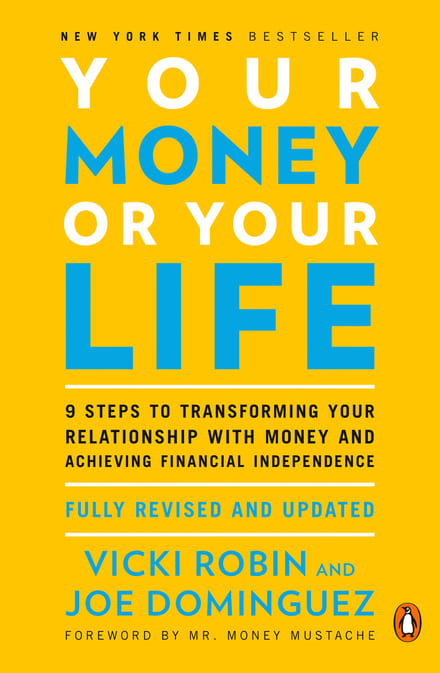
Your Money or Your Life: 9 Steps to Transforming Your Relationship with Money
The full book runs ~376 pages — roughly 7 hours of reading. You get the key ideas here in 4 minutes.
The key ideas
- Money is life energy: your real hourly wage is what's left after subtracting every job-related cost and hour.
- The fulfillment curve peaks at 'enough'; everything past it is clutter that works against you.
- Convert spending into hours of your life, then ask three questions of each category.
- Financial independence arrives at the crossover point, when investment income exceeds monthly expenses.
- Frugality means enjoying what you have — a high joy-to-stuff ratio, not deprivation.
The summary
Money is something you trade your life energy for. That is the one thing the authors insist is true one hundred percent of the time. You sell the hours of your finite life for a paycheck, which means every dollar in your pocket is a slice of the time you have left on earth. Seen this way, financial independence isn’t about getting rich. It’s about valuing that life energy honestly, discovering how much is genuinely “enough,” and closing the gap between what you earn and what you truly need — until the gap becomes savings, and the savings eventually set you free.
Money is life energy
Most people figure their wage the lazy way: a thousand dollars for forty hours means twenty-five dollars an hour. The book tears that number apart. Once you subtract the costs and hours that exist only because you have a job — the commute, the work wardrobe, the decompression drinks, the getaways you take to recover from work — that $25 can shrink to a real hourly wage of $10. Run the arithmetic and every dollar you spend represents six minutes of your life. A $20 impulse buy now costs 120 minutes. The authors call those impulse buys “gazingus pins”: the earbuds, pens, or chocolate you can’t pass without grabbing, the ones that pile up in a drawer with five others you’ve forgotten. When Mark H. did this calculation, he found nearly half his income was being spent just to hold the job — so he left it, and came out ahead.
The fulfillment curve and “enough”
Early in life, more money really did buy more happiness: food, warmth, shelter. But the fulfillment curve bends. Past a certain point each new purchase delivers less, and eventually more stuff starts working against you — the bigger house, the three-car garage, the exercise equipment gathering dust in the basement. The peak of that curve has a name the book wants you to recognize when it’s staring you in the face: enough. Enough is having everything you need and a few real luxuries, with nothing extra to store, clean, insure, or pay off. Everything beyond it is clutter. This isn’t only philosophy. Kahneman’s research put sufficiency around $75,000 a year, and in the authors’ own seminars people at every income level, asked what would finally make them happy, gave the same answer: 50 percent more than I have now.
The nine steps and three questions
The program is nine steps, and they build on one another. You start by making peace with the past — your total lifetime earnings, and your current net worth — then track every cent flowing in and out, tabulate it monthly, and convert each category from dollars into hours of your life. That conversion is where it gets personal. For every spending category, you ask three questions:
- Did I receive fulfillment, satisfaction, and value in proportion to the life energy spent?
- Is this expenditure in alignment with my values and life purpose?
- How might this change if I didn’t have to work for money?
Then you mark each category to rise, fall, or hold. This, the authors say, is the heart of the whole thing. The later steps follow: minimize spending without deprivation, respect and maximize the income your life energy earns, and put your money to work.
The crossover point
Step five puts your income and expenses on a Wall Chart — a big graph you hang where you’ll see it every day. As you do the steps, your expense line settles and your savings grow into capital: money that makes money. You add a third line, monthly investment income, which is your capital multiplied by a safe long-term return. Month by month that line creeps upward while expenses hold flat. The moment it crosses your expense line is the crossover point — the day investment income covers your costs and paid work becomes optional. That is financial independence made concrete. One rule of thumb the book cites: 25 times your annual expenses, drawn down at 4 percent. Spend $36,000 a year and you need roughly $900,000.
Frugality as enjoying what you have
The word “frugal” sounds like deprivation, but its Latin root means to enjoy, to have the use of. Frugality is enjoying what you have — savoring a single orange completely rather than juicing five and rushing on. Waste isn’t in owning little; it’s in failing to enjoy what you own. The measure is your joy-to-stuff ratio: one unit of joy per possession is frugal, while needing ten things to feel anything is missing the point of being alive. There’s a Spanish word for the spirit of it, aprovechar — to use something wisely and get its full value, whether that’s leftovers turned into a good meal or a day at the beach.
The bottom line
Once you truly grasp that money is your life energy — hours you will never get back — the endless chase for “more” loses its grip, and enough becomes a place you can actually reach and stay. Value your time, define enough, and let the growing gap between earning and spending carry you to freedom. Read it if you feel trapped by work and money and want a concrete, humane path out.
Fact check
Popular books repeat findings that later research has complicated. Where Your Money or Your Life makes a testable claim, here's what the evidence actually shows.
Kahneman's research put emotional sufficiency at around $75,000 a year, past which more income stops making you happier.
The $75,000 plateau came from Kahneman and Deaton's 2010 reading of more than 450,000 Gallup responses, and it did not survive better measurement. Killingsworth's 2021 study of 1,725,994 experience-sampling reports from 33,391 employed US adults found day-to-day well-being still rising linearly with log income above $75,000, with an equally steep slope for high earners as for low. Kahneman then co-authored a 2023 reanalysis that placed the flattening only among the least happy people; for everyone else happiness kept climbing with income, and accelerated in the happiest group.
- Kahneman D, Deaton A. High income improves evaluation of life but not emotional well-being. Proc Natl Acad Sci U S A. 2010;107(38):16489-16493. PubMed
- Killingsworth MA. Experienced well-being rises with income, even above $75,000 per year. Proc Natl Acad Sci U S A. 2021;118(4):e2016976118. PubMed
- Killingsworth MA, Kahneman D, Mellers B. Income and emotional well-being: A conflict resolved. Proc Natl Acad Sci U S A. 2023;120(10):e2208661120. PubMed
Financial independence arrives at roughly 25 times your annual expenses, drawn down at a safe 4 percent a year.
The 4 percent figure was calibrated on twentieth-century US market history, which was unusually generous by world standards. Rebuilt on asset returns from 38 developed countries, the sustainable rate drops hard: a 65-year-old couple willing to accept a 5 percent chance of running out could withdraw only 2.31 percent a year, which is closer to 43 times expenses than 25. As a planning anchor for a US-weighted portfolio over a 30-year retirement the rule is defensible; for the 30-something aiming to stop work for 50 years — the reader this book is written for — it is optimistic.
- Anarkulova A, Cederburg S, O'Doherty MS, Sias RW. The safe withdrawal rate: evidence from a broad sample of developed markets. J Pension Econ Financ. 2025;24(3):464-500. Source
Past the peak of the fulfillment curve, buying more actively works against you rather than simply adding less.
The link between chasing possessions and lower well-being is real but modest, and it is correlational. A meta-analysis of 753 effect sizes from 259 independent samples put the association between materialistic values and well-being at r = -.19. It was weakest for precisely the outcomes the fulfillment curve is about — life satisfaction and negative affect, r = -.13 to -.15 — and strongest for risky health and consumer behaviour and negative self-appraisals, r = -.28 to -.44. What the evidence supports is that prioritising money and things tracks lower well-being, not that each purchase past a threshold subtracts satisfaction.
- Dittmar H, Bond R, Hurst M, Kasser T. The relationship between materialism and personal well-being: A meta-analysis. J Pers Soc Psychol. 2014;107(5):879-924. PubMed
Frequently asked questions
What is Your Money or Your Life about?
Your Money or Your Life reframes money as life energy — the hours of your finite life you trade for a paycheck. Written by Vicki Robin and Joe Dominguez, it lays out a nine-step program to define how much is 'enough,' spend less than you earn, and reach financial independence: the point where investment income covers your expenses and working for money becomes optional.
What are the main lessons in Your Money or Your Life?
The book's core lessons are: money is something you trade your life energy for, so calculate your real hourly wage after job costs; find the peak of the fulfillment curve, called 'enough,' and treat everything beyond it as clutter; track every cent and convert spending into hours of life; and build savings into capital until investment income crosses over your expenses.
Who should read Your Money or Your Life?
Anyone who earns or spends money, which is everyone. It's especially useful if you feel trapped in a job that drains you, carry debt or a vague money anxiety, or want to retire far earlier than the standard timeline. The program fits both the fast-moving 'hare' chasing early independence and the steady 'turtle' building security over decades.
Is Your Money or Your Life worth reading?
Yes. It has stayed in print for more than twenty-five years and helped seed the FIRE (Financial Independence, Retire Early) movement because its method works on the root — your beliefs and habits around money — not just the symptoms on your bank statement. If you want one book that treats money and a meaningful life as the same question, this is it.