Book summary
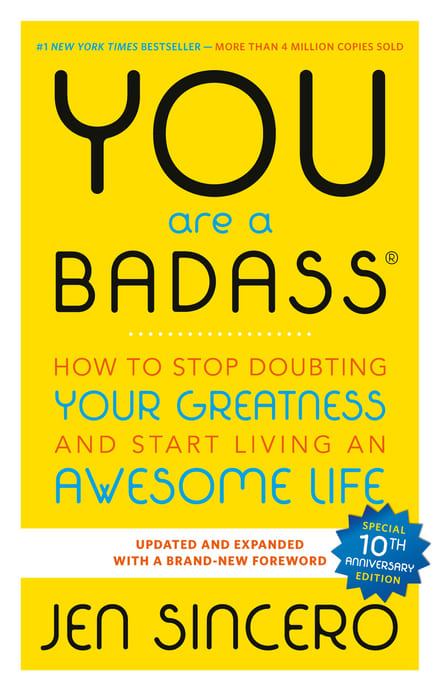
You Are a Badass: How to Stop Doubting Your Greatness and Start Living an Awesome Life
The full book runs ~259 pages — roughly 5 hours of reading. You get the key ideas here in 4 minutes.
The key ideas
- Expose the Big Snooze of limiting beliefs steering your life
- Flood your mind with mantras, affirmations, and daily gratitude
- Shape reality through visualization, meditation, and the frequency you broadcast
- Stop outsourcing self-worth to other people's shifting opinions
- Move before fear disguised as procrastination talks you out
- Treat rejection as an early chapter, not the ending
The summary
The beliefs running your life right now probably aren’t yours. Most of them arrived before you were old enough to weigh them — messages about money, love, and what’s possible for someone like you, absorbed so young they feel like plain fact. Jen Sincero calls this inherited programming the Big Snooze: the subconscious pile of limiting beliefs that keeps your life smaller than it needs to be. Grow up hearing “no one in our family is good at school,” and you may quietly steer away from an ambitious education. Watch your parents’ marriage fall apart, and you may expect the same and hold intimacy at arm’s length. Her whole project is teaching you to notice that script and rewrite it.
Love yourself on purpose
The first move is aggressive self-regard — not the vague advice to be kind to yourself, but active, repeated reminders that you are capable and worth something. Sincero pushes mantras: short, declarative lines you say to yourself whenever your mind goes idle. Waiting in line at the store, tell yourself, “I am smart, beautiful, and a badass.” It feels ridiculous until you notice how much airtime your inner critic already gets for free. Affirmations are how you take that airtime back — not to convince yourself of a lie, but to drown out an old inherited script with one you actually chose, even something as plain as you are enough.
Gratitude works the same muscle. Write down ten things you’re grateful for each night, big or small, and you keep positive evidence in front of you instead of letting your brain’s negativity bias run the show. It also shifts, in Sincero’s framing, the frequency you’re broadcasting — which matters for what comes next.
What you put out comes back
Sincero leans hard on the Law of Attraction: the idea that an invisible Source Energy runs through everything and that like frequencies attract one another. Stay stuck in jealousy and you’ll pull more jealousy-provoking situations toward you; radiate confidence and generosity and those tend to circle back. Whether you take that literally or as metaphor, the practical instruction lands the same — your thoughts shape your reality, so change the thoughts and the reality starts to follow.
Visualization is the main tool. If you want to be a strong public speaker, don’t just wish for it. Close your eyes and picture yourself on stage in real detail: voice steady, the crowd leaning in, the feeling in your chest. This isn’t idle daydreaming, it’s rehearsal, and it teaches your brain to treat the goal as familiar rather than terrifying, which makes acting on it easier when the moment comes. Meditation supports the whole effort by clearing the clutter — sit, breathe, notice when your attention wanders, and bring it back. Sincero frames it as connecting with Source Energy, but even a skeptic gets the payoff: less stress, smaller worries, and enough quiet to hear what you actually want instead of what you were told to want.
Stop outsourcing your worth
As kids, we did what felt right. Then we learned to monitor what other people think, and that monitoring quietly became the organizing principle of adult life — the boring job kept for the sake of others’ approval, the writing never attempted because the family called it impractical. Sincero’s diagnosis is sharp: “What other people think about you has nothing to do with you and everything to do with them.” Base your self-worth on outside validation and you hand your power to people whose opinions shift with the weather. That’s not confidence, it’s dependency.
Everyone is working from different gifts and circumstances anyway. If the Beatles had measured themselves against Beethoven, they’d have quit. Your task is to stop the comparison game and see how singular you are — “you are the only you there is and ever will be,” she writes, and thinking otherwise is as pointless as a river fretting that it has too many curves. The same lens helps with people who irritate you, since that irritation is often a quality you’ve suppressed in yourself; own the fault, notice the pattern, and let it go. If someone is genuinely toxic, cut ties. Guarding your mental environment isn’t selfish, it’s strategic.
Move before fear talks you out
Procrastination and hesitation are fear in disguise — procrastination usually a fear of failure, hesitation a fear of judgment. Sincero’s answer is to reconnect with why the goal matters; if the purpose isn’t strong enough to override the fear, maybe the goal is wrong, but if it is right, stop performing the decision and actually make it. “So often, we pretend we’ve made a decision, when what we’ve really done is signed up to try until it gets too uncomfortable.” Action is the hinge: take a step, feel how it lands, adjust. Rejection is an early chapter, not the ending — Michael Jordan was cut from his high school varsity team and worked harder, and Steven Spielberg was turned away from film school three times. Surround yourself with people and places that pull you toward the goal, and treat money as a tool for the life you want rather than a wall you accept without question.
The bottom line
The life you’re living now is built from beliefs you never chose and fears you haven’t examined — so rewrite the script with deliberate self-love, rehearse the person you’re becoming, and act before the fear of other people’s judgment locks you in place. Read this if you suspect you’re playing smaller than you have to.
Fact check
Popular books repeat findings that later research has complicated. Where You Are a Badass makes a testable claim, here's what the evidence actually shows.
Vividly picturing the outcome you want — the steady voice, the crowd leaning in, how it feels — makes you more likely to get it.
Expecting a good outcome and fantasising about one pull in opposite directions. Across four samples — graduates job-hunting, students with a crush, undergraduates facing an exam, and hip-replacement patients — judging the desired future as likely predicted more effort and better results, while enjoying vivid mental images of that future predicted less effort and worse results, measured weeks to two years later. A later set of four studies found positive fantasies also predicted more depressive symptoms over periods up to seven months, in adults and schoolchildren. Rehearsing the steps is a different act from savouring the finished result, and the instruction here points at the version that backfires.
- Oettingen G, Mayer D. The motivating function of thinking about the future: expectations versus fantasies. J Pers Soc Psychol. 2002;83(5):1198-212. PubMed
- Oettingen G, Mayer D, Portnow S. Pleasure Now, Pain Later: Positive Fantasies About the Future Predict Symptoms of Depression. Psychol Sci. 2016;27(3):345-53. PubMed
Repeating positive affirmations to yourself — "I am smart, beautiful, and a badass" — raises your self-worth.
Affirmations help the people who need them least and can hurt the people they are aimed at. In two experiments, participants with low self-esteem who repeated "I'm a lovable person" ended up in a worse mood than those who never repeated it, while participants with high self-esteem felt better, though only modestly. A softer variant — weighing how the statement was both true and not true — left low-self-esteem participants better off than flat repetition did. The mantra reads as a top-up for people already reasonably secure rather than a rescue for people who aren't.
- Wood JV, Perunovic WQ, Lee JW. Positive self-statements: power for some, peril for others. Psychol Sci. 2009;20(7):860-6. PubMed
Writing down ten things you're grateful for every night meaningfully improves your wellbeing.
Gratitude journalling beats doing nothing, but most of the advantage disappears once it is compared with any other deliberate activity. A meta-analysis found gratitude interventions outperformed measurement-only controls on psychological wellbeing (d = 0.31) and beat an alternative activity (d = 0.17), but did no better than another psychologically active exercise (d = -0.03). They did not reduce anxiety (d = 0.11, not significant). Keeping the habit is defensible; the evidence just doesn't show that gratitude in particular is what's doing the work.
- Davis DE, Choe E, Meyers J, et al. Thankful for the little things: A meta-analysis of gratitude interventions. J Couns Psychol. 2016;63(1):20-31. PubMed
Frequently asked questions
What is You Are a Badass about?
Jen Sincero's premise is that the beliefs running your life right now probably aren't yours, but inherited programming she calls the Big Snooze, absorbed so young they feel like plain fact. The book teaches you to notice that old script about money, love, and what's possible for someone like you, and deliberately rewrite it.
What are the key takeaways from You Are a Badass?
Love yourself on purpose with short mantras and a nightly gratitude list that drown out the inner critic and keep positive evidence in front of you. What you put out comes back, so Sincero leans on the Law of Attraction, using visualization as rehearsal and meditation to clear the clutter. Stop outsourcing your worth, because "what other people think about you has nothing to do with you and everything to do with them," and quit the comparison game. And move before fear talks you out, since procrastination and hesitation are fear in disguise, so reconnect with why the goal matters and actually decide.
Who should read You Are a Badass?
Read it if you suspect you're playing smaller than you have to and want to stop letting other people's judgment lock you in place.
Is You Are a Badass worth reading?
It's brisk, funny, and full of usable prompts, from mantras to gratitude lists to visualization, that make the self-worth message easy to act on. It leans hard on the Law of Attraction and "Source Energy," so anyone who wants evidence over spirituality may bristle, though Sincero often frames the practices so a skeptic can still get the payoff.