Book summary
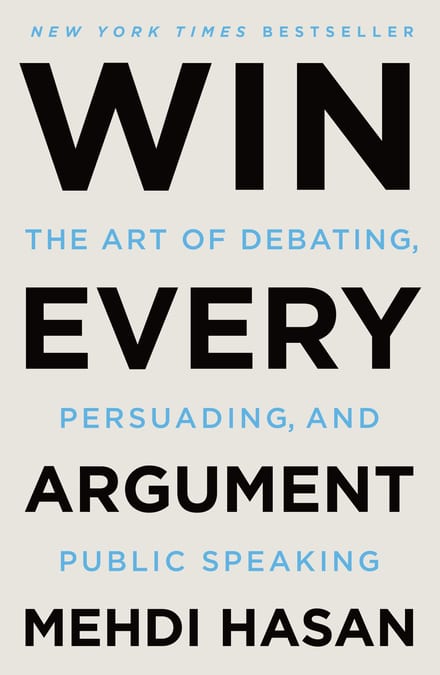
Win Every Argument: The Art of Debating, Persuading, and Public Speaking
The full book runs ~240 pages — roughly 4 hours of reading. You get the key ideas here in 6 minutes.
The key ideas
- Speak to your audience's values, not your own
- Move people with stories and emotion, not just facts
- Arm yourself with evidence and time its deployment
- Attack credibility, because ethos shapes how arguments land
- Structure ideas in threes for clarity and recall
- Stay calm, project confidence, and prepare relentlessly
The summary
Winning an argument has almost nothing to do with being right. Mehdi Hasan’s core claim is that the room decides, and the room runs on values, feelings, and whether you can keep your composure while being attacked. He opens with a case from 428 BCE: after a failed revolt, the Athenian assembly voted to execute every man in Mytilene, and the orator Diodotus talked them out of it. Thousands lived because one person argued well when it counted. The rest of the book is a toolkit for doing the same.
Argue to their values and their feelings
Everything starts with the audience. Facing a crowd of elderly, white, conservative voters in rural England, Hasan was asked whether an extremist preacher should be deported to Jordan, where he’d likely be tortured. His liberal talking points would have died on contact, so he reframed the case around British traditions of liberty and the Magna Carta — their values, not his — and won them over. As the presentation expert Ken Haemer put it, “Designing a presentation without an audience in mind is like writing a love letter and addressing it ’to whom it may concern.'”
Values set the frame; emotion carries the load. Neuroscience is clear that feelings drive decisions far more than logic, which is why a story about a single child with a name and a face moves people more than statistics about millions of nameless ones. To use pathos well, tell concrete stories, pick your words for their emotional charge, and show genuine feeling when it’s real rather than performing it.
Bring receipts, and attack credibility
None of that means abandoning facts — it means deploying them. Hasan calls hard evidence “receipts”: the figures and quotes that prop up your claim and knock down your opponent’s. Gather them in advance, manufacture new ones mid-debate by catching your opponent in a contradiction, and time their release for maximum damage. His model is Christopher Hitchens, who asked Charlton Heston — an advocate of bombing Iraq — to name the countries bordering it clockwise from Kuwait. Heston couldn’t, and Hitchens landed the blow: “If you’re in favor of bombing a country, you might pay it the compliment of knowing where it is.”
Then there’s the uncomfortable truth about attacking the person. Donald Trump’s 2016 primary run leaned on childish nicknames that belittled his rivals, and it worked; the ancient Roman orator Cicero built a reputation on the same kind of scorching personal attack. Modern debate norms file this under ad hominem and wave it off as a fallacy, but its real-world persuasive power is undeniable, because ethos — perceived credibility — shapes how every argument is received. Undercut your opponent’s standing and their points lose their grip.
Structure the message, then set traps
How you arrange an argument matters as much as its content, and the most reliable structure is the rule of three. Our brains grasp and remember things in threes — introduction, body, conclusion; pros, cons, recommendation — and Hasan’s personal favorite is to make a Political, an Economic, and a Moral case for whatever he’s defending. From there he borrows from judo: yield on a few of your opponent’s points to look reasonable, preempt their counterarguments before they can make them, and reframe the debate by questioning its premise, all of which turn their momentum against them.
The sharper tools are rhetorical traps. Quote an opponent’s own words without saying who said them, let them disagree, then reveal it was them. Or ask a plain question they can’t or won’t answer. And when you hit a Gish gallop — an opponent burying you under a fast stream of weak or false claims — don’t try to rebut each one, which is impossible by design. Single out the weakest claim, mock it, and hold it up as representative of the whole performance; or stop them cold on one falsehood and refuse to let them move on; or simply expose the tactic, naming the speed and the laundry list of lies they’ve just recited.
Keep your cool, and prepare like it matters
The best material fails if you lose your composure, because an audience reads a rattled speaker as defensive or unstable. Hasan’s remedies are controlled deep breathing, a bit of humor to regain perspective, and steady positive self-talk — even mid-clash on live television, he’s coaching himself: “Focus, Mehdi!” “Don’t take the bait!” “You got this!” The underlying principle is that you can’t control the situation, only your reaction to it. Confidence, he stresses, isn’t a talent but a belief in yourself that produces action and presence, and you build it by visualizing success, taking risks, keeping supportive company, and faking it until you become it — chin up, voice projected from the diaphragm, eyes making contact.
Under all of it sits preparation. Even Churchill and Martin Luther King Jr. worked hard at their craft. Rehearse in front of a mirror and on camera, master your timing, and mind the “4 Ps” of delivery — pitch, power, pace, and pause — while cutting filler words. Real preparation means brainstorming, deep research, and role-playing the counterarguments, plus listening both critically and empathetically; Nelson Mandela delivered the century’s “I Am Prepared to Die” speech, yet those who knew him thought he was an even better listener than speaker. Finally, engineer your ending — the peroration — to leave a mark, balancing a restatement of your points with an emotional close, the way Barack Obama’s 2008 victory speech used 106-year-old voter Ann Nixon Cooper to trace a century of American progress.
The bottom line
Winning isn’t about being correct; it’s about reading the room, governing your own emotions, and releasing your evidence at the moment it will hit hardest. Read this if you ever need to persuade anyone — in a courtroom, a meeting, or an argument you walked away from wishing you’d said it better.
Fact check
Popular books repeat findings that later research has complicated. Where Win Every Argument makes a testable claim, here's what the evidence actually shows.
You can build genuine confidence by acting confident — chin up, voice projected, eyes making contact — until the feeling catches up.
The 2010 study behind "fake it till you become it" reported that two minutes of expansive posture raised testosterone, lowered cortisol and increased risk-taking, but a larger direct replication found no effect on any of those measures. A meta-analysis of 73 experiments found robust effects on affect and behaviour overall, yet almost all of it came from avoiding a hunched posture rather than adopting a big one: contractive versus neutral displays moved responses by Hedges's g = 0.45, expansive versus neutral by g = 0.06. Not slumping is worth doing and posture does shift how powerful people report feeling; the hormonal and performance payoffs the phrase implies did not hold up.
- Carney DR, Cuddy AJ, Yap AJ. Power posing: brief nonverbal displays affect neuroendocrine levels and risk tolerance. Psychol Sci. 2010;21(10):1363-8. PubMed
- Ranehill E, Dreber A, Johannesson M, Leiberg S, Sul S, Weber RA. Assessing the robustness of power posing: no effect on hormones and risk tolerance in a large sample of men and women. Psychol Sci. 2015;26(5):653-6. PubMed
- Elkjær E, Mikkelsen MB, Michalak J, Mennin DS, O'Toole MS. Expansive and Contractive Postures and Movement: A Systematic Review and Meta-Analysis of the Effect of Motor Displays on Affective and Behavioral Responses. Perspect Psychol Sci. 2022;17(1):276-304. PubMed
Neuroscience has established that feelings drive people's decisions far more than logic does.
Emotion is a pervasive input to choice — a review synthesising 35 years of work concludes that emotions are potent and predictable drivers of judgment, sometimes harmful and sometimes useful. But the model that review proposes, emotion-imbued choice, folds emotional inputs into rational-choice machinery rather than declaring feeling the winner over logic. The neuroscience usually invoked for the stronger version, Damasio's somatic marker hypothesis, has been challenged on the grounds that the Iowa Gambling Task results admit simpler explanations and the causal link from bodily feedback to decision quality was never demonstrated.
A story about one named, identifiable person moves an audience more than statistics about many nameless ones.
The identifiable victim effect is real and has a traceable mechanism: people gave more to orphans shown by photograph than by silhouette, and the increase was mediated by positive arousal and predicted by nucleus accumbens activity. It is not, however, reliably the strongest lever in the room. Across two COVID-19 messaging experiments with 998 participants, individual-victim framing beat statistical framing in only one of them, and that advantage vanished once other factors were controlled for — moral and political beliefs predicted compliance better than the framing did.
- Genevsky A, Västfjäll D, Slovic P, Knutson B. Neural underpinnings of the identifiable victim effect: affect shifts preferences for giving. J Neurosci. 2013;33(43):17188-96. PubMed
- Byrd N, Białek M. Your health vs. my liberty: Philosophical beliefs dominated reflection and identifiable victim effects when predicting public health recommendation compliance during the COVID-19 pandemic. Cognition. 2021;212:104649. PubMed
Arguments should be structured in threes because our brains grasp and remember things in threes.
Three is a genuinely good number of points to make, but not for the reason given. Across four experiments, impressions peaked at three positive claims and fell at the fourth — and only when the audience knew the source was trying to persuade them, which points to skepticism rather than memory as the mechanism: a fourth claim tips listeners into discounting the whole message. Where memory does impose a limit, the best current estimate of what people can hold at once is about four chunks, not three.
Frequently asked questions
What is Win Every Argument about?
Mehdi Hasan's core claim is that winning an argument has almost nothing to do with being right, because the room decides, and the room runs on values, feelings, and whether you keep your composure while being attacked. The book is a toolkit for persuading real audiences, opening with the Athenian orator Diodotus, who talked an assembly out of executing every man in Mytilene.
What are the key takeaways from Win Every Argument?
Argue to their values and their feelings, reframing your case in the audience's terms and telling concrete stories, since emotion drives decisions more than logic. Bring "receipts," the figures and quotes that prop up your claim and knock down your opponent's, and undercut their credibility, because perceived credibility shapes how every argument lands. Structure with the rule of three and set traps, conceding minor points, preempting counterarguments, and handling a Gish gallop by targeting its weakest claim. And keep your cool while preparing hard, using controlled breathing, self-talk, the "4 Ps" of delivery, and a memorable ending.
Who should read Win Every Argument?
Read it if you ever need to persuade anyone, in a courtroom, a meeting, or an argument you walked away from wishing you'd said it better.
Is Win Every Argument worth reading?
It's concrete and example-rich, from Hitchens cornering Charlton Heston over Iraq's borders to Obama's 2008 closing, so the tactics are easy to picture and use. Some methods lean toward winning over truth-seeking, and Hasan is frank that personal attacks work, so anyone hoping for high-minded, purely rational debate may be uneasy with parts of it.