Book summary
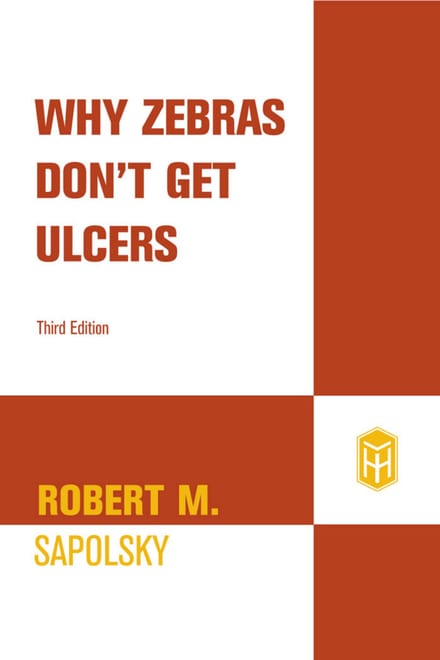
Why Zebras Don't Get Ulcers: The Acclaimed Guide to Stress, Stress-Related Diseases, and Coping
The Acclaimed Guide to Stress, Stress-Related Diseases, and Coping
The full book runs ~560 pages — roughly 10 hours of reading. You get the key ideas here in 5 minutes.
The key ideas
- Understand the damage comes from the response, not from the threat.
- Watch duration flip the sign: brief stress boosts immunity, chronic stress suppresses it.
- Read stress as a thumb on the scale, rarely a direct cause.
- Rank matters less than control — low control drove Whitehall's health gradient.
- Check four levers: control, predictability, an outlet, and other people.
- Expect mitigation, not cure: warned rats still ulcerated, just less.
The summary
A zebra sprinting from a lion and a person lying awake over a mortgage are running the same physiology. That is the argument. The mammalian stress response is a superb three-minute emergency system, and Sapolsky’s claim is that humans switch it on for weeks over things that cannot be outrun, then get sick from the response rather than the threat. We live well enough and long enough, he writes, “to generate all sorts of stressful events purely in our heads.” His example: no hippo worries whether Social Security will outlast it.
Sapolsky is a Stanford neurobiologist who started following wild baboons in Kenya’s Masai Mara in 1978 and kept at it for roughly thirty years, drawing blood from animals whose main occupation is making one another anxious. That fieldwork is the book’s spine; the argument is endocrinology.
The response is what damages you
Under threat, adrenaline and glucocorticoids mobilise stored energy, drive it to muscle, raise heart rate and blood pressure, and postpone everything that can wait — digestion, growth, tissue repair, reproduction, immune surveillance. That triage is exactly right when the emergency lasts minutes. In his own review work, Sapolsky sorted glucocorticoid actions into four jobs: permitting other systems to run at baseline, amplifying the response in a crisis, suppressing it so it does not overshoot, and preparing you for the next one. Nothing on that list was designed to run for a decade.
Immunity shows the shape of it. Stress lasting minutes to hours strengthens innate and adaptive immune responses, largely by moving immune cells where they will be needed. Stress lasting months does the reverse: dysregulated signalling, chronic inflammation, fewer protective cells. Same hormones; duration flips the sign.
One caveat on the book’s most-quoted brain claim. That chronic stress kills hippocampal neurons was Sapolsky’s own hypothesis — he titled a 1996 review of the evidence “the current state of confusion” — and the field has since softened it. What holds up best is the reversible part. Sustained high cortisol retracts hippocampal dendrites and shrinks hippocampal volume — and when twenty-two people with Cushing’s disease were scanned before and after surgery lowered their cortisol, that volume grew back by 3.2 percent on average, up to 10 percent in some. Outright neuron death has proved much harder to pin down.
Stress does not cause diseases, it tips odds
The title is doing some work. Ulcers turned out to be largely infectious: Marshall and Warren took the 2005 Nobel for showing that Helicobacter pylori causes more than 90 percent of duodenal ulcers and up to 80 percent of gastric ones.
The bacterium does not finish the story, though, and the book says so. Roughly half of all humans carry it and only 10 to 15 percent ever develop an ulcer. In a Danish cohort of 3,379 adults tracked for eleven years, people in the top third of a life-stress index were about twice as likely to get a confirmed ulcer as those in the bottom third — and the effect was the same whether or not they carried the bug. That is the shape of nearly every claim here. Sapolsky has said he is drawn to stress precisely because its impact is distributed: it rarely causes anything outright, but makes a great many things somewhat worse. A smaller claim than the genre usually makes, and far more defensible.
Rank matters less than control
The obvious guess about hierarchy is that the bottom is the bad place to be. In a stable baboon troop that holds — subordinate males carry higher resting cortisol while dominants enjoy predictability and control. Destabilise the hierarchy and the advantage disappears: through a period of instability in Sapolsky’s troop, the high-ranking males lost that low-cortisol profile and carried elevated basal cortisol instead. Reviewing the primate literature, Sapolsky concluded the rank-health relationship depends on how a given society is organised.
Two things cut across rank. Personality is one: the low-cortisol dominants were the males best at telling a genuinely threatening rival from a neutral one and, when it was the former, most likely to strike first — dominants without that knack ran cortisol as high as subordinates. Affiliation is the other — among high-ranking males, more grooming and friendly contact with females and infants goes with lower baseline cortisol and a blunted cortisol stress response.
Humans show the same gradient with better paperwork. Whitehall II followed 10,314 British civil servants and found health worsening step by step down the employment grades. What failed to explain it is the interesting part: in the original Whitehall study, standard coronary risk factors accounted for only about a quarter of the mortality gradient. In Whitehall II, low control at work made the largest single contribution to the coronary gradient — ahead of those risk factors, and ahead of height.
Four things change how hard it lands
Jay Weiss’s rats made the point before anyone measured a civil servant. Give two rats identical shocks and the one that cannot predict them ulcerates far worse; give one a lever that ends the shock and it fares better than the yoked twin taking the same current. Identical stressor, different disease.
Sapolsky compresses the coping literature into four questions. Do you have control? Can you see it coming? Do you have an outlet for the frustration? Do you have people? Lose all four and glucocorticoid output climbs and stays there. He is blunt that social isolation is a health risk factor in its own right.
These are levers, not cures. Weiss’s warned rats ulcerated less than unwarned ones, not less than unshocked ones: predictability makes a bad thing more survivable, not good. And because for a creature like us a stressor includes merely anticipating one, a sense of control over what you cannot influence becomes its own trap.
The bottom line
Most of what kills people in wealthy countries accumulates slowly, and running an acute emergency system chronically is one of the accelerants — not the cause of any single disease, but a thumb on the scale for many. Most of the gain comes not from removing stressors but from changing the control, predictability, outlets and connection around them.
Read it if you want the physiology instead of the pep talk, from a scientist funnier than his subject deserves and scrupulous about what the evidence will carry.
Fact check
Popular books repeat findings that later research has complicated. Where Why Zebras Don't Get Ulcers makes a testable claim, here's what the evidence actually shows.
Psychological stress is a genuine contributor to peptic ulcers, even after Helicobacter pylori turned out to be the main cause.
The bacterium does most of the work: it causes more than 90% of duodenal ulcers and up to 80% of gastric ones, yet it colonises the stomach of about half of all humans and only 10-15% of carriers ever get an ulcer. That gap is where stress lives. In a population-based Danish cohort of 3,379 adults followed for 11-12 years with every diagnosis confirmed by endoscopy or radiology, ulcer incidence was 3.5% in the highest third of a life-stress index against 1.6% in the lowest (adjusted odds ratio 2.2, 95% CI 1.2-3.9), and the risk was similar whether or not people carried H. pylori. Part of the effect runs through behaviour rather than physiology — the per-point odds ratio fell from 1.19 to 1.11 after adjusting for smoking, NSAIDs and exercise.
- Levenstein S, Rosenstock S, Jacobsen RK, Jorgensen T. Psychological stress increases risk for peptic ulcer, regardless of Helicobacter pylori infection or use of nonsteroidal anti-inflammatory drugs. Clin Gastroenterol Hepatol. 2015;13(3):498-506.e1. PubMed
- The Nobel Assembly at Karolinska Institutet. The Nobel Prize in Physiology or Medicine 2005: Barry J. Marshall and J. Robin Warren — press release. 3 October 2005. Source
Sustained stress hormones damage the hippocampus by killing neurons.
What replicates is structural remodelling, not cell death. Chronic stress and prolonged glucocorticoid exposure retract and debranch hippocampal dendrites, and reviews of that literature find the hippocampus recovers from the retraction without noticeable neuron loss — the damage is a window of vulnerability rather than a body count. The reversibility shows up in humans too: in 22 patients treated for Cushing's disease, hippocampal volume rose by a mean of 3.2% (up to 10%) once cortisol came down, and the gain tracked the size of the cortisol drop (r = -0.61). Sapolsky flagged the trouble himself, titling his 1996 review of the neurotoxicity evidence "the current state of confusion".
- Conrad CD. Chronic stress-induced hippocampal vulnerability: the glucocorticoid vulnerability hypothesis. Rev Neurosci. 2008;19(6):395-411. PubMed
- Starkman MN, Giordani B, Gebarski SS, Berent S, Schork MA, Schteingart DE. Decrease in cortisol reverses human hippocampal atrophy following treatment of Cushing's disease. Biol Psychiatry. 1999;46(12):1595-602. PubMed
- Sapolsky RM. Stress, glucocorticoids, and damage to the nervous system: the current state of confusion. Stress. 1996;1(1):1-19. PubMed
Rank predicts health even where nobody is poor, and the reason is how much control you have rather than how much you have.
Whitehall II enrolled 10,314 British civil servants — all employed, all covered by the NHS — and found illness worsening step by step down the employment grades, with no narrowing over the twenty years since the first Whitehall study. Over a mean 5.3 years of follow-up, men in the lowest grade had 1.5 times the odds of new coronary heart disease against the top grade (2.27 for doctor-diagnosed ischaemia), and of everything measured, low control at work made the largest contribution to that gradient; standard coronary risk factors and height contributed less. Adjusting for the full set flattened the excess almost completely, from 1.50 to 0.95 in men. The caveat is design: both the exposure and the coronary outcomes were self-reported, so the ranking of contributors is firmer than the causal step.
- Marmot MG, Smith GD, Stansfeld S, Patel C, North F, Head J, White I, Brunner E, Feeney A. Health inequalities among British civil servants: the Whitehall II study. Lancet. 1991;337(8754):1387-93. PubMed
- Marmot MG, Bosma H, Hemingway H, Brunner E, Stansfeld S. Contribution of job control and other risk factors to social variations in coronary heart disease incidence. Lancet. 1997;350(9073):235-9. PubMed
Sapolsky's wild baboons show that low rank means high stress hormones, and that the pattern reverses when the hierarchy is unstable.
His own papers are narrower than the shorthand. In stable troops dominant males did carry lower basal cortisol than subordinates, but rank alone did not produce it: the low-cortisol profile belonged only to dominant males with particular behavioural styles — best at telling a threatening rival from a neutral one, most likely to initiate the fight when it was threatening, and most likely to displace aggression after a loss. Dominant males without those traits ran cortisol as high as subordinates. Through a period of social instability in the troop, high-ranking males lost the profile entirely and showed elevated basal cortisol with a suppressed cortisol stress response, so the dominants' advantage vanished rather than flipping to the bottom of the hierarchy. Reviewing the wider primate literature in 2005, Sapolsky concluded that which rank is most stressed varies with how a given species or population is socially organised.
- Sapolsky RM, Ray JC. Styles of dominance and their endocrine correlates among wild olive baboons (Papio anubis). Am J Primatol. 1989;18(1):1-13. PubMed
- Sapolsky RM. Endocrine aspects of social instability in the olive baboon (Papio anubis). Am J Primatol. 1983;5(4):365-379. PubMed
- Sapolsky RM. The influence of social hierarchy on primate health. Science. 2005;308(5722):648-52. PubMed
Frequently asked questions
What is Why Zebras Don't Get Ulcers about?
A zebra sprinting from a lion and a person lying awake over a mortgage run the same physiology — a superb three-minute emergency system. Robert Sapolsky's argument is that humans switch it on for weeks over things that can't be outrun, and then get sick from the response rather than the threat. He builds the case from endocrinology and from roughly thirty years following wild baboons in Kenya's Masai Mara.
What are the key takeaways from Why Zebras Don't Get Ulcers?
Adrenaline and glucocorticoids mobilise energy and postpone digestion, growth, repair, reproduction and immune surveillance — exactly right for minutes, damaging over years. Duration flips the sign: stress lasting hours strengthens immune responses, stress lasting months dysregulates them. Stress rarely causes disease outright, it tips odds — H. pylori causes most ulcers, yet in a Danish cohort of 3,379 adults tracked eleven years, the most stressed third were about twice as likely to get one whether or not they carried the bug. Rank matters less than control: Whitehall II followed 10,314 British civil servants and low control at work was the largest single contributor to the heart-disease gradient. Four things change how hard a stressor lands — control, predictability, an outlet for frustration, and other people.
Who should read Why Zebras Don't Get Ulcers?
Read it if you want the physiology instead of the pep talk, from a scientist who is scrupulous about what the evidence will carry and funnier than the subject deserves.
Is Why Zebras Don't Get Ulcers worth reading?
Its honesty is the selling point: it makes a smaller claim than the genre usually does — stress rarely causes anything outright, it makes a great many things somewhat worse — and it even softens its own most-quoted claim, that chronic stress kills hippocampal neurons, which has proved much harder to pin down than the reversible shrinkage. The coping material is real but modest, and framed as levers rather than cures: predictability makes a bad thing more survivable, not good. If you want a step-by-step stress program rather than the mechanism underneath it, this will feel like a lot of biology for a short list of advice.