Book summary
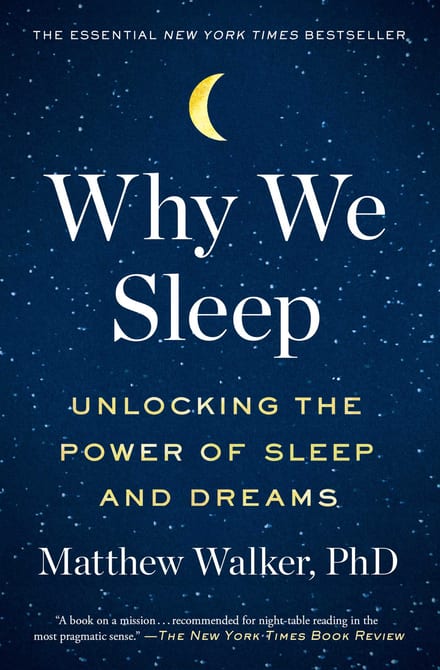
Why We Sleep: Unlocking the Power of Sleep and Dreams
The full book runs ~360 pages — roughly 7 hours of reading. You get the key ideas here in 2 minutes.
The key ideas
- Skimping under seven hours raises heart disease, diabetes, and cancer risk.
- Honor your circadian rhythm; night owls suffer forced morning schedules.
- Drowsy driving impairs you as much as legal drunkenness.
- Every animal sleeps, but stages and durations vary wildly.
- Avoid alcohol and nicotine; take hot baths and get daylight.
- Can't sleep in 20 minutes? Get up and do something calming.
The summary
Sleep is not a cost you can trim to buy more waking hours. Walker’s whole case is that it sits underneath everything else—memory consolidation, emotional regulation, physical restoration, metabolism, and the health of your heart—which is why shorting it doesn’t just make you tired but measurably raises your risk of serious disease. He puts the hierarchy plainly: if diet and exercise are the pillars of health, then sleep is the foundation they stand on. Pull it out and the pillars start to crack.
Losing sleep is a slow medical emergency
The numbers behind this are hard to shrug off. Chronic sleep deprivation raises your risk of heart disease, diabetes, and cancer, and it degrades cognition and emotional control on top of that. The cardiovascular link is especially direct: too little sleep pushes up blood pressure, which damages the walls of your blood vessels over time. A study of more than 500,000 participants worldwide found that lack of sleep increases the risk of cardiovascular disease by 45%, and research in Japan found that people who slept six hours or less were 500% more likely to suffer a cardiac arrest than those who slept longer. Sleep is also when your brain files away memories and works through emotion, so running short leaves you not merely foggy but genuinely less able to learn or handle stress.
Your body clock doesn’t care about the office
Everyone runs on a circadian rhythm, the natural 24-hour cycle that governs sleep, appetite, mood, and metabolism. The catch is that this clock is set differently for different people. Around 30% of the population are natural night owls, biologically inclined to stay up late and wake late, and a world built around early starts forces them into chronic sleep loss and the health problems that follow. This isn’t a matter of discipline; it’s biology colliding with the schedule society happens to reward, leaving a large group of people permanently out of sync with their own bodies.
Drowsy driving is drunk driving
Sleep loss doesn’t just harm you—it makes you dangerous to everyone around you. Once you drop below seven hours, you become vulnerable to microsleep, involuntary lapses that last only a few seconds. You don’t choose them and may not even notice them, but a few seconds is enough to drift out of your lane. Walker points to research showing that sleep-deprived people perform about as badly on a concentration test as people who are legally drunk, which makes driving tired every bit as reckless as driving under the influence, even though we don’t treat it that way. Sleep can turn dangerous in stranger ways, too. Most sleepwalking is harmless, but Walker cites the case of Kenneth Parks, who killed his mother-in-law during a sleepwalking episode. Notably, sleepwalkers aren’t acting out dreams, because sleepwalking happens outside REM sleep; it’s more common in children, possibly because they spend less time in REM than adults do.
Sleep is universal, and it responds to simple habits
Every animal sleeps, though the amount and kind vary enormously—humans need about eight hours, elephants sleep four, bats are awake only five hours a day, and sharks sleep with their eyes open because they have no eyelids. All non-aquatic mammals and birds pass through REM sleep, the stage where dreaming occurs, while other animals do not. For humans, the encouraging part is that a handful of well-evidenced habits genuinely help:
- Avoid alcohol and nicotine—alcohol blocks deep sleep and can impair breathing, and nicotine is a stimulant that keeps you in light sleep and wakes you early through withdrawal.
- Take a hot bath or shower before bed; the drop in body temperature afterward brings on drowsiness.
- Get natural sunlight during the day to keep your circadian rhythm regulated, and keep the bedroom cool at night.
- If you can’t fall asleep within 20 minutes, get up and do something calming until you feel drowsy.
- Open the curtains before bed so morning light wakes you naturally instead of an alarm jolting you awake.
The bottom line
Sleep is not a luxury or a recoverable expense but a biological necessity that underpins nearly every system in your body, and chronically shorting it raises your disease risk while leaving you as impaired at the wheel as legal intoxication. Anyone who wants to protect their health, sharpen their thinking, or simply stop living in a fog should read this book—and then act on the one habit it insists you can’t skip.
Fact check
Popular books repeat findings that later research has complicated. Where Why We Sleep makes a testable claim, here's what the evidence actually shows.
A worldwide study of more than 500,000 people found that too little sleep raises the risk of cardiovascular disease by 45%.
The closest matching meta-analysis pooled 15 studies and 474,684 people and did find short sleepers at 48% higher risk of developing or dying from coronary heart disease (RR 1.48), so the figure is in the right range. But the same analysis found long sleepers worse off for stroke (RR 1.65) and total cardiovascular disease (RR 1.41), and a companion meta-analysis of 1,382,999 people found long sleep predicted death more strongly (RR 1.30) than short sleep did (RR 1.12). The curve is U-shaped, not the straight line "less sleep, more risk" implies, and these are observational associations in which illness can drive the sleep pattern as easily as the reverse.
- Cappuccio FP, Cooper D, D'Elia L, Strazzullo P, Miller MA. Sleep duration predicts cardiovascular outcomes: a systematic review and meta-analysis of prospective studies. Eur Heart J. 2011;32(12):1484-92. PubMed
- Cappuccio FP, D'Elia L, Strazzullo P, Miller MA. Sleep duration and all-cause mortality: a systematic review and meta-analysis of prospective studies. Sleep. 2010;33(5):585-92. PubMed
Research in Japan found that people sleeping six hours or less were 500% more likely to suffer a cardiac arrest.
The study exists and points the right way, but it is smaller and narrower than the number suggests: 2,282 male factory workers followed for 14 years, producing a hazard ratio of 4.95 for coronary events in the under-six-hour group — roughly a fivefold rate, with a confidence interval running from 1.31 to 18.73. That estimate rests on 27 coronary events in the entire cohort, and sudden cardiac death accounted for only 7 of the 64 cardiovascular events recorded, so "cardiac arrest" is not what was measured. Stroke showed no significant association with sleep duration at all.
- Hamazaki Y, Morikawa Y, Nakamura K, et al. The effects of sleep duration on the incidence of cardiovascular events among middle-aged male workers in Japan. Scand J Work Environ Health. 2011;37(5):411-7. PubMed
Chronically sleeping under seven hours raises your risk of heart disease, diabetes, and cancer.
Two of the three hold up well. Short sleep predicts type 2 diabetes across 10 studies of 107,756 people (RR 1.28) and coronary heart disease across 474,684 people (RR 1.48). Cancer is the odd one out: pooled prospective data on 555,678 participants found no association between short sleep and cancer risk (RR 1.05, 95% CI 0.90-1.24), and a separate meta-analysis of 723,337 people reached the same null result (HR 1.06, 95% CI 0.92-1.23).
- Cappuccio FP, D'Elia L, Strazzullo P, Miller MA. Quantity and quality of sleep and incidence of type 2 diabetes: a systematic review and meta-analysis. Diabetes Care. 2010;33(2):414-20. PubMed
- Lu Y, Tian N, Yin J, Shi Y, Huang Z. Association between sleep duration and cancer risk: a meta-analysis of prospective cohort studies. PLoS One. 2013;8(9):e74723. PubMed
- Zhao H, Yin JY, Yang WS, et al. Sleep duration and cancer risk: a systematic review and meta-analysis of prospective studies. Asian Pac J Cancer Prev. 2013;14(12):7509-15. PubMed
Sleep-deprived people perform about as badly on concentration tests as people who are legally drunk.
A controlled comparison of 39 transport and army workers found that after 17 to 19 hours awake, response speeds were up to 50% slower and accuracy worse than at a blood alcohol concentration of 0.05% — the legal driving limit across much of the world. Longer wakefulness degraded performance to the level of the study's highest alcohol dose, 0.10%. Real crashes track the same pattern: among 6,845 US drivers in federally investigated crashes, those who had slept 4 hours in the previous 24 had 2.9 times the odds of being the at-fault driver, rising to 15.1 times for under 4 hours.
- Williamson AM, Feyer AM. Moderate sleep deprivation produces impairments in cognitive and motor performance equivalent to legally prescribed levels of alcohol intoxication. Occup Environ Med. 2000;57(10):649-55. PubMed
- Tefft BC. Acute sleep deprivation and culpable motor vehicle crash involvement. Sleep. 2018;41(10):zsy144. PubMed
Frequently asked questions
What is Why We Sleep about?
Matthew Walker's case is that sleep is not a cost you can trim to buy more waking hours, because it sits underneath memory, emotional regulation, physical restoration, metabolism, and heart health. If diet and exercise are the pillars of health, sleep is the foundation they stand on, so shorting it doesn't just make you tired, it measurably raises your risk of serious disease.
What are the key takeaways from Why We Sleep?
Losing sleep is a slow medical emergency, since chronic deprivation raises the risk of heart disease, diabetes, and cancer, with one study of over 500,000 people finding a 45% higher cardiovascular risk. Your body clock is biology, not discipline, and about 30% of people are natural night owls forced out of sync by early schedules. Drowsy driving is drunk driving, because below seven hours you're vulnerable to microsleeps and perform about as badly as someone legally drunk. And sleep responds to simple habits: avoid alcohol and nicotine, take a hot bath before bed, get daytime sunlight, keep the bedroom cool, and get up if you can't sleep within 20 minutes.
Who should read Why We Sleep?
Read it if you want to protect your health, sharpen your thinking, or simply stop living in a fog, and then act on the one habit it insists you can't skip.
Is Why We Sleep worth reading?
It's persuasive and alarming in equal measure, marshaling striking statistics and offering a practical habit list you can start tonight. The relentless one-note urgency and heavy reliance on scary numbers can feel overwhelming, so anyone wanting a calmer, more caveated treatment may find it intense, though the core message is hard to ignore.