Book summary
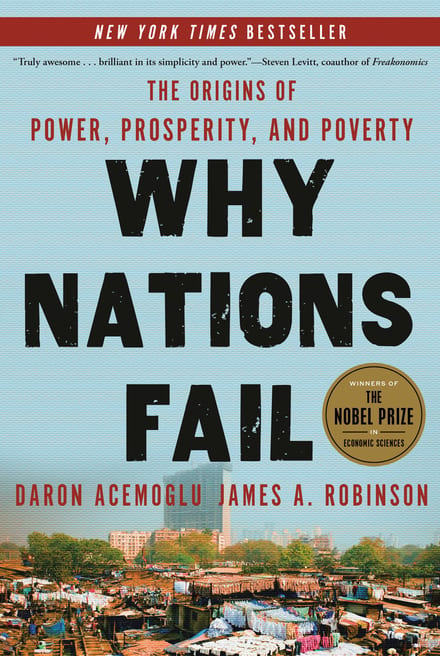
Why Nations Fail
The Origins of Power, Prosperity, and Poverty
The full book runs ~529 pages — roughly 10 hours of reading. You get the key ideas here in 3 minutes.
The key ideas
- Distinguish inclusive institutions from extractive ones to explain global inequality
- Debunk geography, culture, and ignorance as the real causes
- Reward broad participation: secure property fuels investment and innovation
- Fear creative destruction—elites choose stagnation to protect their power
- Recognize critical junctures as windows for institutional change
- Build broad coalitions to break extractive vicious circles
The summary
Walk across the fence that splits Nogales, Arizona from Nogales, Sonora and you cross from wealth into poverty without changing the desert, the climate, the language, or even the families, many of whom have relatives on both sides. What changes is institutions. On the Arizona side, people choose their work, get schooling, and hold their government to account; on the Sonora side, corruption bends all of it. Daron Acemoğlu and James Robinson build their whole argument on comparisons like this. The tenfold income gap between South and North Korea, identical in culture and geography until 1945, makes the same case: prosperity comes from the rules a society lives by, not the land it sits on.
The usual explanations fall apart
Three popular theories don’t survive contact with history. Geography can’t be the answer, because the tropical zones of the Americas that once held the rich Aztec and Inca empires are now poorer than the once-marginal temperate north, and because Singapore and Botswana prosper in climates that supposedly doom a country. Culture fails too: it can’t explain why one Korean people split into wealth and famine, or why former British colonies range from rich to desperately poor. And the idea that poor countries simply have ignorant leaders gets it backward—their rulers often know exactly what would create prosperity and reject it, because bad policies keep them rich. As the authors put it, “poor countries are poor because those who have power make choices that create poverty.”
Inclusive institutions versus extractive ones
Everything turns on one distinction. Inclusive economic institutions let ordinary people use their talents: property is secure, markets are open, and newcomers can challenge established players. Inclusive political institutions spread power broadly and constrain it—pluralism—while a capable central state keeps order and delivers services. When you trust that your work and investment won’t be seized, you build and innovate; a businessman “who expects his output to be stolen, expropriated, or entirely taxed away” simply won’t bother. Extractive institutions do the opposite. Extractive economic systems—colonial forced labor like the encomienda and mita, or slavery in the American South—move wealth from the many to a narrow elite. Extractive political systems concentrate power in a few hands with few checks, the old absolutism. The two kinds reinforce themselves: inclusive politics and economics prop each other up in a virtuous circle, while extractive elites rig the economy to enrich themselves and use the proceeds to entrench their power in a vicious one.
Why elites strangle growth
Sustained prosperity depends on creative destruction, the churn in which new technologies bury old ones, and that is precisely what threatens the people on top. In 1589, William Lee invented a stocking-frame knitting machine and asked Queen Elizabeth I for a patent. She refused, warning that it would “bring to them ruin by depriving them of employment, thus making them beggars”—she feared the newly jobless would become a political threat, so she chose stagnation to protect her throne. Extractive regimes can still generate bursts of growth by shoving resources into productive sectors, but it never lasts, because concentrated power invites vicious infighting over the spoils, which tips into civil war and collapse. When Zimbabwe replaced white-minority rule, Robert Mugabe’s government simply inherited the machinery of repression and ran it for a new elite. Colonial expansion often did the same on a continental scale, imposing extractive institutions where they hadn’t existed; the Atlantic slave trade turned African societies into “war machines” built to capture and sell people and left a legacy of absolutism that stunted the region for centuries.
How the circle breaks
Nothing about this is permanent. Big shocks—plagues, revolutions, new technologies—act as critical junctures that pry institutions open. The Black Death of the 1300s killed so many laborers that the survivors could suddenly bargain, and feudalism unraveled across Western Europe. But the same shock produces different results in different places, and breaking a vicious circle usually takes two things at once: a critical juncture and a broad coalition able to face down the elite. In 1688, merchants, industrialists, gentry, and rival political groups joined to topple the Stuart monarchy in the Glorious Revolution—a coalition wide enough that no single faction could rebuild absolutism afterward. A free press helps hold the gains, letting society coordinate its demands and expose abuses before they harden into new forms of extraction.
The bottom line
Nations fail when extractive institutions kill the incentive to save, invest, and innovate, and when the politics of a narrow elite exist mainly to protect the people doing the extracting. Prosperity clusters where power is shared and disruption is allowed. Read this if you want to understand why some countries are rich and others stay poor, and why outside aid and advice so often miss what actually matters.
Fact check
Popular books repeat findings that later research has complicated. Where Why Nations Fail makes a testable claim, here's what the evidence actually shows.
Institutions, not geography, explain why some countries are rich and others poor.
The statistical backbone of this argument is the authors' own settler-mortality study, which reported that institutions account for roughly three-quarters of income differences across former colonies and that being in Africa or near the equator stops predicting lower income once institutional quality is controlled for. Jeffrey Sachs re-ran the analysis using malaria ecology and found geography still moves income per capita directly, after controlling for institutions. David Albouy then showed that 36 of the 64 countries in the original sample were assigned mortality rates borrowed from other countries, and that once the data problems are corrected the instrument becomes unreliable, sometimes yielding infinite confidence intervals. Institutions plainly matter a great deal; the flat exclusion of geography is stronger than the evidence carries.
- Acemoglu D, Johnson S, Robinson JA. The colonial origins of comparative development: an empirical investigation. NBER Working Paper 7771. National Bureau of Economic Research; June 2000. Source
- Sachs JD. Institutions don't rule: direct effects of geography on per capita income. NBER Working Paper 9490. National Bureau of Economic Research; February 2003. Source
- Albouy DY. The colonial origins of comparative development: an empirical investigation: comment. Am Econ Rev. 2012;102(6):3059-3076. Source
North and South Korea, identical in culture and geography until 1945, now differ roughly tenfold in income.
If anything the book understates it. The UN's country profiles put GDP per capita at $640 for the Democratic People's Republic of Korea against $35,538 for the Republic of Korea — a gap of more than fifty to one in nominal dollars. North Korean figures are necessarily estimates, since the country publishes no national accounts, and purchasing-power adjustments narrow the gap considerably, which is why the conservative tenfold figure is the one usually quoted. The 1945 division remains about as close to a controlled experiment as comparative economics gets: one language, one culture, one peninsula, two sets of rules.
The Black Death killed so many labourers that survivors could bargain, and feudalism unravelled across Western Europe.
The mechanism is right and the bargaining did happen — English wages rose 12 to 28 percent between the 1340s and the 1350s as labour became scarce — but inflation ate much of that gain, and the immediate response was legal repression rather than emancipation: the Ordinance of Labourers of 1349 and the Statute of Labourers of 1351 tried to force wages and terms back to their 1346 levels, and England's relatively effective government enforced them well enough to slow wage growth for a time. Robert Brenner's comparison is the harder problem for the simple story: the same plague preceded serfdom's decline in the west and its intensification in Eastern Europe, so mortality alone cannot be the cause. Serfdom came apart over generations and turned on who could still enforce the old obligations — which is closer to the book's own institutional argument than its compressed retelling suggests.
Frequently asked questions
What is Why Nations Fail about?
Daron Acemoğlu and James Robinson argue that the gap between rich and poor countries comes down to institutions, not geography, culture, or the ignorance of leaders. Where power is shared and ordinary people can use their talents and hold their government to account, prosperity follows; where a narrow elite rigs the rules to enrich itself, poverty follows, as the split cities of Nogales and the two Koreas show.
What are the key takeaways from Why Nations Fail?
The usual explanations fall apart, because geography, culture, and "ignorant leaders" can't explain identical peoples split into wealth and poverty, and rulers often reject prosperity because bad policies keep them rich. Inclusive institutions, with secure property, open markets, and broadly shared power, stand against extractive ones like forced labor and absolutism that funnel wealth to a few. The two kinds reinforce themselves in virtuous and vicious circles. And elites strangle creative destruction to protect their position, as when Queen Elizabeth refused William Lee's knitting-machine patent, while vicious circles break at critical junctures like plagues and revolutions when a broad coalition can face down the elite.
Who should read Why Nations Fail?
Read it if you want to understand why some countries are rich and others stay poor, and why outside aid and advice so often miss what actually matters.
Is Why Nations Fail worth reading?
Its single, clear thesis is carried by a sweep of vivid historical cases, from Nogales to the Black Death to Zimbabwe, that make a big argument concrete. That one-lens focus is also the critique, since readers may feel it downplays other factors, but as a framework for thinking about prosperity it's powerful and readable.