Book summary
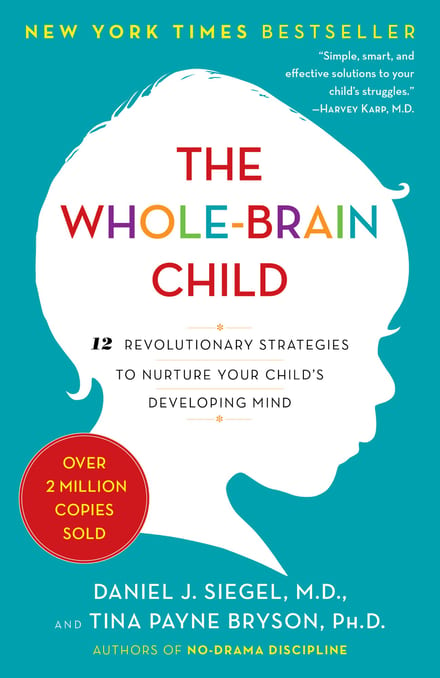
The Whole-Brain Child: 12 Revolutionary Strategies to Nurture Your Child's Developing Mind
12 Revolutionary Strategies to Nurture Your Child's Developing Mind
The full book runs ~192 pages — roughly 4 hours of reading. You get the key ideas here in 5 minutes.
The key ideas
- Integration — their word for the brain's parts cooperating — anchors all twelve strategies.
- Connect before you redirect: meet the feeling, then bring the lesson.
- Name it to tame it — telling the story drains a memory's heat.
- Engage the upstairs brain with real dilemmas instead of blunt commands.
- Siegel's hand model makes flipping your lid teachable in ten seconds.
- Hold the left/right split and mid-twenties date loosely — the science is thinner.
The summary
Every hard parenting moment — the meltdown over the wrong cup, the slammed door, the flat refusal to get in the car — looks like a discipline problem. Daniel Siegel and Tina Payne Bryson argue it is closer to a wiring problem. A child’s brain has many parts, and early on they don’t work together well, so one takes over and the rest drop out. Their word for the remedy is integration: getting the pieces to cooperate. On their account, the bad moments are exactly where that wiring gets built, turning a blow-up into something your child grows from.
Integration is the whole argument
Everything hangs off one claim, stated on the free “refrigerator sheet” the authors publish with the book: the brain “performs at its best when its different parts work together in a coordinated and balanced way.” Siegel’s image for that state is a river of well-being, with a bank of chaos on one side, rigidity on the other. A child screaming on the floor has run aground in chaos; one who won’t deviate from the bedtime script has run aground in rigidity. Neither is a character flaw; both are parts of a brain that stopped talking to each other. The twelve strategies sort into five kinds of integration: left with right, upstairs with downstairs, implicit memory with explicit, the many parts of the self, and self with other.
Connect before you redirect
This pair is the one most parents remember. When a child is flooded, the authors say, you can’t reason your way in — the reasoning part isn’t the part that’s talking. So you connect and redirect: meet the feeling first, through tone and touch and face, then bring the lesson in once the child is calm enough to receive it. The publisher’s own description states the claim underneath it bluntly — “especially in young children, the right brain and its emotions tend to rule over the logic of the left brain.”
The second strategy is name it to tame it, the phrase of Siegel’s that has travelled furthest past the book. Once a child can tell the story of what happened, naming what scared them and putting the sequence in order, the telling itself takes heat out of the memory.
The upstairs brain is still under construction
The next metaphor is a two-story house. Downstairs is the older machinery: breathing, heart rate, fight-flight-freeze, which the authors describe as intact at birth. Upstairs is the part that, in the publisher’s phrasing, makes decisions and balances emotions: planning, empathy, holding an impulse long enough to think. That floor is “under construction” through childhood and adolescence, and the jacket copy dates the finish to “the mid-twenties.” Between the floors is a staircase, and the parent’s job is to build it.
Siegel’s hand model makes this teachable in ten seconds, kids included. “If you put your thumb in the middle of your palm and then curl your fingers over the top, you’ll have a pretty handy model of the brain,” he writes. Wrist is brainstem, thumb the emotional midbrain, fingers the cortex folded over the top. Lift the fingers and you have his picture of flipping your lid.
Three strategies follow. Engage, don’t enrage: in a tense moment ask a question, ask for alternatives, negotiate — don’t play the “Because I said so!” card, which lands downstairs. Use it or lose it: exercise the upstairs floor with real dilemmas and “What would you do?” games, and stop rescuing a child from every hard call. Move it or lose it: when a child has lost the thread entirely, move the body; the fastest route back is physical, not verbal.
Give a child words for what’s happening inside
The rest of the strategies teach a child to watch their own mind. On memory, the authors want implicit experience made explicit: use the remote of the mind lets a reluctant child pause, rewind and fast-forward a painful story so they control how much they look at, and remember to remember is practice — asking about the day in the car or at dinner until narrating becomes ordinary.
For the inner weather, let the clouds of emotion roll by teaches that fear and loneliness are temporary states, not fixed traits, and SIFT hands a child four things to check for: Sensations, Images, Feelings, and Thoughts. Siegel’s wheel of awareness gives them a mind that can aim attention rather than stay stuck. The last pair is social: enjoy each other means building fun into family life on purpose, and connect through conflict treats a sibling fight as practice at reading a face and making amends.
Where the metaphors outrun the science
The book is sold as brain science, and some of that science is looser than the framing suggests. The clean split between a logical left brain and an emotional right brain is the weakest part. Language genuinely is lateralized in most people, but a 2013 resting-state imaging study of 1,011 people aged 7 to 29 found local lateralization and no evidence that individuals run on a dominant hemisphere — and emotion is not a right-hemisphere department. The mid-twenties figure is rounder than the evidence too: the imaging work behind it ran out around age 21, and a 2025 lifespan study of brain network organization puts its turning points at roughly 9, 32, 66 and 83 — real transitions, just not one at 25.
None of it sinks the advice, which doesn’t depend on the anatomy: naming a feeling has real support in emotion research, though it shows up in the body more than in how calm people feel, and connecting before correcting works at any age. Read the metaphors as teaching aids, not findings.
The bottom line
Treat your child’s worst moments as wiring opportunities, not discipline failures: meet the feeling first, help them put words to it, then give the slow-developing thinking part regular exercise. Read this if you want a short, concrete parenting book you can use tonight — and hold its neuroscience more loosely than its authors do.
Fact check
Popular books repeat findings that later research has complicated. Where The Whole-Brain Child makes a testable claim, here's what the evidence actually shows.
Logic is a left-hemisphere job and emotion a right-hemisphere one, which is why a young child's emotions overrule their reasoning.
Lateralization itself is real: a resting-state scan of 1,011 people aged 7 to 29 found genuinely left-lateralized hubs, including Broca's and Wernicke's areas, alongside right-lateralized attention hubs. What it did not find was left-brained or right-brained people — lateralization turned out to be a local property of particular networks rather than a whole-brain trait, with no individual running on a dominant hemisphere. The logic-versus-emotion mapping fares worse still: a meta-analysis of 65 neuroimaging studies of emotion found no support for overall right-lateralization of emotional function, and only limited support for valence-specific lateralization in frontal cortex. Neither study directly tests the developmental version — that young children lean right until the left side catches up — but that version rests on the same mapping, and the strategies built on it work without it.
- Wager TD, Phan KL, Liberzon I, Taylor SF. Valence, gender, and lateralization of functional brain anatomy in emotion: a meta-analysis of findings from neuroimaging. Neuroimage. 2003;19(3):513-31. PubMed
- Nielsen JA, Zielinski BA, Ferguson MA, Lainhart JE, Anderson JS. An evaluation of the left-brain vs. right-brain hypothesis with resting state functional connectivity magnetic resonance imaging. PLoS One. 2013;8(8):e71275. PubMed
The brain's decision-making, emotion-balancing "upstairs" is under construction until the mid-twenties.
The direction is right and the date is the problem. The longitudinal MRI work behind the claim tracked 13 children scanned every two years between ages 4 and 21, and found higher-order association cortex — the upstairs regions — maturing only after the sensory and visual areas whose input it integrates. But that study's data stopped at 21. Larger datasets since put the boundaries elsewhere: normative charts built from 123,984 scans of 101,457 people find total grey matter volume peaking at 5.9 years, subcortical grey matter at 14.4 and cerebral white matter not until 28.7, while a lifespan diffusion-imaging study of 4,216 people aged 0 to 90 places the major turning points in brain network organization at roughly 9, 32, 66 and 83. There are real transitions, then — they just don't land on 25, and different measures run on different clocks.
- Gogtay N, Giedd JN, Lusk L, Hayashi KM, Greenstein D, Vaituzis AC, et al. Dynamic mapping of human cortical development during childhood through early adulthood. Proc Natl Acad Sci U S A. 2004;101(21):8174-9. PubMed
- Bethlehem RAI, Seidlitz J, White SR, Vogel JW, Anderson KM, Adamson C, et al. Brain charts for the human lifespan. Nature. 2022;604(7906):525-533. PubMed
- Mousley A, Bethlehem RAI, Yeh FC, Astle DE. Topological turning points across the human lifespan. Nat Commun. 2025;16(1):10055. PubMed
Naming a feeling takes the heat out of it — "name it to tame it."
The physiological half holds up. The original fMRI study found that labelling the emotion in a picture lowered amygdala response and raised activity in right ventrolateral prefrontal cortex, with the two inversely correlated. Two later randomised trials found the same thing downstream of the scanner: spider-fearful people who labelled their fear during exposure showed lower skin conductance a week later, against a different spider in a different room, than people who reappraised, distracted or just endured it; and people with public-speaking anxiety who labelled showed larger drops in physiological arousal than exposure alone. What did not move in either trial was self-reported fear — participants said they felt no calmer. The effect is real but quieter than the phrase implies, and it has been tested on adults, not on flooded three-year-olds.
- Lieberman MD, Eisenberger NI, Crockett MJ, Tom SM, Pfeifer JH, Way BM. Putting feelings into words: affect labeling disrupts amygdala activity in response to affective stimuli. Psychol Sci. 2007;18(5):421-8. PubMed
- Kircanski K, Lieberman MD, Craske MG. Feelings into words: contributions of language to exposure therapy. Psychol Sci. 2012;23(10):1086-91. PubMed
- Niles AN, Craske MG, Lieberman MD, Hur C. Affect labeling enhances exposure effectiveness for public speaking anxiety. Behav Res Ther. 2015;68:27-36. PubMed
Frequently asked questions
What is The Whole-Brain Child about?
Daniel Siegel and Tina Payne Bryson reframe hard parenting moments — the meltdown over the wrong cup, the flat refusal to get in the car — as a wiring problem rather than a discipline problem. Their claim is that a child's brain has parts that don't yet work together well, so one takes over and the rest drop out, and the remedy is what they call integration: getting the pieces to cooperate. The book offers twelve strategies for doing that, sorted into five kinds of integration.
What are the key takeaways from The Whole-Brain Child?
Connect and redirect: when a child is flooded you can't reason your way in, so meet the feeling first through tone, touch and face, then bring the lesson. Name it to tame it: once a child can tell the story of what happened in order, the telling takes heat out of the memory. The upstairs brain — planning, empathy, impulse control — is, on the authors' account, still under construction, so engage it with questions and real dilemmas rather than "Because I said so!", and move the body when a child has lost the thread entirely. Siegel's hand model (thumb in the palm, fingers curled over) makes flipping your lid teachable in ten seconds.
Who should read The Whole-Brain Child?
Parents who want a short, concrete book with strategies they can use the same evening. It suits anyone whose current approach is reasoning with a child who is in no state to be reasoned with.
Is The Whole-Brain Child worth reading?
The advice is practical and mostly doesn't depend on the neuroscience it's wrapped in — naming a feeling has support in emotion research that stands on its own, and connecting before correcting works on anyone at any age. The framing is looser than it sounds: a 2013 imaging study of 1,011 people found no evidence that individuals run on a dominant hemisphere, so the clean logical-left, emotional-right split is the weakest part, and the jacket's "mid-twenties" finish line for brain development is rounder than the evidence supports. Read the metaphors as teaching aids and hold the science more loosely than the authors do.