Book summary
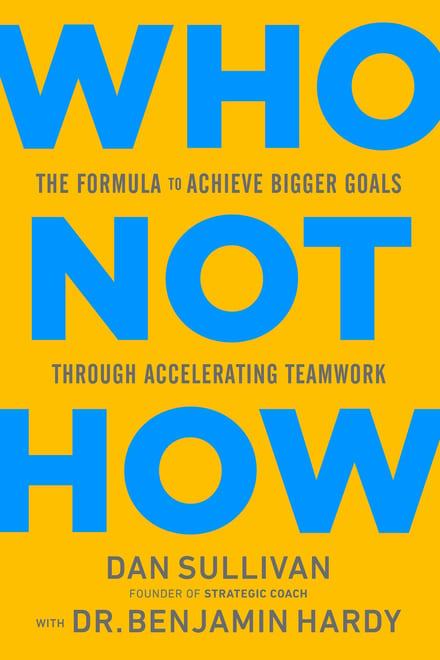
Who Not How: The Formula to Achieve Bigger Goals Through Accelerating Teamwork
The Formula to Achieve Bigger Goals Through Accelerating Teamwork
The full book runs ~208 pages — roughly 4 hours of reading. You get the key ideas here in 5 minutes.
The key ideas
- Ask who can do this, not how do I do this.
- Read procrastination as a signal you're the wrong person for the work.
- Write an Impact Filter: outcome, worst case, best case, measurable success criteria.
- Hand over the what and the why, and never supply the how.
- Find the person for whom that work is the good part of the day.
- Know the evidence here is a coaching practice, not a research literature.
The summary
You hit a wall on a goal you actually want, and the next thought arrives automatically: how do I do this? Dan Sullivan’s argument is that this is the wrong question and always has been. The moment you ask it, you’ve capped your future at the size of your own capability. The replacement is one word long — who can do this? — and it works because the right person arrives with the How already installed.
Procrastination is a signal, not a defect
The sharpest move in the book is what Sullivan does with stalling. He’s blunt that he procrastinates constantly and that “everybody who is ambitious also procrastinates,” which puts it in a different category from a character flaw. His reading: procrastination is your brain telling you that you are not the appropriate person to achieve this goal. The goal isn’t wrong. The assumption that you must both imagine it and execute it is.
The test he pairs it with is Unique Ability — work you’re both exceptional at and genuinely energized by. If the stalled project sat inside that, you wouldn’t be avoiding it; you’d feel pulled toward it. The delay is information about staffing, not about you.
Take it as a working rule rather than a diagnosis. Plenty of avoidance is fear, or a badly defined task, or a project that deserves to die, and Sullivan doesn’t separate those cases. But for someone staring at work that hasn’t moved in three weeks, it points somewhere more useful than guilt does.
You owe your Who a result, not a method
Deciding to find a Who does nothing if you can’t say what you want. Sullivan’s tool here is the Impact Filter, and it takes about half an hour. You write down what you’re trying to achieve and what difference it would make, then the worst-case scenario in detail — he recommends doing that one first — then the best, then your success criteria: the actions, decisions, communications and completions that have to be true at the end, with real numbers and dates attached.
Half the value lands on you. If you can’t sell yourself on the project in thirty minutes, it dies on the page, which is far cheaper than dying six weeks in. The other half is the handoff. As Sullivan puts it, he doesn’t tell other people how to do things — the filter supplies the what and the why; the person you hand it to supplies the how. Founders who can’t give up the method end up doing the work anyway, now with an extra salary attached to it.
The right Who wants the work
Passing a job you hate to somebody who also hates it isn’t the framework. Sullivan’s version asks you to find the person for whom that job is the good part of the day, which is why Unique Ability has four tests: you produce results others notice and rely on, you love it enough that you once did it free, it energizes you and everyone near you, and you never run out of ways to get better at it.
Strategic Coach publishes members describing the shift. Katerina Stepanova landed on hers — “putting teams together to make deals happen” — and with it the discovery that her real job was to stop meddling in departments where she was not the expert. Christopher Johnson gives the arithmetic: alone at a perfect close rate he could sign thirty clients, while fourteen good salespeople closing at eighty percent goes far past that with almost none of his time in it. His summary is the honest cost — you trade an excellence mindset for an expansion mindset, and give up being the best one at it.
He’s equally candid about the failure modes. Hire the wrong Whos and you have people practising on your business while you pay for the lessons. And the right person is frequently outside your budget the day you find them.
That last problem is where the book is thinnest. Sullivan says a Who is an investment rather than a cost, which is true and doesn’t pay anybody. If you want the arithmetic — what your hour is worth, what you can afford to buy back and in what order — Buy Back Your Time does that work. This book doesn’t.
What the evidence actually is
Be clear about what’s holding the argument up. It isn’t a research literature. Benjamin Hardy is an organizational psychologist and supplies the vocabulary, but the substance is Sullivan’s coaching career, which began in 1974, plus the roughly 25 Strategic Coach clients interviewed for each book. The transformation stories are members of the program, published by the program.
Sullivan is unembarrassed about that. He calls the books the finest marketing available to him, there to attract qualified entrepreneurs into Strategic Coach; the first three sold around 600,000 copies in four years. He’s also open that he didn’t write this one — Hardy wrote it from interviews, Tucker Max coached the deal into existence, Hay House published it, and Sullivan handed Hardy every advance and royalty. The book is an artifact of its own thesis, which is either elegant or circular depending on your mood.
The bottom line
Treat a stalled goal as a staffing question rather than a verdict on you: define the outcome precisely enough that somebody else could own it, then find the person for whom that work is the good part. It’s one idea stretched across two hundred pages, resting on a coach’s observation rather than evidence — but it’s the right idea to be holding the morning you’re about to spend six months learning something a better person could do next week.
Read it if you are the bottleneck in your own business. It’s the first of Sullivan and Hardy’s Transformation Trilogy; The Gap and the Gain comes next, and solves a different problem — how to measure the results once your Whos start delivering them.
Fact check
Popular books repeat findings that later research has complicated. Where Who Not How makes a testable claim, here's what the evidence actually shows.
Procrastination is a signal that you are the wrong person for that particular task, rather than a self-regulation or character problem.
The book is partly right about where to look. Steel's meta-analysis of 691 correlations found task aversiveness among the strongest and most consistent predictors of delay, so a stalled project genuinely is telling you something about the task. But the other equally strong predictors — impulsiveness, low self-efficacy, and low conscientiousness with its self-control and organization facets — are stable properties of the person, and they travel to the next project. A behaviour-genetic study put procrastination at 46% heritable and found it genetically inseparable from impulsivity (genetic correlation of 1.0), which is hard to reconcile with reading each delay as a staffing readout.
- Steel P. The nature of procrastination: a meta-analytic and theoretical review of quintessential self-regulatory failure. Psychol Bull. 2007;133(1):65-94. PubMed
- Gustavson DE, Miyake A, Hewitt JK, Friedman NP. Genetic relations among procrastination, impulsivity, and goal-management ability: implications for the evolutionary origin of procrastination. Psychol Sci. 2014;25(6):1178-88. PubMed
Writing the outcome down precisely — success criteria with real numbers and dates — before handing a project to anyone is what makes the handoff work.
This is the one part of the book standing on a research literature rather than a coaching practice. Locke and Latham's 35-year review of goal-setting research reports that specific, difficult goals reliably produce higher performance than vague "do your best" instructions, and traces the effect to effort, persistence, and the search for task strategies. The Impact Filter is a goal-specificity exercise, and specificity is the part that does the work. What the research does not cover is the second half of Sullivan's move — that the person receiving the goal should be given no method at all.
- Locke EA, Latham GP. Building a practically useful theory of goal setting and task motivation. A 35-year odyssey. Am Psychol. 2002;57(9):705-17. PubMed
Hand your Who the what and the why and stay out of the how, and you get a better result than if you had specified the method.
Empowering leadership — delegating authority and letting people choose their own method — was one of the stronger predictors of followers' intrinsic motivation in a meta-analysis of 50 independent samples covering 21,873 participants, ahead of transformational leadership. So the instinct has support. The gap is what gets measured: motivation and engagement, not the business results Sullivan attributes to the handoff, and nothing in that literature tests his stronger claim that the right person arrives with the How already installed.
- Xue H, Luo Y, Luan Y, Wang N. A meta-analysis of leadership and intrinsic motivation: Examining relative importance and moderators. Front Psychol. 2022;13:941161. PubMed
Frequently asked questions
What is Who Not How about?
Every stalled goal is a staffing problem. The moment you ask "how do I do this?" you've capped your future at the size of your own capability, so Dan Sullivan's replacement question is one word long — who can do this? — and it works because the right person arrives with the How already installed.
What are the key takeaways from Who Not How?
Procrastination is treated as information rather than a defect: Sullivan reads a stall as your brain saying you aren't the appropriate person to achieve this goal, since work inside your Unique Ability — what you're both exceptional at and energized by — doesn't get avoided. Handing it over needs a defined outcome, which is what the Impact Filter produces in about half an hour: what you're trying to achieve, the difference it would make, the worst case (written first), the best case, and success criteria with real numbers and dates. You supply the what and the why; the Who supplies the how, and founders who can't give up the method end up doing the work anyway with an extra salary attached. The right Who is someone for whom that job is the good part of the day, not another person who hates it, and the arithmetic favors it — one member calculated that fourteen salespeople closing at eighty percent goes far past the thirty clients he could sign alone at a perfect close rate, at the price of trading an excellence mindset for an expansion mindset. Sullivan is candid about the failure modes too: the wrong Whos practise on your business while you pay for the lessons, and the right one is frequently outside your budget the day you find them.
Who should read Who Not How?
Read it if you are the bottleneck in your own business. It's the first of Sullivan and Hardy's Transformation Trilogy, with The Gap and the Gain next.
Is Who Not How worth reading?
It's one idea stretched across two hundred pages, and what holds it up isn't a research literature — it's Sullivan's coaching career since 1974 and roughly 25 Strategic Coach clients interviewed per book, so the transformation stories are members of the program, published by the program. Sullivan is unembarrassed about that, calling the books the finest marketing available to him. The book is also thinnest exactly where readers need it most, on affording a Who: calling one an investment rather than a cost is true and doesn't pay anybody, and Buy Back Your Time does that arithmetic instead. Still the right idea to be holding the morning you're about to spend six months learning something a better person could do next week.