Book summary
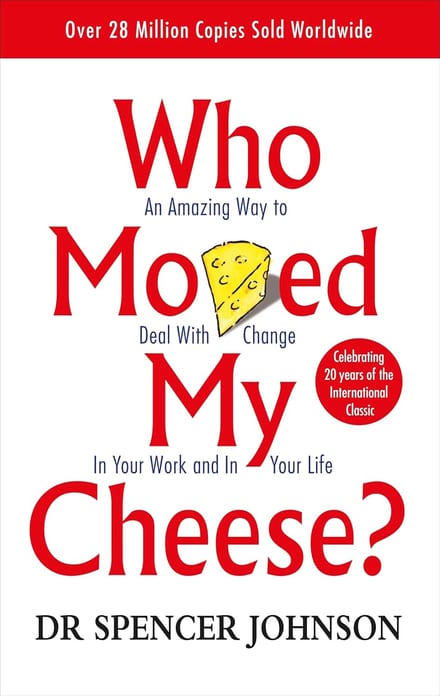
Who Moved My Cheese? An Amazing Way to Deal with Change in Your Work and in Your Life
The full book runs ~96 pages — roughly 2 hours of reading. You get the key ideas here in 2 minutes.
The key ideas
- Expect change: every good situation has an expiration date
- Monitor constantly so you notice the supply shrinking early
- Confront denial: clinging to gone cheese only breeds hunger
- Visualize the goal to override fear and start moving
- Act despite fear; the maze is safer than imagined
- Repeat boldly: each risk makes the next one easier
The summary
Every good situation has an expiration date. The question in Spencer Johnson’s little parable isn’t whether your cheese will run out — it will — but whether you’ll notice it going and move early, or stay put until you’re forced out hungry and weak. Four characters hunt for cheese in a maze: two mice, Sniff and Scurry, and two little people, Hem and Haw. The mice keep it simple, sniffing out the supply and reacting the moment it changes. Hem and Haw strategize, overthink, and — once they hit a giant cheese station — build their whole lives around it. The contrast is the whole lesson: the simple, watchful habits of the mice end up beating the clever, attached ones of the people, who mistake a lucky supply for a permanent right.
Success breeds the blindness that strands you
When Hem and Haw found their enormous stash, they settled in and stopped watching it. They assumed it would always be there, because they’d worked hard for it and felt they deserved it. Sniff and Scurry, meanwhile, kept an eye on the pile and noticed it shrinking. So on the morning the cheese was finally gone, the mice had already moved on and were eating somewhere new, while Hem and Haw stood frozen in disbelief. They came back to the empty station day after day, growing hungrier and angrier, demanding to know who moved their cheese. Convinced they were owed more, they refused to accept the change and took to smashing walls in search of hidden reserves that weren’t there. That’s the trap: success breeds attachment, attachment breeds blindness, and blindness leaves you stranded when things shift.
Fear is louder in your head than in the maze
Haw is the one who finally breaks the pattern. He starts picturing himself sitting on a fresh block of cheese, and the image is vivid enough to get him moving when logic alone couldn’t. Visualizing the goal in concrete detail is how he overrides his own paralysis. Staying put guarantees starvation; venturing out only might lead somewhere better, and he decides that’s a bet worth making. Once he’s actually in the maze, he learns the fear was mostly in his head — the corridors aren’t as dangerous as he imagined, and he finds scraps of cheese along the way that keep him going until he reaches another abundant station. As he travels he carves messages on the walls, half to encourage himself and half as breadcrumbs for his friend: “If You Do Not Change, You Can Become Extinct” and “What Would You Do If You Weren’t Afraid?” Hem, gripped by that same fear, never leaves, and stays at the empty station frustrated and malnourished.
The more you move, the easier it gets
Reaching new cheese doesn’t make Haw complacent. He keeps exploring, because he’s learned that no supply lasts and complacency is what nearly finished him. He also notices that each risk makes the next one smaller: the more he moves, the less fear has a grip on him, and confidence grows through repetition. On the largest wall he can find, he writes down what the whole ordeal taught him:
- Change happens — they keep moving the cheese.
- Anticipate change — get ready for the cheese to move.
- Monitor change — smell the cheese often so you know when it’s getting old.
- Adapt quickly — the sooner you let go of old cheese, the sooner you find new cheese.
- Move with the cheese.
- Enjoy change — savor the adventure and the taste of new cheese.
- Be ready to change again, because they’ll keep moving it.
The bottom line
The cost of clinging to an expired situation is all the time you burn waiting for it to come back instead of finding what’s next. Watch for the decline and move before you’re desperate, and each move gets easier. Read this if you’re stuck in denial about a job, relationship, or strategy that’s already over — or if you’d rather not become the person who is.
Fact check
Popular books repeat findings that later research has complicated. Where Who Moved My Cheese? An Amazing Way to Deal with Change in Your Work and in Your Life makes a testable claim, here's what the evidence actually shows.
Picturing the desired outcome in vivid detail is what breaks paralysis and gets you moving.
Across four samples — job seekers, students with a romantic interest, undergraduates facing an exam and patients recovering from hip replacement — positive expectations (judging success likely) predicted more effort and better outcomes weeks or months later, while positive fantasies about the desired future predicted the opposite. Later experiments found that indulging in idealized fantasies drains energy rather than supplying it. What does drive action is pairing the wished-for outcome with the obstacle in the way; Haw's reasoning that staying put guarantees starvation is closer to that than to the daydream the summary credits.
The fear of leaving is worse than what you actually meet once you go.
Six studies on affective forecasting found people consistently overestimate how long a bad outcome will hurt — after a breakup, a job rejection, an election loss or harsh feedback — because they do not anticipate how quickly they rationalize and recover. The mistake is about duration, not about whether the event stings, so the risk itself is real even when the dread is inflated. The parable's version, that the corridors turn out less frightening than they looked from the empty cheese station, is the direction the evidence points.
- Gilbert DT, Pinel EC, Wilson TD, Blumberg SJ, Wheatley TP. Immune neglect: a source of durability bias in affective forecasting. J Pers Soc Psychol. 1998;75(3):617-638. PubMed
Frequently asked questions
What is Who Moved My Cheese? An Amazing Way to Deal with Change in Your Work and in Your Life about?
Spencer Johnson's parable follows four characters, two mice and two little people, hunting for cheese in a maze, where the cheese stands for whatever you want in work or life. Its point is that every good situation has an expiration date, and the real question is whether you'll notice the decline and move early or cling until you're forced out hungry and weak.
What are the key takeaways from Who Moved My Cheese? An Amazing Way to Deal with Change in Your Work and in Your Life?
Success breeds attachment, attachment breeds blindness, and blindness leaves you stranded when things shift, which is exactly what happens to Hem and Haw. Fear is usually louder in your head than in the maze, and the corridors turn out less dangerous than imagined. Visualizing the goal in concrete detail is what gets you moving when logic alone can't. And each move makes the next one easier, captured in the handwriting on the wall: change happens, anticipate it, monitor it, adapt quickly, enjoy it, and be ready to change again.
Who should read Who Moved My Cheese? An Amazing Way to Deal with Change in Your Work and in Your Life?
Read it if you're stuck in denial about a job, relationship, or strategy that's already over, or if you'd rather not become the person who is.
Is Who Moved My Cheese? An Amazing Way to Deal with Change in Your Work and in Your Life worth reading?
It's short, memorable, and turns one hard truth about change into an easy-to-share story you can act on the same day. That simplicity is also the catch, so anyone wanting nuance or evidence rather than a fable may find it thin, though the message is deliberately one you won't forget.