Book summary
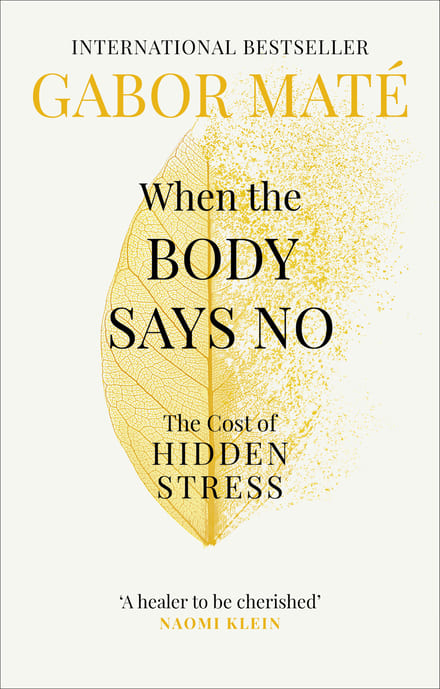
When the Body Says No: The Cost of Hidden Stress
The Cost of Hidden Stress
The full book runs ~320 pages — roughly 6 hours of reading. You get the key ideas here in 5 minutes.
The key ideas
- Stress is a cortisol cascade, not a mood; it runs while you feel fine.
- Chronic strain suppresses immunity: caregivers' wounds healed nine days slower than controls'.
- Niceness is often a survival strategy learned young, later mistaken for personality.
- Type C — cooperative, unassertive, anger held down — recurs across his cancer patients.
- Repression is a risk factor, not a cause; genes and environment stay real.
- Healing starts with negative thinking: what isn't working, what have I ignored?
The summary
Mary had been Gabor Maté’s patient for eight years before he thought to ask her about her life. She had scleroderma, an autoimmune disease that hardens skin and organs, and every doctor treating her — himself included — worked strictly on the tissue. When he finally booked an hour just to listen, out came a childhood of abuse and foster homes: a seven-year-old huddled in an attic holding her sisters while her drunken foster parents fought below. “I was so scared all the time,” she told him. “And no one protected me.” She had told no one, not even her husband of twenty years, and described herself as incapable of saying no. Maté wrote about her in a 1993 column: “When we have been prevented from learning how to say no, our bodies may end up saying it for us.” That line is the whole book.
Stress is something the body does, not something you feel
Maté builds on Hans Selye, who borrowed the engineering word stress for what happens inside an organism under threat. It isn’t the jangled feeling before a deadline. It’s a measurable cascade — hypothalamus signals pituitary, pituitary signals adrenals, adrenals pour out cortisol — and it can run at full volume in someone who reports feeling perfectly fine. Cortisol dampens immune activity, thins bone and ulcerates the gut lining. Sustained for years, the machinery that saves you in an emergency starts dismantling you.
His evidence is mostly about chronic, unremarkable strain. Spouses caring for partners with Alzheimer’s showed suppressed natural killer cell activity — the immune cells that attack tumours and infections — in some cases three years after the spouse had died. In another study, 80 per cent of unstressed controls developed immunity from a flu shot against only 20 per cent of Alzheimer caregivers, and caregivers’ wounds took nine days longer to heal. None of this is catastrophe. It’s load that never lifts.
The people who cannot say no
The book’s spine is his patients, and the same character keeps walking in. Alexa, a teacher with ALS, arrived at school at dawn to scrawl the day’s lesson with the chalk gripped in her fist. A dying executive kept swallowing foul-smelling shark cartilage he no longer believed in, so his business partner wouldn’t be disappointed.
Clinicians have noticed. A 1970 Yale study of ten ALS patients by Walter Brown and Peter Mueller found two lifelong traits: rigidly competent behaviour — an inability to ask for help — and habitual exclusion of fear, anxiety and sadness. Neurologists from the Cleveland Clinic presented a paper in Munich titled “Why Are Patients with ALS So Nice?” — their technologists could guess the diagnosis from bedside manner alone: this patient can’t have ALS, he isn’t nice enough. Lou Gehrig played 2,130 consecutive games; X-rays later showed seventeen fractures across his hands.
Maté’s reading is that niceness of this kind isn’t temperament but a survival strategy laid down early. A child whose parents can’t tolerate her anger or sadness learns to shut it down, and the shutdown hardens into what everyone later calls personality.
Repressed anger and the Type C pattern
The same pattern surfaces across diseases. A 1974 British study interviewed 160 women admitted for breast biopsy, before anyone knew the results, and linked a cancer diagnosis to a lifelong pattern of abnormal emotional release — usually extreme suppression of anger. In a 1984 study, melanoma patients, heart patients and healthy controls viewed insulting slides while a dermograph tracked their skin’s electrical response. The three groups reacted identically in the body; only the melanoma group tended to report feeling nothing. Out of this came the label Type C: cooperative, patient, unassertive, holding a happy facade over unexpressed anger — as against the driven, hostile Type A linked to heart disease.
Long-run data points the same way. Johns Hopkins psychologically tested 1,130 medical students from 1946; those who later developed cancer had scored lowest of anyone for depression, anxiety and anger, and reported the greatest distance from their parents. Harvard undergraduates were asked how cared-for they felt; thirty-five years on, a quarter of those who had felt strongly loved were ill, against almost 90 per cent of those who hadn’t.
A risk factor is not a verdict
He does not claim emotions cause cancer. “One does not get cancer simply from repressing anger,” he writes, “or ALS just from being too nice.” Melanoma needs fair skin, ultraviolet damage and something more; genes and environment are real. His claim is narrower: repression is a risk factor that works by keeping the stress apparatus switched on for decades. He also separates blame from responsibility. Blaming the sick is morally obtuse and scientifically unfounded; responsibility means only the ability to respond, which requires knowing what is happening to you.
Healing starts with negative thinking
His remedy begins by dropping compulsive positive thinking, which he calls the coping mechanism of the hurt child. What he wants instead is the nerve to ask unpleasant questions: what isn’t working, what have I ignored, what is my body saying no to? He closes with seven A’s — acceptance, awareness, anger, autonomy, attachment, assertion, affirmation — capacities most of us never got to build. He is explicit that this is not a book of prescriptions: insight, he argues, does more for people than advice.
The bottom line
Hidden chronic stress — much of it generated by an inability to feel and express your own emotions — is a real physiological risk factor for serious illness, working alongside genes and environment, not instead of them. Maté’s point isn’t that you made yourself sick; it’s that nobody taught you to hear what your body has been telling you. Read it if you’re the reliable one, the person everyone calls, who has never once managed to say no.
Fact check
Popular books repeat findings that later research has complicated. Where When the Body Says No makes a testable claim, here's what the evidence actually shows.
Chronic, unremarkable stress measurably degrades immune function — caregivers heal slower and respond worse to vaccines.
This part holds up. Thirteen women caring for a relative with dementia took 48.7 days to heal a 3.5 mm punch biopsy against 39.3 days in matched controls — the nine-day gap the book describes — and their white cells produced less interleukin-1 beta. On influenza vaccination, 50 spousal carers had higher salivary cortisol than 67 controls, and 16% of carers versus 39% of controls mounted a four-fold antibody rise. The direction is right, though that is a narrower split than the 20-versus-80 per cent figure the book cites, and both samples are small.
- Kiecolt-Glaser JK, Marucha PT, Malarkey WB, Mercado AM, Glaser R. Slowing of wound healing by psychological stress. Lancet. 1995;346(8984):1194-6. PubMed
- Vedhara K, Cox NK, Wilcock GK, et al. Chronic stress in elderly carers of dementia patients and antibody response to influenza vaccination. Lancet. 1999;353(9153):627-31. PubMed
Chronic psychological stress and adverse life events are a risk factor for developing cancer.
Large prospective cohorts do not find this. Following 106,000 UK women to 1,783 incident breast cancers, perceived frequency of stress showed no association with risk, and death of a close relative in the preceding five years went the other way (RR 0.87, 95% CI 0.78-0.97). Pooling 12 European cohorts — 116,056 people, 5,765 incident cancers, median 12 years of follow-up — job strain gave a hazard ratio of 0.97 (0.90-1.04) overall, with nothing for colorectal, lung, breast or prostate cancer. An 18-year Copenhagen cohort found high self-reported stress associated with a lower breast cancer rate (HR 0.60, 0.37-0.97), which its authors attribute to stress impairing oestrogen synthesis rather than to any benefit.
- Schoemaker MJ, Jones ME, Wright LB, et al. Psychological stress, adverse life events and breast cancer incidence: a cohort investigation in 106,000 women in the United Kingdom. Breast Cancer Res. 2016;18(1):72. PubMed
- Heikkilä K, Nyberg ST, Theorell T, et al. Work stress and risk of cancer: meta-analysis of 5700 incident cancer events in 116,000 European men and women. BMJ. 2013;346:f165. PubMed
- Nielsen NR, Zhang ZF, Kristensen TS, Netterstrøm B, Schnohr P, Grønbaek M. Self reported stress and risk of breast cancer: prospective cohort study. BMJ. 2005;331(7516):548. PubMed
A "Type C" personality — cooperative, unassertive, holding a pleasant facade over unexpressed anger — marks out who develops cancer.
The design the book cites, questioning women before anyone knew their biopsy results, was later run at scale and came back empty. Among 2,224 older women recalled after mammography and tested while waiting, the 298 who turned out to have breast cancer did not differ from three control groups on emotional expression-in, expression-out, emotional control, defence style, self-esteem, anxiety or depression. Nordic registry data on 59,548 people followed up to 30 years, yielding 4,631 cancers, found neither extraversion nor neuroticism predicted risk (both hazard ratios 0.99-1.00). A meta-analysis of 165 studies did find stress-prone personality and coping style associated with higher incidence, but it also documented publication bias and cautioned against taking the result at face value.
- Price MA, Tennant CC, Smith RC, et al. The role of psychosocial factors in the development of breast carcinoma: Part I. The cancer prone personality. Cancer. 2001;91(4):679-85. PubMed
- Nakaya N, Bidstrup PE, Saito-Nakaya K, et al. Personality traits and cancer risk and survival based on Finnish and Swedish registry data. Am J Epidemiol. 2010;172(4):377-85. PubMed
- Chida Y, Hamer M, Wardle J, Steptoe A. Do stress-related psychosocial factors contribute to cancer incidence and survival? Nat Clin Pract Oncol. 2008;5(8):466-75. PubMed
People who develop ALS share a premorbid character of rigid competence and habitual exclusion of fear, anxiety and sadness.
The trait pattern is real; the causal reading is not established. The 1970 Yale paper behind the observation studied ten patients. An MMPI comparison of 38 people with ALS against 50,500 general medical patients found no marked deviation and, specifically, no increased defensiveness on the L or K validity scales — the scales that would pick up habitual emotional suppression. The largest test, 339 people with ALS rating themselves as they were before diagnosis against 402 controls, did find higher Agreeableness, Conscientiousness and Extraversion and lower Neuroticism, which the authors read as consistent with the "nice" perception — while proposing genetic influences on personality or personality-driven lifestyle, not learned repression, as the likelier link.
- Brown WA, Mueller PS. Psychological function in individuals with amyotrophic lateral sclerosis (ALS). Psychosom Med. 1970;32(2):141-52. PubMed
- Peters PK, Swenson WM, Mulder DW. Is there a characteristic personality profile in amyotrophic lateral sclerosis? A Minnesota Multiphasic Personality Inventory study. Arch Neurol. 1978;35(5):321-2. PubMed
- Parkin Kullmann JA, Hayes S, Pamphlett R. Are people with amyotrophic lateral sclerosis (ALS) particularly nice? An international online case-control study of the Big Five personality factors. Brain Behav. 2018;8(10):e01119. PubMed
Frequently asked questions
What is When the Body Says No about?
It is about hidden stress — the kind that runs in the body without registering as a feeling — and its role in serious illness. Gabor Maté draws on his own patients, from a woman with scleroderma who had never told anyone about her childhood to a teacher with ALS, to argue that people who cannot say no keep the stress machinery switched on for decades. His claim is that repression is a risk factor working alongside genes and environment, never a replacement for them.
What are the key takeaways from When the Body Says No?
Stress in Hans Selye's sense is a physiological cascade — hypothalamus, pituitary, adrenals, cortisol — that can run at full volume in someone who reports feeling fine, and sustained cortisol dampens immunity, thins bone and ulcerates the gut. Chronic, unremarkable strain shows up in the body: Alzheimer caregivers had suppressed natural killer cell activity and wounds that took nine days longer to heal. The recurring character is the person who cannot ask for help and habitually excludes fear, anger and sadness — the ALS "niceness" pattern, and the Type C profile (cooperative, patient, unassertive, a happy facade over unexpressed anger) as against the driven, hostile Type A linked to heart disease. Maté's remedy is to drop compulsive positive thinking and ask what isn't working, ending with seven A's: acceptance, awareness, anger, autonomy, attachment, assertion, affirmation.
Who should read When the Body Says No?
Read it if you're the reliable one — the person everyone calls, who has never once managed to say no. It also speaks to anyone living with an autoimmune or chronic illness who has only ever been treated at the level of tissue, and to clinicians who never think to book the hour and ask about a patient's life.
Is When the Body Says No worth reading?
Its strength is the case material and the careful framing: Maté is explicit that emotions don't simply cause cancer, that melanoma still needs fair skin and ultraviolet damage, and that blaming the sick is both cruel and unfounded. He separates blame from responsibility, which he defines only as the ability to respond. Readers wanting a protocol will be frustrated — he says outright this is not a book of prescriptions, and several of the studies he leans on are small and decades old.