Book summary
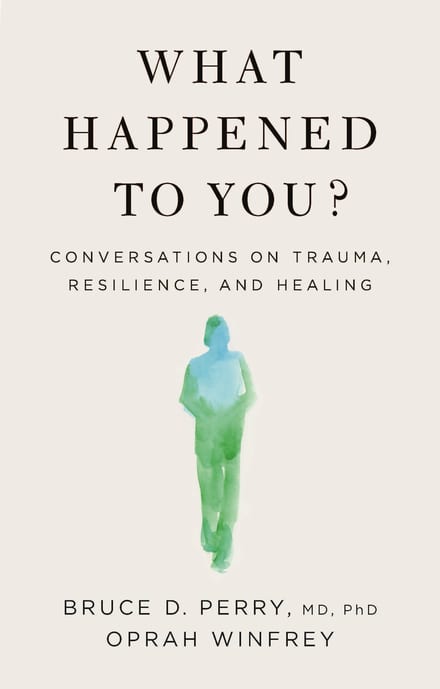
What Happened To You?
Conversations on Trauma, Resilience, and Healing
The full book runs ~280 pages — roughly 5 hours of reading. You get the key ideas here in 4 minutes.
The key ideas
- Ask 'What happened to you?' not 'What's wrong with you?'
- Trauma lives in the body, triggering automatic survival responses.
- Children aren't resilient—they're malleable, and trauma reshapes them.
- Relational health predicts well-being more than adversity's severity.
- Trauma ripples across generations and through systemic racism.
- Healing builds new neural pathways; it never deletes old ones.
The summary
The most useful question you can ask about difficult behavior isn’t “What’s wrong with you?” but “What happened to you?” That single reframe holds the whole argument of Bruce Perry and Oprah Winfrey’s conversation. Early adversity physically wires the brain’s stress machinery, so conduct that looks irrational is usually an old survival response firing on a familiar cue. A teenager in residential care abruptly turned aggressive toward a teacher he’d gotten along with for months. The trigger turned out to be the man’s Old Spice deodorant—the same scent his abusive father had worn. Switch the deodorant, and the relationship healed. In a fast-developing brain, sensory experiences lay down thousands of associations that become a kind of codebook, dictating reactions years or even decades later.
Oprah, who suffered severe physical abuse from her grandmother, spent much of her life people-pleasing and struggling to set boundaries. That wasn’t weakness; a child forced to suppress pain learns that her needs don’t count. After absorbing such experiences, kids develop a deep ache to feel needed and valued, and if it goes unaddressed it can harden into self-sabotage, addiction, or a pull toward relationships that are familiar but harmful. This isn’t rare. Sixty percent of American adults report at least one adverse childhood experience and nearly a quarter report three or more—figures researchers believe understate the truth.
Trauma lives in the body
Survival runs through the brain stem, which reacts to danger in an instant, bypassing the rational cortex entirely. Decades after the Korean War, veteran Mike Roseman heard a car backfire and dove for cover in terror; his thinking brain knew he was safe, and his brain stem overruled it. That’s why regulation—physical and emotional balance—has to come before reasoning with anyone in distress. It also explains why trauma survivors are more prone to every kind of addiction: their baseline stress is already elevated, so anything that soothes the dysregulation becomes a survival tool.
The nervous system gets calibrated early. Infants can’t parse words, but they read tone, tension, and despair, and because the brain grows so fast in the first years, that emotional climate leaves an outsized mark. Responsive caregiving teaches a child the world is safe and their needs matter; its absence does its own damage. Neglect, Perry stresses, is as harmful as active abuse—it leaves a void where connection should be, and children often fill that void with dissociation, retreating inward because there’s no one to turn to. Useful once, dissociation can grow oversensitive and calcify into avoidance, hollow compliance, or self-harm. Moderate, predictable stress builds resilience; it’s the chronic, extreme, and unpredictable kind that breaks the system.
Children are malleable, not resilient
We like to say children bounce back, but Perry calls that a convenient myth. Children aren’t resilient—they’re malleable. Trauma doesn’t glance off them and leave them unchanged; it reshapes them, biologically and functionally. Calling them resilient is a way to look away from the damage.
What actually helps is safety and control. When Perry’s team worked with children rescued from a violent cult, forcing them into ordinary classrooms and therapy made things worse and led to misdiagnosis. Progress came from a predictable environment where the kids could make their own choices and rebuild trust at their own pace. The evidence points the same way at scale: after studying 70,000 cases across 25 countries, researchers found that relational health—how connected a person is to family, community, and culture—predicts well-being more strongly than the severity of the adversity they survived. Rhythmic activities like walking, music, and time in nature help regulate the system, but nothing rivals positive human connection. Trauma fractures relationships, and relationships are what repair it.
Trauma travels through families and systems
The damage rarely stops with one person. It moves across generations through emotional contagion, learned behavior, and possibly epigenetic changes that tune a child’s stress response before they’re old enough to remember. Oprah traces her own fear of being alone to a night she watched her grandfather attack her grandmother. Whole populations carry this weight too. Perry and Winfrey point to systemic racism as a compounding trauma—the dogs once turned on enslaved people and civil rights marchers echo in inherited fears today—and argue that marginalization is itself a fundamental trauma, because humans are relational creatures and prolonged exclusion is prolonged, uncontrollable stress. You can’t be trauma-informed, they insist, while ignoring the biases built into people and institutions.
Repair, at this level, takes immersion rather than a three-hour seminar. Anthony Bourdain modeled it by actually sitting with people, cooking their food and joining their celebrations. Māori healing works through community life, storytelling, shared meals, and connection to ancestors and land. Modern life pushes the opposite way, into what Perry calls relational poverty—smaller households, isolation, sensory overload from screens, less face-to-face contact—and the cost shows up as falling resilience and rising mental-health struggles.
Building new pathways
The hopeful core of the book is neuroplasticity: the brain keeps changing with experience. Healing isn’t erasing the past, which can’t be done anyway. It’s laying down new, healthier defaults through repetition and safe relationships. Perry’s image is building a four-lane freeway beside an old two-lane dirt road—the dirt road stays, but you stop driving it. You don’t get to return to who you were before the trauma; you get to build new patterns, one experience at a time, until they become the route you take without thinking.
The bottom line
Behavior makes sense once you know what happened to someone: trauma physically rewires the brain, but new experiences inside safe, steady relationships can build healthier pathways alongside the old ones. Read this if you want to understand your own reactions, help someone who’s been through something terrible, or see how the systems meant to help people so often wound them again.
Fact check
Popular books repeat findings that later research has complicated. Where What Happened To You? makes a testable claim, here's what the evidence actually shows.
About 60% of American adults report at least one adverse childhood experience, and nearly a quarter report three or more.
CDC's analysis of 214,157 adults across 23 states in the 2011-2014 Behavioral Risk Factor Surveillance System found 61.55% reported at least one ACE and 24.64% reported three or more — essentially the figures the book gives. Emotional abuse was the most common single category at 34.42%, followed by parental separation or divorce at 27.63%. Because these are self-reports of events decades earlier, under-reporting is likely, which matches the book's caveat that the real numbers are probably higher.
- Merrick MT, Ford DC, Ports KA, Guinn AS. Prevalence of Adverse Childhood Experiences From the 2011-2014 Behavioral Risk Factor Surveillance System in 23 States. JAMA Pediatr. 2018;172(11):1038-1044. PubMed
Neglect damages a developing child as much as active abuse does.
A meta-analysis of 124 studies confirms neglect carries substantial long-term risk — odds ratios of 2.11 for depressive disorders, 1.95 for suicide attempts and 1.57 for risky sexual behavior — so treating it as the lesser category is wrong. But the equivalence does not hold outcome by outcome: neglect beat physical abuse for depression (2.11 vs 1.54) while physical abuse carried far higher odds for suicide attempts (3.40 vs 1.95), and emotional abuse was the strongest predictor of depression at 3.06. The book's corrective is well aimed; 'as harmful' is a simplification of a pattern that varies by type and outcome.
- Norman RE, Byambaa M, De R, Butchart A, Scott J, Vos T. The long-term health consequences of child physical abuse, emotional abuse, and neglect: a systematic review and meta-analysis. PLoS Med. 2012;9(11):e1001349. PubMed
Across 70,000 cases in 25 countries, relational health predicts well-being more strongly than the severity of the adversity someone survived.
The published analysis from Perry's clinical network covers 3,523 children aged 6 to 13, not 70,000, and its finding is narrower than the summary's: when adversity happened mattered more for current functioning than how much of it there was, with perinatal experiences the most damaging, and relationally rich environments buffering the effect. That does support the book's central point — a raw ACE tally is a poor predictor and connection changes the outcome — but the specific ranking of relational health above adversity severity, at the scale quoted, is not what the peer-reviewed data show.
- Hambrick EP, Brawner TW, Perry BD, Brandt K, Hofmeister C, Collins JO. Beyond the ACE score: Examining relationships between timing of developmental adversity, relational health and developmental outcomes in children. Arch Psychiatr Nurs. 2019;33(3):238-247. PubMed
Trauma travels down generations partly through epigenetic changes that tune a child's stress response before birth.
The most-cited human evidence found altered FKBP5 methylation in both Holocaust survivors and their adult children, but it rested on 32 survivors, 22 offspring and control groups of 8 and 9 — far too small to settle a question this contested. The lead author's own later review calls the epigenetic mechanism putative and notes how hard it is, in humans, to separate an inherited molecular mark from shared environment, parenting and prenatal exposure. The summary hedges with 'possibly epigenetic', which is about the right level of confidence for where this evidence sits.
- Yehuda R, Daskalakis NP, Bierer LM, Bader HN, Klengel T, Holsboer F, Binder EB. Holocaust Exposure Induced Intergenerational Effects on FKBP5 Methylation. Biol Psychiatry. 2016;80(5):372-380. PubMed
- Yehuda R, Lehrner A. Intergenerational transmission of trauma effects: putative role of epigenetic mechanisms. World Psychiatry. 2018;17(3):243-257. PubMed
Frequently asked questions
What is What Happened To You? about?
Bruce Perry and Oprah Winfrey's conversation reframes the most useful question about difficult behavior from "What's wrong with you?" to "What happened to you?" Early adversity physically wires the brain's stress machinery, so conduct that looks irrational is usually an old survival response firing on a familiar cue, and new experiences inside safe relationships can build healthier pathways alongside the old ones.
What are the key takeaways from What Happened To You??
Trauma lives in the body, and the brain stem reacts to danger instantly, bypassing reason, so regulation has to come before reasoning with anyone in distress. Children aren't resilient, they're malleable, since trauma reshapes them and neglect is as harmful as active abuse. Relational health predicts well-being more strongly than the severity of the adversity someone survived, and positive human connection is what repairs trauma. And the damage travels through families and systems, including systemic racism, but neuroplasticity lets you build new defaults, like a four-lane freeway beside the old dirt road.
Who should read What Happened To You??
Read it if you want to understand your own reactions, help someone who's been through something terrible, or see how the systems meant to help people so often wound them again.
Is What Happened To You? worth reading?
It pairs Perry's clinical explanation with Oprah's personal stories, making the brain science of trauma readable and humane, and its central reframe is genuinely useful. The conversational format circles and repeats rather than building tightly, so anyone wanting a structured clinical text may prefer something more systematic.