Book summary
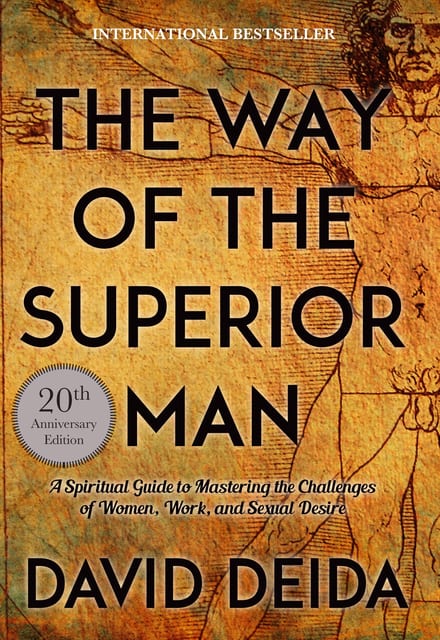
The Way of the Superior Man: A Spiritual Guide to Mastering the Challenges of Women, Work, and Sexual Desire
A Spiritual Guide to Mastering the Challenges of Women, Work, and Sexual Desire
The full book runs ~224 pages — roughly 4 hours of reading. You get the key ideas here in 5 minutes.
The key ideas
- Purpose first — he says you would choose your mission over the perfect relationship
- Cut your father's strings, then find your edge and live just past it
- Polarity, on his account, is about energies rather than the sexes
- Sameness kills desire, he argues; difference is what carries the charge
- Testing never ends, and lands hardest at your moments of triumph
- Doctrine, not evidence — the essentialism is its most criticised feature
The summary
Everything in this book follows from one premise: that masculine and feminine are real, opposed energies, and that sexual attraction is the charge between them. In David Deida’s scheme, the masculine is a drive toward freedom, direction and purpose; the feminine is the flow of love, radiance and ever-changing emotion. “You are always attracted to your sexual reciprocal,” he writes — so a strongly masculine man will be drawn to a strongly feminine woman, and the traits that exasperate him about her are the same energy that draws him. None of this is offered as psychology with evidence behind it. It is a metaphysics, delivered in the voice of a spiritual teacher, and the book stands or falls on whether you grant it.
Published in 1997 and reissued for its twentieth anniversary in 2017, it has sold over a million copies and carries endorsements from Tony Robbins and Ken Wilber. The form is part of its pull: 51 chapters in eight parts, most only two or three pages — an italicised law (Live As If Your Father Were Dead, Her Complaint Is Content-Free), then commentary and often an exercise. The register is tantric throughout: the man who stays present under provocation is, in Deida’s language, Shiva, the divine masculine.
Purpose comes before the relationship
The book’s bluntest instruction: admit to yourself that if you had to choose between the perfect intimate relationship and your highest purpose, you would choose the purpose. On Deida’s account this is honesty, not callousness — a man who shelves his mission for his partner “weakens himself, disserves the universe, and cheats his woman of an authentic man who can offer her full, undivided presence.”
The surrounding chapters build the working method. Cut the invisible strings first: “A man must love his father and yet be free of his father’s expectations and criticisms in order to be a free man” — with homework attached: do the thing you’ve been avoiding because of his influence. Then find the edge: “Your edge is where you stop short, or where you compromise your fullest gift, and, instead, cater to your fears.” His counsel is to lean just beyond it — neither hiding in a job that is secure but dead, nor faking a fearlessness you don’t have. And stop waiting: on his telling there is no future point where the work is done and life begins, so start today on what you keep postponing.
Polarity is his theory of desire
Deida is explicit that the poles are not the sexes. Keeping your word, he writes, is a masculine trait in men or women; a feminine-essence man will be drawn to a masculine woman’s direction; he offers “masculine and feminine, top and bottom, butch and femme” as versions of the same reciprocal charge. But the book speaks throughout to “the most common case of a masculine sexual essence: a heterosexual man with a masculine sexual essence,” and that man is its entire audience.
The practical claim is that sameness kills desire. Couples who share everything depolarise, in his term, into comfortable neutrality; passion, he argues, needs difference, and a man who tries to make his partner more consistent and reasonable is sanding off the very energy that attracted him. Her changing mind, on this premise, isn’t dishonesty: feminine speech expresses the feeling of the moment, not a commitment, so he tells the reader to hear her fully and then decide from his own core rather than build plans on her words.
The testing never ends
In Deida’s account, a woman tests the man she loves — and hardest at his moments of triumph. In one scene, a man comes home wanting to tell her he just made a million dollars; she says, “That’s nice.” She pokes at the weak spot, Deida says, because the success means nothing to her unless he stays free and loving — she wants to feel that nothing can collapse him. “It never ends,” he warns: another woman won’t end it, therapy won’t, money won’t. This chapter also holds the title’s definition: a superior man, for Deida, is one whose heart stays open and whose truth stays firm under his partner’s criticism — who can laugh at “That’s nice” on the day of the million. The same logic runs through his claim that she doesn’t really want to be number one — that if he makes her the point of his life, she feels his dependence and trusts him less.
A doctrine, not a finding
There are no studies here, and Deida doesn’t pretend otherwise; the laws arrive as revelation. That matters most where they sound medical or universal. “Although you and your woman are equal beings, you are very different creatures,” he writes, and goes on to claim that women who de-prioritise love for career predispose themselves to depression and disease. Another chapter sorts women’s energetic temperature partly by hair colour and ethnicity — “blonde, light-skinned, Japanese, and Chinese women are cooler,” in Deida’s words. This essentialism is the book’s most criticised feature: a Good Men Project reviewer found two dozen passages worth highlighting, wedged between what they called borderline sexist or outdated views of gender, and a 2021 Jezebel critique argued that for all the energies-not-genders caveats, Deida’s portrayal of the essences “falls along expected gendered lines.”
The bottom line
The purpose material is why the book survives: know your real edge, stop waiting for completion, and don’t make one person the point of your life. The account of women and desire wrapped around it is a doctrine — asserted, not argued — that you either grant or don’t. Read it if you want the source text behind so much of today’s men’s work and can hold both of those at once; skip it if you’re looking for anything resembling evidence.
Fact check
Popular books repeat findings that later research has complicated. Where The Way of the Superior Man makes a testable claim, here's what the evidence actually shows.
Women who put career ahead of love and intimacy predispose themselves to depression and physical disease.
The long-run evidence points the other way. A synthesis of 161 measures of women's employment and well-being published between 1950 and 2000 found that in the methodologically stronger longitudinal studies, paid employment had no adverse effect on women across psychological distress, subjective health, cardiovascular risk or mortality. A study following 2,540 American mothers from 1979 onward found that full-time, continuous employment after a first birth predicted significantly better health at age 40 than part-time work, work interrupted by unemployment, or unpaid work in the home — and the gap held after adjusting for which mothers selected into which path.
Sexual attraction runs on masculine-feminine opposition, so partners who grow similar lose the charge between them.
Couples resemble each other far more than they complement each other. A 2023 meta-analysis pooling 480 partner correlations from 199 studies found positive correlations for every one of the 22 traits examined, from r = 0.08 for extraversion to r = 0.58 for political values; among 133 traits computed in up to 79,074 UK Biobank couples, the lowest correlation of all was -0.18, for being a morning versus an evening person. Similarity also does little work in either direction once each partner's own traits are accounted for: across three nationally representative samples of married couples, personality similarity explained under 0.5% of the variance in relationship satisfaction. What this literature does not measure directly is long-term erotic desire, which is the part of the claim that stays open.
- Horwitz TB, Balbona JV, Paulich KN, Keller MC. Evidence of correlations between human partners based on systematic reviews and meta-analyses of 22 traits and UK Biobank analysis of 133 traits. Nat Hum Behav. 2023;7(9):1568-1583. PubMed
- Dyrenforth PS, Kashy DA, Donnellan MB, Lucas RE. Predicting relationship and life satisfaction from personality in nationally representative samples from three countries: the relative importance of actor, partner, and similarity effects. J Pers Soc Psychol. 2010;99(4):690-702. PubMed
Men and women carry opposed masculine and feminine essences, and each person has one of them as a type.
Average differences between men and women are real, but they do not sort people into two kinds. A taxometric study designed to test exactly this found that stereotyped hobbies and physical characteristics were genuinely categorical by sex, while the psychological indicators — masculinity and femininity among them, alongside empathy, sociosexual orientation and the Big Five — were with few exceptions dimensional, varying by degree rather than by type. A metasynthesis of 106 meta-analyses and 386 individual effects put the average absolute gender difference at d = 0.21, with 46% of effects small and a further 39% very small.
Frequently asked questions
What is The Way of the Superior Man about?
David Deida's 1997 guide for men, built on one premise: that masculine and feminine are real, opposed energies and that sexual attraction is the charge between them. Across fifty-one short chapters he argues that a man's deepest purpose comes before his relationship, that a partner's testing never ends, and that sameness between partners kills desire. It is offered as spiritual doctrine rather than psychology, and the book doesn't pretend otherwise.
What are the key takeaways from The Way of the Superior Man?
Purpose first — Deida's bluntest instruction is to admit you'd choose your highest purpose over the perfect relationship. Cut your father's strings, then find your edge, the point where you compromise your gift and cater to your fears, and live just past it. Polarity, on his account, is about energies rather than sexes, though the examples rarely bear that out. And a woman tests the man she loves hardest at his moments of triumph, which he treats as a demand for presence rather than an attack.
Who should read The Way of the Superior Man?
Men who want the source text behind a great deal of today's men's work, and who can take the purpose material seriously while holding the theory of women at arm's length.
Is The Way of the Superior Man worth reading?
The purpose material is why it survives: know your real edge, stop waiting for life to be complete, don't make one person the point of your existence. The account of women and desire wrapped around it is asserted rather than argued, and the gender essentialism is the book's most criticised feature. Skip it if you want anything resembling evidence — the fact-check on this page finds the central claims about polarity and about women's careers going the other way.