Book summary
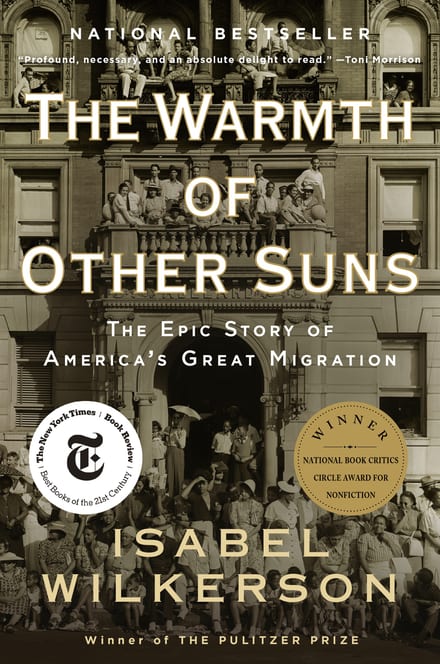
The Warmth of Other Suns: The Epic Story of America's Great Migration
The Epic Story of America's Great Migration
The full book runs ~640 pages — roughly 12 hours of reading. You get the key ideas here in 5 minutes.
The key ideas
- Read the Great Migration as an immigration: six million people leaving a caste system, 1915–1970.
- Follow the rail lines — Mississippi fed Chicago, Florida New York, Louisiana Los Angeles.
- Question the story that migrants broke northern cities; Wilkerson argues poverty was built around them.
- Note who actually left: Tolnay found the leavers had more schooling than the South they left.
- Expect containment, not welcome — the Clarks' Cicero apartment was emptied and the building burned.
- Ask what went unrecorded: many who left never spoke of the South to their own children.
The summary
Six million people left, and the country barely wrote it down. Between roughly 1915 and 1970, that many Black Americans walked away from the South for the North, the Midwest and the West, in a movement with no founding date and, for most of the twentieth century, no settled name. Isabel Wilkerson’s argument is that this was one of the great population shifts in American history, that the people who made it were immigrants in everything but the legal definition, and that missing this has warped the way Americans explain their own cities ever since.
The outline is a matter of record. Around 1900 roughly nine in ten African Americans lived in the South; by 1970, according to the Smithsonian’s National Museum of African American History and Culture, that share had fallen to about 53 percent. It moved in two waves — the first toward New York, Philadelphia, Chicago and Detroit around the First World War, the second running west after the Second, to Los Angeles, Seattle and Portland. Wilkerson gave fifteen years to the book and interviewed more than 1,200 people. Then she narrowed it to three.
An immigration nobody filed as one
Her framing is deliberately provocative. She calls the Great Migration a defection as much as a migration, and describes the people who made it as seeking political asylum from a caste system inside the borders of their own country. That is the load-bearing claim, and the rest of the book tests it. Immigrants leave a place that will not have them, travel at cost and risk, cluster on arrival, take the work available, and get blamed for the condition of the neighborhoods they are confined to. Every part of that pattern shows up here — except that these travelers never crossed a border, so the country filed them as a domestic problem rather than as a wave of arrivals.
The routes make the point. People did not scatter at random. They followed the rail lines, which is why Mississippi emptied into Chicago, Florida into New York, and Louisiana and Texas into Los Angeles. A movement with that much structure is not a drift. It is a decision, made six million times.
The sociology had the causation backwards
For decades the received story was that southern migrants brought their troubles with them and broke the northern cities — a reading often hung on Daniel Patrick Moynihan’s 1965 Labor Department report, whose fourth chapter was titled “The Tangle of Pathology.” Wilkerson’s case is that this reverses cause and effect, and she leans on demographers to make it. The sociologist Stewart Tolnay found that the migrants had more schooling than the southern Black population they left behind — the leavers, not the stayers. That edge was real but modest: Tolnay found they had less schooling than northern-born Black residents, and both gaps narrowed over the century.
What met them was not opportunity but containment. She describes a family named Clark moving into Cicero, Illinois, and a mob ransacking the apartment, throwing their belongings out the windows, and eventually burning the building down. Restricted to a few blocks, charged more rent for worse housing, shut out of the better work — that, on her reading, is where northern urban poverty actually came from. The migrants did not import it. They were sorted into it on arrival, and then held responsible for it.
What the leaving cost
Three lives carry all of this, and none of them is a clean escape story.
Ida Mae Brandon Gladney, a sharecropper’s wife, left Mississippi for Chicago in 1937 after her husband’s cousin was beaten nearly to death over a theft he had not committed. In Chicago her husband hauled ice up four and five flights of stairs before she found steady work as a hospital aide. George Swanson Starling was a strong student pulled out of school and into the citrus groves around Eustis, Florida; he began pressing the growers for better pay, and fled for his life in 1945, spending the rest of it working the railroads that carried other people north. Robert Joseph Pershing Foster left Monroe, Louisiana in 1953 and drove west across the desert alone because no motel along the way would take him. He became a Los Angeles surgeon whose patients came to include Ray Charles.
The North charged its own price. Wilkerson notes that Black residents already established in those cities often resented the new arrivals, the way settled immigrants close the door behind them. And the historical record thinned by choice: some who left never spoke of the South to their children, out of embarrassment or a refusal to look back, much as immigrant parents sometimes decline to pass on the old language. A movement she reckons larger than the Gold Rush went partly unrecorded because the people who made it preferred not to discuss it.
They remade the culture regardless. Wilkerson counts Toni Morrison, Miles Davis, Aretha Franklin, August Wilson, Prince and Tupac Shakur among the children of the Great Migration — artists whose work, she argues, is unreadable without it. The title itself comes from a passage in Richard Wright’s Black Boy, written by a man who had made the same trip out of Mississippi.
The bottom line
The Great Migration was an immigration story the United States declined to recognize as one, and Wilkerson’s central correction concerns blame: the people who left were, by the research she cites, more ambitious and better educated than the story told about them, and the poverty later pinned on them was largely built around them after they arrived. Six million private decisions, taken without anyone calling for them, reshaped American cities and American culture.
Read it if you want the twentieth century to make more sense than it currently does. Pair it with Caste, where Wilkerson gives a name to the system these three were running from.
Fact check
Popular books repeat findings that later research has complicated. Where The Warmth of Other Suns makes a testable claim, here's what the evidence actually shows.
About six million Black Americans left the South between roughly 1915 and 1970, a movement large enough to cut the South's share of the Black population from about 90 percent in 1900 to 53 percent by 1970.
The National Archives and the Smithsonian's National Museum of African American History and Culture both put the total at approximately six million between 1910 and 1970, and NMAAHC is where the 90-to-53-percent shift comes from. The number is an estimate rather than a count, and it moves with the window and the counting method: Brookings puts net out-migration over the same six decades nearer five million. Six million sits at the top of a 5–6 million range that no source contradicts, so the scale the book describes holds.
- U.S. National Archives and Records Administration. The Great Migration (1910-1970). archives.gov. Source
- Smithsonian National Museum of African American History and Culture. The Great Migration. Searchable Museum. Source
- Brookings Institution. A "New Great Migration" is bringing Black Americans back to the South. Source
Sociologist Stewart Tolnay found that the people who left the South were the most educated segment of the Black population they left behind, reflecting a general rule that harder, longer journeys select for the most driven migrants.
The education advantage is real and it is Tolnay's: his census-microdata study covering 1880 to 1990 found southern-born Black migrants had more schooling than the nonmigrants who stayed. The same study found they had less schooling than northern-born Black residents, and that both gaps narrowed substantially over the period, so the edge was sharpest early and thinned later. Economists working from linked census records reach a similarly qualified answer — Collins and Wanamaker's panel of more than 5,000 men matched between the 1910 and 1930 censuses found positive selection alongside large migrant gains, and their later study concluded the degree of selection was small and that participation in the migration was widespread. Migrants skewed upward without being an elite, and the broader "farther equals more driven" rule is not something these studies test.
- Tolnay SE. Educational Selection in the Migration of Southern Blacks, 1880-1990. Social Forces. 1998;77(2):487-514. Source
- Collins WJ, Wanamaker MH. Selection and Economic Gains in the Great Migration of African Americans: New Evidence from Linked Census Data. American Economic Journal: Applied Economics. 2014;6(1):220-52. Source
- Collins WJ, Wanamaker MH. The Great Migration in Black and White: New Evidence on the Selection and Sorting of Southern Migrants. NBER Working Paper 21384. July 2015. Source
In 1965 Daniel Patrick Moynihan described southern migrants as importing a "tangle of pathology" into the urban North.
The phrase, the author and the year are right: "The Tangle of Pathology" is the title of Chapter IV of Moynihan's March 1965 Labor Department report The Negro Family: The Case for National Action. The report does not describe migrants as importing it. Moynihan places the weakness of family structure at the center of the tangle and traces it to slavery, Reconstruction, urban conditions and unemployment, and the chapter ends by calling the result a world white America made. His chapter on causes does connect rural southern migrants to family breakdown up north, but through what the northern slum did to them after they arrived — quoting E. Franklin Frazier that poverty, ignorance and color forced those families into deteriorated areas from which institutional life had disappeared.
- Moynihan DP. The Negro Family: The Case for National Action. Chapter IV: The Tangle of Pathology. Office of Policy Planning and Research, U.S. Department of Labor, March 1965. Source
- Moynihan DP. The Negro Family: The Case for National Action. Chapter III: The Roots of the Problem. Office of Policy Planning and Research, U.S. Department of Labor, March 1965. Source
Northern Black urban poverty was largely built around the migrants after they arrived rather than carried north by them.
The quantitative work runs in the book's direction. Derenoncourt's study of the 1940-1970 migration found that Black arrivals reduced the long-run gains of growing up in the North for Black families and account for 27 percent of the region's racial upward-mobility gap today — and that the driver was how destination cities responded, through segregation, rising crime and policing, with negative selection of the migrants themselves ruled out. Boustan measured one channel of that response: each Black arrival in a northern city was followed by an estimated 2.7 white departures for the suburbs, and the tax base went with them. The mechanism these studies find sits in the destination, not in what the migrants brought.
- Derenoncourt E. Can You Move to Opportunity? Evidence from the Great Migration. American Economic Review. 2022;112(2):369-408. Source
- Boustan LP. Was Postwar Suburbanization "White Flight"? Evidence from the Black Migration. NBER Working Paper 13543. October 2007; published in Quarterly Journal of Economics. 2010;125(1):417-443. Source
Frequently asked questions
What is The Warmth of Other Suns about?
Between roughly 1915 and 1970, six million Black Americans left the South for the North, the Midwest and the West — a movement with no founding date and, for most of the century, no settled name. Isabel Wilkerson spent fifteen years on it and interviewed more than 1,200 people, then narrowed the book to three lives. Her argument is that this was an immigration in everything but the legal definition, and that missing it has warped the way Americans explain their own cities.
What are the key takeaways from The Warmth of Other Suns?
The movement had structure, not drift: people followed the rail lines, which is why Mississippi emptied into Chicago, Florida into New York, and Louisiana and Texas into Los Angeles. Wilkerson's central correction is about blame — the received story held that southern migrants broke the northern cities, and she cites demographers, including Stewart Tolnay's finding that the leavers had more schooling than the southern Black population they left behind, to argue the causation runs the other way. What met them was containment rather than opportunity: restricted to a few blocks, charged more rent for worse housing, shut out of better work. Three lives carry it — Ida Mae Brandon Gladney, George Swanson Starling and Robert Joseph Pershing Foster — and none is a clean escape story.
Who should read The Warmth of Other Suns?
Read it if you want the American twentieth century to make more sense than it currently does — especially how northern cities came to look the way they do. It pairs naturally with Wilkerson's later book Caste, which names the system these three were leaving.
Is The Warmth of Other Suns worth reading?
It's the standard account of the Great Migration for good reason: Wilkerson braids three full biographies through the research, so the argument arrives as lived experience rather than statistics. That structure makes it long, and readers who want a compact analytical history will find it takes its time. If you'd rather follow people than tables, that's exactly the point.