Book summary
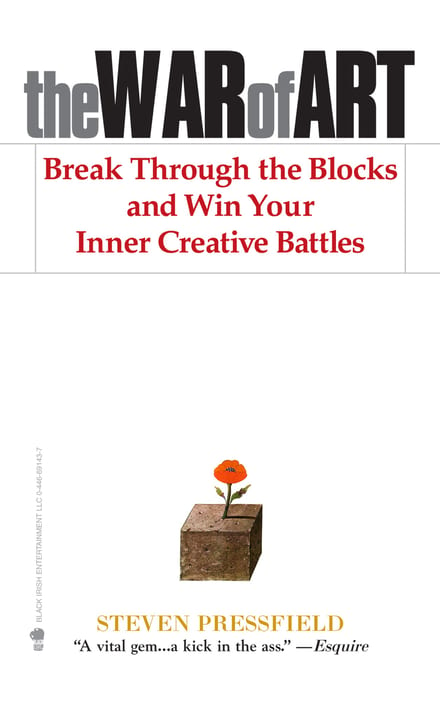
The War of Art: Winning the Inner Creative Battle
The full book runs ~192 pages — roughly 4 hours of reading. You get the key ideas here in 3 minutes.
The key ideas
- Name Resistance: procrastination, self-doubt, and fear defending the status quo.
- Follow your fear—terror signals the work that matters most.
- Turn pro: clock in daily whether inspired or not.
- Prioritize process over goals, and use criticism as fuel.
- Work for the craft itself, not applause or hierarchy.
- Commit fully to your territory to reach creative flow.
The summary
You already know the work you’re supposed to be doing. Steven Pressfield’s claim is that what stops you isn’t a shortage of talent, time, or ideas—it’s a single hidden force he names Resistance. It’s the negative, repelling energy that shows up as procrastination, self-doubt, fear, and endless rationalization, whispering “I’ll start eating healthy tomorrow” or “my dream is too risky, so I’ll stay in this job.” Resistance has one purpose: to shove you away from your work and keep everything comfortable and unchanged. It afflicts everyone, beginner and veteran alike, and it feeds on stagnation, defending the status quo at all costs.
Fear is a compass
The strange gift buried in all this is that Resistance is predictable. It pushes hardest against the work that matters most to you, which turns your fear into a navigational tool. If you keep asking yourself and your friends, “Am I really a writer? Am I really an artist?"—chances are you are, because the fake innovator is wildly self-confident while the real one is scared to death. As Pressfield puts it, fear, like self-doubt, is an indicator; the more frightened you are of a calling, the more certain you can be that you have to pursue it. It’s why many Hollywood actors deliberately chase roles that terrify them—the fear is the tell that they care. So instead of fleeing what scares you, follow it. The thing you’re avoiding is usually the thing you were meant to do.
Turn professional
Naming the enemy isn’t enough; you beat it by adopting the mindset of a professional. That has nothing to do with getting paid and everything to do with commitment: you treat your craft like a job you clock into every single day, inspired or not. “The most important thing about art is to work,” Pressfield writes. “Nothing else matters except sitting down every day and trying.” William Somerset Maugham said it with a wink: “I write only when inspiration strikes. Fortunately it strikes every morning at nine o’clock sharp.”
Consistency is what changes things. When you sit down and do the work day after day, power concentrates around you—you become like a magnetized rod pulling in iron filings, and ideas and insights start to accrue as the Muse takes note of your dedication and rewards it. Being a professional also means knowing your own abilities and limits and asking for help when you need it; even LeBron James and Tiger Woods, the best in their fields, still keep coaches. And it means loving the process rather than sprinting for the finish line. When Oprah Winfrey faced skepticism that a Black woman could break into a talk-show world run by white men, she held to her vision of drawing out her guests’ personal lives and used the criticism as fuel to work harder—and built one of the most successful shows ever made.
Claim your territory
The last obstacle is the hierarchy. Most of us spend our lives inside systems that hand us a role and reward us for pleasing others so we can climb, and those hierarchies resist change and smother creativity. The professional steps outside them, working for the craft itself rather than for an audience, a rank, or applause. As Rilke wrote, “the creative artist must be a world for himself, and find everything within himself.” You do the work for its own sake, not for fortune or attention.
To live that way, you need a territory—the domain where you pour yourself into your craft. Arnold Schwarzenegger’s was the gym; Alfred Hitchcock’s was filmmaking. A true territory gives you sustenance, a sense of satisfaction and growth; it’s where you spend most of your time and effort, and it rewards you in proportion to what you put in. Commit that deeply and you can drop into what Plato called “madness,” the state of being wholly absorbed in the creative flow—the one place Resistance can’t reach you. And the point isn’t self-indulgence. Your work is a gift to the world, so don’t cheat the rest of us out of what you have to give.
The bottom line
Fear and self-doubt aren’t proof you’re on the wrong path; they’re proof you care about something that matters, and Resistance always fights hardest at the door you most need to walk through. Beat it the only way that works—show up daily like a professional and do the work for its own sake. Read this if you’ve been circling a creative calling that scares you and need the enemy named clearly enough to start fighting back.
Frequently asked questions
What is The War of Art about?
Steven Pressfield's claim is that what stops you from doing your real work isn't a shortage of talent, time, or ideas, but a single hidden force he names Resistance, which shows up as procrastination, self-doubt, fear, and endless rationalization. Its one purpose is to shove you away from your work and keep everything comfortable and unchanged.
What are the key takeaways from The War of Art?
Fear is a compass, because Resistance pushes hardest against the work that matters most, so the thing that scares you is usually the thing you were meant to do. Turn professional by treating your craft like a job you clock into every day, inspired or not, since "nothing else matters except sitting down every day and trying." Consistency concentrates power around you and draws in ideas like a magnetized rod pulling iron filings. And claim your territory, doing the work for its own sake rather than for rank or applause, because your work is a gift to the world.
Who should read The War of Art?
Read it if you've been circling a creative calling that scares you and need the enemy named clearly enough to start fighting back.
Is The War of Art worth reading?
Its naming of Resistance is a durable, motivating lens, and the short, punchy sections make it easy to reach for when you're stuck. It's more rallying cry than method, heavy on conviction and anecdote and light on step-by-step process, so anyone wanting a concrete system may need to pair it with something else.