Book summary
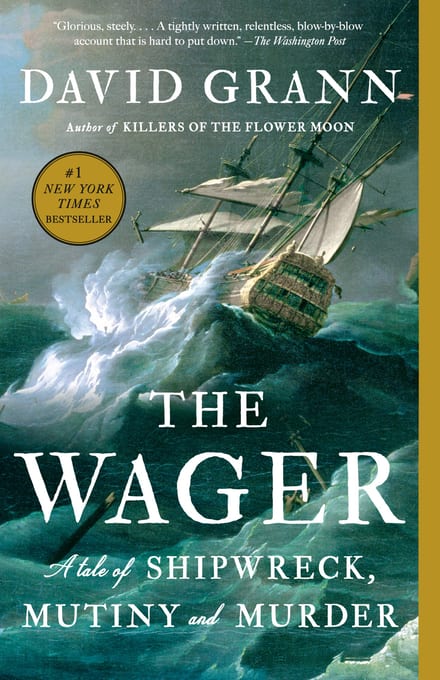
The Wager: A Tale of Shipwreck, Mutiny, and Murder
A Tale of Shipwreck, Mutiny, and Murder
The full book runs ~352 pages — roughly 6 hours of reading. You get the key ideas here in 6 minutes.
The key ideas
- Distrust the surviving account: Bulkeley published in 1743, three years before Cheap could answer.
- Look at what was loaded before sailing — press-ganged seamen and Chelsea invalid pensioners.
- Watch rank outlive its basis: Cheap kept commanding until he shot a midshipman in the face.
- Read the non-verdict — the 1746 court martial tried the loss of a ship and nothing else.
- Ask what an empire gains by looking away from its own officers' conduct.
- Notice the missing stories: John Duck survived the wreck, was sold into slavery, left no record.
The summary
The shipwreck is not the story. On January 28, 1742, thirty skeletal men drifted into an inlet off the Brazilian coast in a boat patched together from scraps of wood and cloth, and announced themselves as castaways from His Majesty’s Ship the Wager. They had last been seen 283 days earlier. England received them as heroes. Six months later three more survivors washed up in Chile, half naked and crawling with insects, carrying a different account: the men in Brazil were not heroes but mutineers.
Both parties were summoned before the Admiralty, where the punishment on the table was the yardarm. Grann’s interest is in what happened next. Having survived typhoons, scurvy and starvation, the men now had to survive each other’s version of events — as he put it to NPR, after waging a war against the elements they began to wage a war over the truth.
The disaster was loaded aboard before the ship sailed
The Wager left Portsmouth in September 1740 carrying some 250 officers and crew, one ship in a squadron of roughly two thousand men under Commodore George Anson. The mission was secret and frankly piratical: round Cape Horn and seize a Spanish treasure galleon that the Centurion’s chaplain called the most desirable prize on the globe. It was the War of Jenkins’ Ear, and Britain wanted silver.
The vessel was a bad joke — a tubby East Indiaman bought off the merchant trade, refitted as a sixth-rate of 28 guns, the lowest class of warship. Manning it was worse. Volunteers had run out, so press gangs kidnapped seamen off the streets. And in place of the regiment Anson expected, the Admiralty allotted his squadron five hundred invalid out-pensioners of Chelsea. Only 259 came aboard: everyone with the limbs and strength to walk out of Portsmouth deserted, leaving, in the official account’s words, only those who were literally invalids — most over sixty, some past seventy.
Grann builds this slowly, on purpose. By the time the Wager strikes rock off Patagonia on May 14, 1741, the catastrophe reads as something assembled on land by an empire in a hurry.
Rank was the last thing to sink
The castaways landed on a mountainous, rain-lashed island in what mariners called the Gulf of Sorrows. Grann went there himself, hiring a boat at Chiloé for the 350-mile run south; bundled in a winter coat he was still bone cold, and found almost nothing to eat but wild celery.
What interests him is that the hierarchy survived the ship. Captain David Cheap kept issuing orders as though the quarterdeck still existed, and for a while the men obeyed — they built an outpost, put up shelters, dug irrigation. Then Cheap shot Midshipman Henry Cozens in the cheek at point-blank range. Cozens lingered fourteen days and died in June 1741, and the gunner John Bulkeley treated the killing as the moment the captain’s authority forfeited itself. What provoked it was never settled: in Bulkeley’s account Cozens was unarmed and asking why a seaman’s wine allowance had been stopped, while naval historians writing from Cheap’s side called him a ringleader shot in open mutiny.
Grann is careful about class here. Cheap was himself a casualty of the system he enforced: a younger son who inherited nothing, dodged creditors, and went to sea at seventeen because there was nowhere else to go.
Whoever published first got to shape the record
In October 1741, eighty-one men left the island in a lengthened longboat they named the Speedwell. Thirty reached Brazil. Bulkeley and the carpenter John Cummins understood exactly what awaited them, and got their journal into print in London in 1743 — three years before Cheap and John Byron made it home. Bulkeley had written to the Admiralty first and been told the journal was his own and their Lordships would have nothing to do with it, which he noted was the point of asking: had he not, they might have blamed him. Their dedication is a small masterpiece of pre-emption: “We stand or fall by the Truth; if Truth will not support us, nothing can.”
Byron’s own Narrative did not appear until 1768; his grandson, the poet Lord Byron, later mined it for Don Juan.
Grann structures the book around this problem, shifting between the perspectives of Cheap, Bulkeley and Byron and letting the accounts contradict each other in the open. The gaps are exact: one officer conceded only that he had “proceeded to extremities,” while another witness described him shooting a seaman in the head. In an author’s note Grann declines to rule, leaving the verdict to the reader. Comparing the versions is how you watch a historical record get manufactured.
The empire had more to lose than the men did
The court martial convened in April 1746, and nobody was convicted of mutiny or murder — for the blunter reason that nobody was charged with either. When Bulkeley objected to giving a deposition while under arrest, the Admiralty’s marshal told him the court was only to know how the ship was lost. Everything after the wreck sat outside its remit. Lieutenant Robert Baynes was reprimanded for disobeying Cheap’s orders over the main-topsail and the anchor, then acquitted in light of his hardships, and that was the sum of it. Cheap and Bulkeley were both offered promotions; Bulkeley turned his down.
Grann’s reading of that non-verdict is the sharpest argument in the book. A real trial, he suggests, would have established on the record that the Navy’s officers — the supposed apostles of the Enlightenment — had degenerated into brutes on a beach, which was awkward for a country whose stated justification for conquest was the superiority of its civilization. Better, on his account, to look away. Anson, meanwhile, had taken the galleon Nuestra Señora de Covadonga in June 1743 and paraded the silver through London to cheering crowds, handing the Admiralty a much better story to tell.
Some stories never got told at all. Grann notes that John Duck, a free Black seaman on the Wager, survived the wreck and the castaway voyage only to be kidnapped and sold into slavery; there is no record of what happened to him. Near the end of the book Grann writes that empires preserve their power with the stories they tell, but just as much with the ones they don’t — “the dark silences they impose, the pages they tear out.”
The bottom line
Grann argues that the fight over what happened on Wager Island mattered more than what actually happened there, because the account that prevails becomes the past. The castaways understood that; so did the Admiralty, which is why the trial examined the loss of a ship and nothing else. Read it if you want a survival story that turns, halfway through, into an argument about who gets believed.
Fact check
Popular books repeat findings that later research has complicated. Where The Wager makes a testable claim, here's what the evidence actually shows.
The 1746 court martial convicted nobody of mutiny or murder, and the only censure was a reprimand for Lieutenant Robert Baynes over an unreported sighting of land.
The first half holds, for a blunter reason than "nobody was convicted": nobody was charged. When Bulkeley protested at being asked for a deposition while under arrest, the Admiralty's marshal told him the court was "only to know how the ship was lost" — everything after the wreck sat outside its remit. But the sentence Bulkeley reprinted in his own journal reprimands Baynes for disobeying Cheap's orders "by not setting the main-topsail, and letting go the anchor," then acquits him anyway "in regard to his hardships and misfortunes." The unreported land sighting turns up in later retellings of the trial rather than in the wording of the verdict.
- Bulkeley J (gunner of HMS Wager), Cummins J. A Voyage to the South Seas, in the Years 1740-1 (London, 1743; 1757 edition, which adds the author's account of the court martial and the narrative of Isaac Morris). Source
- Royal Geographical Society of South Australia, Heritage Treasures: "Bulkeley and Cummins - loss of HMS Wager, 1743". Source
Bulkeley and Cummins put their journal into print in 1743 without the Admiralty's approval, getting their account out two years ahead of Cheap and Byron.
They did publish first, and it did shape the record — but not in defiance. Bulkeley wrote to the Admiralty before selling the manuscript and was answered that "the journal was our own, and their Lordships would have nothing to do with it, so you may do as you will with it"; he added that had he not asked leave, "they might have blamed me." Modern editors describe the book as appearing with the Admiralty's tacit permission. The head start was also nearer three years than two — the journal was out in 1743, and Cheap and Byron did not reach England until 1746.
- Bulkeley J (gunner of HMS Wager), Cummins J. A Voyage to the South Seas, in the Years 1740-1 (London, 1743; 1757 edition), letter to the Lords of the Admiralty and their reply. Source
- Gurney A (intro.). The Loss of the Wager: The Narratives of John Bulkeley and the Hon. John Byron. Woodbridge: Boydell & Brewer, 2004 - Epilogue. Source
Captain Cheap shot Midshipman Henry Cozens in the face at point-blank range, refused him proper care, and Cozens died of the wound.
Bulkeley's journal has Cheap "clapped a pistol to Mr. Cozens's cheek, and precipitately shot him, without asking any questions"; the surgeon then refused to dress the wound, and Cheap refused to let Cozens be moved out of the sick tent, saying that if he lived he would hang him. The one thing the summary compresses is time — Cozens died on 24 June 1741 "after languishing fourteen days with the wound he had received in his cheek," not at the scene. What is genuinely contested is the provocation: Bulkeley describes an unarmed man asking why another seaman's wine allowance had been stopped, while naval historians writing from Cheap's side, Clowes among them, called Cozens a ringleader shot in open mutiny.
- Bulkeley J (gunner of HMS Wager), Cummins J. A Voyage to the South Seas, in the Years 1740-1 (London, 1743; 1757 edition), journal entries for 10-24 June 1741. Source
- Clowes WL. The Royal Navy: A History from the Earliest Times to the Present, vol. III. London: S. Low, Marston (1897-1903), pp. 321-322. Source
John Duck, a free Black seaman from the Wager, survived the wreck and the boat voyage only to be sold into slavery, with no record of what became of him.
The source is Isaac Morris's narrative, printed with later editions of Bulkeley's journal. Duck was one of eight men the boat party left behind on the South American coast weeks before it reached Brazil; after the group was taken in by Indigenous horsemen, all of them moved on "except John Duck, whose misfortune it was to be too near of a complexion with those Indians (for he was a mulatto, born in London)," and the chief sold him to a master further inland, with "no prospect of his ever returning to England." Bulkeley's own list of the eight names him and gives his birthplace as London. Three of that group eventually reached England and told the story; nothing further about Duck appears in the record.
- Morris I. A Narrative of the Distresses of Eight of the Crew of the Long Boat, who were left on the Coast of Patagonia, printed with Bulkeley J, Cummins J, A Voyage to the South Seas (1757 edition). Source
Frequently asked questions
What is The Wager about?
In 1740 HMS Wager sailed from Portsmouth as part of a British squadron sent to round Cape Horn and capture a Spanish treasure galleon. She struck rock off Patagonia in May 1741, and the survivors came home in two groups carrying stories that could not both be true — one side arrived as heroes, the other named them mutineers. David Grann tells the wreck and the castaway months, then turns to the fight that followed over which account the Admiralty would believe.
What are the key takeaways from The Wager?
The catastrophe was assembled on land before the ship sailed: a converted merchant vessel, crew taken by press gangs, and five hundred invalid pensioners rounded up from a Chelsea hospital. On the island, rank outlasted the ship — Captain Cheap kept issuing orders until he shot Midshipman Henry Cozens at point-blank range, which the gunner John Bulkeley treated as the moment his authority ended. Getting to print first turned out to be the decisive move: Bulkeley and John Cummins published their journal in 1743, two years before Cheap and John Byron made it home. The 1746 court martial convicted nobody of mutiny or murder and examined only the loss of the ship.
Who should read The Wager?
It suits readers who want a survival story that turns, halfway through, into an argument about who gets believed — and anyone curious about how an official record gets manufactured rather than discovered.
Is The Wager worth reading?
Yes, if you like narrative history built on primary documents; Grann shifts between Cheap, Bulkeley and Byron and lets their accounts contradict each other in the open, which is the most interesting thing in the book. He also declines to rule on what really happened, leaving the verdict to the reader — bracing if you enjoy the ambiguity, frustrating if you wanted a judgment. The opening moves slowly on purpose, laying out the ship, the crew and the mission long before the wreck.