Book summary
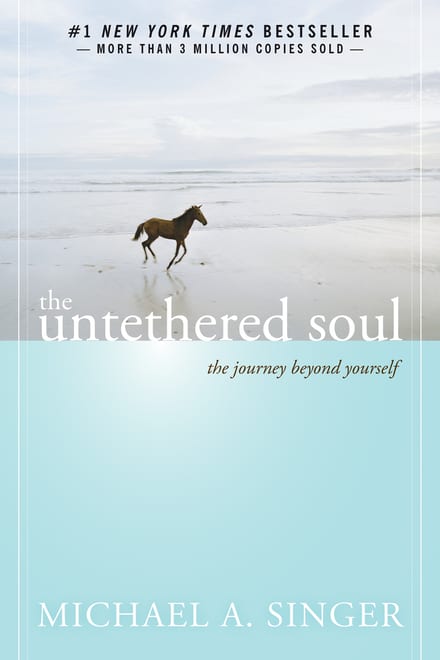
The Untethered Soul: The Journey Beyond Yourself
The full book runs ~200 pages — roughly 4 hours of reading. You get the key ideas here in 3 minutes.
The key ideas
- Disidentify from your inner narrator and watch it instead
- Stay open when triggered; let painful energy pass through
- Pull out psychological thorns rather than building defenses around them
- Treat every disturbance as a chance to let go
- Choose unconditional happiness independent of circumstances
- Stop resisting reality; live in the peaceful center
The summary
You are not the voice in your head. You are the one who hears it. Michael Singer builds his entire book on that single distinction. Most of us go through life fused to an inner narrator that never stops — second-guessing, rehearsing, replaying, judging — and we assume that running commentary is who we are. It isn’t. The real you is the awareness underneath, the consciousness that notices the chatter. Once you can hear the voice as something separate from yourself, you can stop letting it run your life.
You are the one who hears the voice
Singer offers a simple test: imagine your inner voice as a person sitting beside you, saying aloud everything it says inside. It would sound neurotic, contradictory, and exhausting — a roommate you’d never choose to live with. Yet you tolerate it internally because it offers a kind of false comfort. Narrating and judging the world gives you the illusion of control and a buffer against experiencing reality directly. That buffer is the trap. The voice isn’t keeping you safe; it’s keeping you locked inside your head, cut off from actually being alive. The same continuous awareness that hears it today, Singer notes, is the one you’ve had since childhood, unchanged beneath every passing thought and mood.
Pull out the thorn
Most people organize their whole lives around avoiding their psychological sore spots. Singer calls these thorns. If a criticism at work stings, you build elaborate defenses so it can never happen again; if deep loneliness sits at your center, you lean on a relationship to cover it, and then your energy goes to managing that wound instead of genuinely connecting. His image is exact: pull a thorn out and you’re free, but leave it in and “you will end up responsible for both the thorn and everything you pulled around yourself in an attempt to avoid it.” The whole apparatus of avoidance becomes a second problem stacked on the first.
Pulling the thorn means staying open at the exact moment you want to slam shut. When rejection lands or old shame flares, your instinct is to contract and protect. Do the opposite — relax, and let the painful feeling move through you. It’s just energy, temporary and impersonal, and if you don’t resist it, it burns off; resist it and you become its permanent caretaker. Singer points to how a depressed person too drained to leave bed can flood with energy the instant an estranged lover calls to apologize. The energy was never gone. It gets blocked when you close and flows when you open.
Every disturbance is a chance to let go
From there, ordinary irritations become practice. A coworker keeps taking your pencil; your mind wants to build a courtroom drama about respect, or you can treat the small sting as a chance to notice the reaction and decline to feed it. The point isn’t to purge problems from your life but to stop letting them drag your consciousness into a distorted, reactive place. Your personality, Singer argues, is a fortress built around a core of pain, and what people call enlightenment is simply what happens when you stop maintaining the walls and let life take them down. When reality contradicts your model of how things should be, don’t rush to patch the model — let the disturbance break it open.
This is the path of nonresistance. Stress, in Singer’s reading, doesn’t come from events but from resisting events. A leaf drops into a still lake and sends out ripples; fighting something that has already happened is as futile as trying to stop those ripples after the fact. “It is not life’s events that are causing problems or stress. It is your resistance to life’s events.”
The choice, death, and the middle way
The boldest claim in the book is also the simplest: “If you decide that you’re going to be happy from now on for the rest of your life, you will not only be happy, you will become enlightened.” It sounds glib until you actually try it. Miss a flight, find a fresh dent in your car, and refuse to break your vow to enjoy life anyway; external events don’t dictate your inner state unless you hand them the power. Death sharpens the same lesson. Told you had a week left, you’d find the feeling of rain on your face precious — not because the rain changed, but because urgency burns off the pettiness. Death, Singer writes, “helps you get your life back by making you pay attention to the moment.” His closing image is the Tao, the peaceful center between extremes: like a sailboat trimmed between wind and sail, you navigate best without grasping too tightly or drifting too loosely, letting go of the ego’s demands and opening upward into something larger — the heart of real spiritual growth.
The bottom line
You are the awareness behind your thoughts, not the thoughts themselves, and freedom comes from staying open when life presses on your wounds rather than spending your days defending them. Let the energy pass, stop resisting what’s already happened, and choose your inner state instead of outsourcing it to circumstances. Read this if you’re tired of being run by the voice in your head and want a direct, unsentimental path out of the cage it builds.
Frequently asked questions
What is The Untethered Soul about?
Michael Singer builds the whole book on one distinction: you are not the voice in your head, you are the one who hears it. The real you is the awareness underneath the constant mental chatter, and once you can hear the voice as something separate from yourself, you can stop letting it run your life.
What are the key takeaways from The Untethered Soul?
You are the one who hears the voice, and its endless narrating and judging offers false comfort while keeping you locked in your head. Pull out the thorn: stop organizing your life around avoiding your sore spots, and stay open at the exact moment you want to slam shut so the painful energy can move through you. Every disturbance becomes a chance to let go, since stress comes from resisting events, not the events themselves. And you can choose your inner state, deciding to be happy and refusing to hand external events the power over how you feel.
Who should read The Untethered Soul?
Read it if you're tired of being run by the voice in your head and want a direct, unsentimental path out of the cage it builds.
Is The Untethered Soul worth reading?
It reduces a lot of spiritual teaching to a few sharp, testable moves, notice the voice, relax and open, stop resisting, that you can try immediately. Its boldest claims, like deciding to be happy for the rest of your life, can feel glib until you actually try them, so anyone wanting research or step-by-step technique rather than reframing may want more.