Book summary
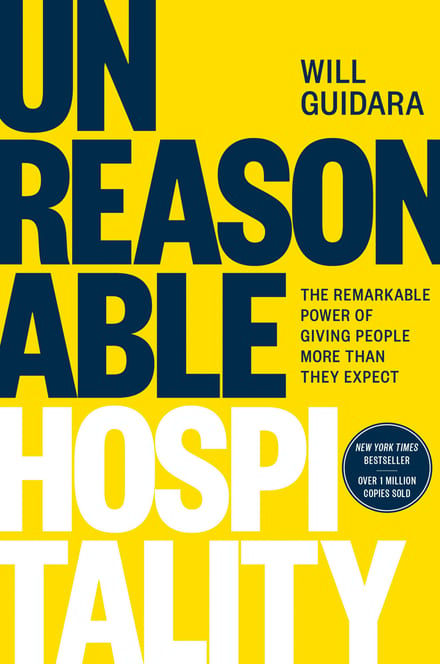
Unreasonable Hospitality: The Remarkable Power of Giving People More Than They Expect
The Remarkable Power of Giving People More Than They Expect
The full book runs ~288 pages — roughly 5 hours of reading. You get the key ideas here in 5 minutes.
The key ideas
- Separate the disciplines: competence gets you on the list, feeling gets you first.
- Fund the gestures with 95/5 — run the money tight, then spend on purpose.
- Remember one size fits one: a two-dollar hot dog beat champagne and caviar.
- Hire for it — dream weavers whose job is making other people's ideas happen.
- Let the team design what it delivers; people sell harder what they invented.
- Expect the bill: he grants that perfectionism makes trusting people hard.
The summary
Fine dining has long celebrated chefs for being unreasonable about food. Will Guidara’s bet was that nobody had tried being just as unreasonable about how a meal makes you feel.
The bet came out of a humiliation. At the 2010 World’s 50 Best Restaurants awards in London, Eleven Madison Park entered at number fifty — dead last, and called first, so Guidara and chef-partner Daniel Humm learned their faces were on a thirty-foot screen only after the room watched them slump. Over a bottle of bourbon on their hotel steps they reached the real problem: the restaurant was excellent and had changed nothing. On a cocktail napkin they wrote that they would be number one in the world, and before he slept Guidara added two words: unreasonable hospitality. In 2017 they got there.
Service is black and white; hospitality is color
Guidara used to ask job candidates the difference between service and hospitality. The best answer he ever got came from a woman he didn’t hire: “Service is black and white; hospitality is color.”
Black and white, in his gloss, is doing your job with competence and efficiency; color is making someone feel great about the job you did. Getting the right plate to the right person at the right table is service; making a real connection with them is hospitality. Most businesses, on his account, invest hard in the first and leave the human behind, so focused on their products that they forget about people. Excellence in the black and white got Eleven Madison Park onto the list; going Technicolor, as he puts it, got them to number one. And he thinks it generalizes: on his numbers, more than three-quarters of US GDP comes from service industries, so you are already in the business of serving people.
The two-dollar hot dog
In early 2010, during a busy lunch, Guidara was clearing plates from four food obsessives heading to the airport. He overheard them totting up the trip — Per Se, Le Bernardin, Daniel, Momofuku, now Eleven Madison Park — until one said the only thing they never got to try was a New York City hot dog.
He dropped the plates in the kitchen, ran down the block to the hot dog cart, then had to talk his chef into serving a dirty water dog in a four-star dining room. The chef cut it into four pieces, each with a swish of ketchup and mustard, a quenelle of sauerkraut and one of relish. It went out just before the final savory course, a honey-lavender glazed duck dry-aged two weeks, introduced as insurance against going home with any culinary regrets.
Nothing he ever served got a better reaction, he says; each guest called it the highlight of the trip. He worked out three conditions behind it. Being present — caring about the person in front of you enough to stop caring about your to-do list, since a throwaway line is all you get. Taking the work seriously without taking yourself too seriously, because a hot dog in that room was sacrilege and worked anyway. And one size fits one: vintage champagne and a bucket of caviar wouldn’t have come close, he reckons, because they wouldn’t have been about them.
The 95/5 rule buys the permission
A good instinct is not yet a system. Hence his rule of 95/5: run the money like a fanatic 95 percent of the time so the last 5 percent can go out the door “foolishly” — his scare quotes, since he considers that 5 percent the most deliberate spending of all.
The 95 percent is unglamorous: overtime, turnover, disposables, payroll, every penny. The 5 percent pays for what no spreadsheet would sign off, and they hired for it — dream weavers, whose whole job was helping everyone else get their ideas made. A family from Spain whose children were watching their first-ever snow through the windows left to find a chauffeur-driven SUV waiting to take them to Central Park, because a dream weaver had found a store still selling sleds at eight on a Friday night.
The budget, he insists, is not the constraint. The hot dog cost two dollars.
One size fits one applies to your own team
None of this works from the outside in, he argues: frontline staff will not manufacture warmth they are not receiving. He built an organization where everyone started at the bottom and promotion came from within, so he hired almost nobody for experience — he wanted integrity, curiosity and appetite for work: connection over perfection.
Then he handed the experience over. His claim is that inviting the team to design what they deliver turns salespeople into product designers — he has never met anyone who won’t sell harder something they helped design. He leads on vulnerability for the same reason: nobody would admit to disliking an ingredient on the new tasting menu until he confessed that he hates sea urchin and doesn’t like oysters. Out came the celery and the beets.
He is candid about the cost. He calls himself a lifelong perfectionist — he remakes a bed his wife already made, reparks a car she left crooked — and grants that perfectionism makes trust hard, because people are inherently imperfect. His remedy is self-awareness, plus relationships close enough that someone tells you when it lapses. He and Humm had bought the restaurant from Danny Meyer’s Union Square Hospitality Group in 2011; the partnership ended with Humm taking sole ownership — July 2019 on the World’s 50 Best record, the beginning of 2020 by Guidara’s own account.
The bottom line
Guidara’s case is that the thing every company files under personality — how people feel after dealing with you — is a discipline, with a budget line, a job description and a hiring standard behind it. The stories are what you’ll remember; the structure under them is what you’d copy. Read it if your team delivers competently and forgettably, or if the sentence we could never justify that is making more of your decisions than it deserves.
Fact check
Popular books repeat findings that later research has complicated. Where Unreasonable Hospitality makes a testable claim, here's what the evidence actually shows.
More than three-quarters of US GDP now comes from service industries, so almost every business is in the business of serving people.
The World Bank's national-accounts series puts services value added at 76.6% of US GDP in 2019, 77.0% in 2020 and 76.3% in 2021, the last year in the series — so "more than three-quarters" is right, and has been steady at that level since at least 2015. The definition behind the number is broad: it counts public administration and defence, education, and health and social work alongside retail, transport, finance and real estate, so government services are inside the three-quarters, not outside it.
- World Bank, World Development Indicators. Services, value added (% of GDP), United States (indicator NV.SRV.TOTL.ZS): 76.4% (2015), 77.0% (2016), 76.5% (2017), 76.3% (2018), 76.6% (2019), 77.0% (2020), 76.3% (2021). Source
- World Bank, World Development Indicators. Indicator metadata for Services, value added (% of GDP) (NV.SRV.TOTL.ZS): services industries correspond to ISIC Rev. 4 divisions 45-99, including wholesale and retail trade, hotels and restaurants, transport, financial intermediation, real estate, public administration and defence, education, and health and social work. Source
Investing in how customers feel, rather than only in serving them competently, shows up in business results.
The association is real and large where Guidara puts most of his weight, and small where a CFO would look. A meta-analysis of 535 correlations from 245 studies (combined sample about 1.16 million) found customer satisfaction correlates strongly with word of mouth (r = 0.68) and retention (r = 0.60), but only weakly with profit (r = 0.10), sales (r = 0.15) and stock returns (r = 0.08), and not measurably with market share (r = 0.05, not significant). An earlier meta-analysis of 251 correlations from 96 studies put the average satisfaction-to-performance correlation at r = .101, reaching r = .349 only under the most favourable combination of setting and measures. One caution on the retention figure: it falls from r = 0.65 when retention is measured as stated intention to r = 0.21 when it is measured as actual behaviour.
- Mittal V, Han K, Frennea C, Blut M, Shaik M, Bosukonda N, Sridhar S. Customer satisfaction, loyalty behaviors, and firm financial performance: what 40 years of research tells us. Mark Lett. 2023;34:171-187. Source
- Otto AS, Szymanski DM, Varadarajan R. Customer satisfaction and firm performance: insights from over a quarter century of empirical research. J Acad Mark Sci. 2020;48:543-564. Source
One size fits one: a cheap gesture aimed at the specific person in front of you lands harder than a lavish generic one, because what registers is the thought behind it.
The cost half holds up well. Across three studies, givers expected appreciation to rise with what they spent — assuming a pricier gift reads as more thoughtful — while recipients reported no relationship at all between a gift's price and how much they appreciated it. The thoughtfulness half is more conditional: four experiments found a giver's thought raised recipients' appreciation only when something prompted them to consider it, such as a friend giving a bad gift, and givers systematically mispredicted when it would count. Thought did register reliably for the giver, increasing their own sense of connection — which fits Guidara's other argument, that the team enjoys these gestures as much as the guests.
- Flynn FJ, Adams GS. Money can't buy love: Asymmetric beliefs about gift price and feelings of appreciation. J Exp Soc Psychol. 2009;45(2):404-409. Source
- Zhang Y, Epley N. Exaggerated, mispredicted, and misplaced: when "it's the thought that counts" in gift exchanges. J Exp Psychol Gen. 2012;141(4):667-81. PubMed
Frequently asked questions
What is Unreasonable Hospitality about?
Will Guidara's argument that hospitality is a discipline rather than a personality trait, and that it is the widest open lane in business. Service, on his account, is doing your job well; hospitality is how the delivery makes someone feel. The book runs on his years at Eleven Madison Park, which went from the bottom of the World's 50 Best Restaurants list to the top of it, and on the systems he built to make extravagant gestures ordinary.
What are the key takeaways from Unreasonable Hospitality?
Separate service from hospitality and invest in the second as deliberately as you invest in the first. Build the permission structure before the gestures: his 95/5 rule is to manage money tightly ninety-five percent of the time so the remaining five can be spent on things no spreadsheet would approve. One size fits one — a gesture works because it is about that specific person, which is why a two-dollar hot dog beat vintage champagne. And hand the design of the experience to the team delivering it, because people sell harder what they helped invent.
Who should read Unreasonable Hospitality?
Anyone whose team delivers competently and forgettably, and anyone who leads people in a service business — which, given that services are more than three-quarters of US GDP, is most people. Restaurant experience is not required.
Is Unreasonable Hospitality worth reading?
Yes, and the reason is the plumbing rather than the anecdotes. The stories are what get quoted, but the useful part is the budget rule, the dream-weaver roles and the hiring standard that make the stories repeatable. The caveat is that it comes out of fine dining, where a single guest is worth a lot, so translating the ideas to a lower-margin business takes work the book doesn't do for you.