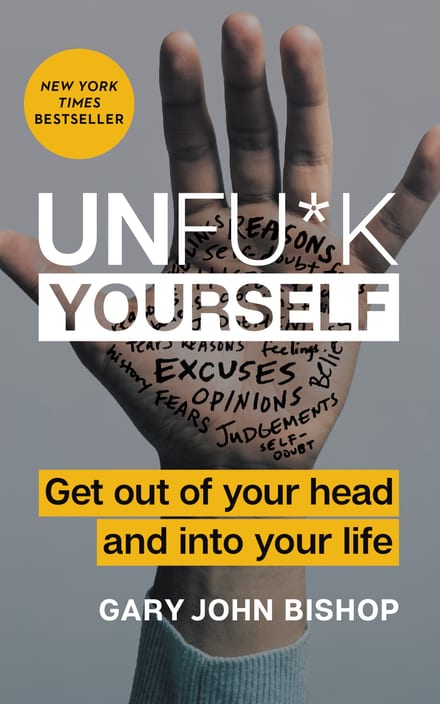
Book summary
Unfu*k Yourself: Get Out of Your Head and Into Your Life
The full book runs ~224 pages — roughly 4 hours of reading. You get the key ideas here in 4 minutes.
The key ideas
- Recognize your subconscious autopilot keeps confirming old limiting beliefs.
- Rewire your brain with present-tense self-talk: 'I am,' not 'I will.'
- Ask what you're willing to do, not what you want.
- Embrace uncertainty; control what you can, accept the rest.
- Act despite your thoughts—doing shifts thinking, not the reverse.
- Be relentless while expecting nothing and accepting everything.
The summary
Your subconscious is already winning. That’s the unsettling premise beneath the whole book: roughly 95% of your daily behavior runs on autopilot, and that autopilot is quietly succeeding at proving whatever you deep down believe about yourself. If the belief is that you’re unworthy of love or bound to fail, then the doomed relationship and the abandoned project aren’t accidents — they’re wins for the story you absorbed in childhood, playing out exactly as programmed. The way out isn’t more thinking. It’s blunt, present-tense self-talk and action taken before you feel ready.
Your internal monologue runs the show
You have more than fifty thousand thoughts a day, and each one wears a groove into your neural pathways like water cutting rock. How you describe your circumstances, studies show, shapes how you actually experience them. Positive self-talk measurably lifts mood, confidence, and productivity; negative self-talk does the reverse, inflating small problems into huge ones and even manufacturing problems that weren’t there. Left unchecked, that inner voice can leave you feeling helpless and stuck.
The lever is neuroplasticity — through deliberate language you can physically rewire the brain. But the tense matters. Say “I am relentless,” not “I will be relentless.” The first intervenes in this moment of your life; the second is just a description of a future you’re not living in yet. Present-tense, assertive language lands with real physiological and psychological force right now, which is the only place change ever happens.
You have the life you’re willing to put up with
Stop asking what you want and start asking what you’re willing to do. Are you willing to go to the gym? To work on the project you’ve been dodging? To face the social fears you keep avoiding? Framing choices around willingness, rather than vague desire, cuts through your self-imposed barriers and forces clarity. It also demands full ownership: you accept 100% responsibility for how you respond to circumstances instead of blaming outside forces. The life you have is precisely the one you’ve been willing to tolerate, and it changes only when you become unwilling to keep tolerating it.
When problems pile into a single overwhelming mass, take them one at a time — give each the attention it needs, then move on. And when you can’t find the solution, it’s often because you’re standing too close to the problem. Zoom out, way out. Psychologists call this cognitive restructuring: shifting how a problem presents itself changes what you can do about it. Socrates said that if everyone threw their misfortunes into a common pile and had to take an equal share, most people would gladly grab their own back and leave. Set against the wider world, your troubles are usually smaller than they feel.
Embrace uncertainty and act anyway
The craving for certainty once kept our ancestors alive; now it mostly keeps us small. True certainty is an illusion, and uncertainty is exactly where growth, new experience, and unprecedented results come from. Focus on what you can control, accept what you can’t, and both your stress and your results improve.
You are what you do, not what you think. You can’t reliably control your thoughts, and those thoughts aren’t always aligned with what’s good for your life, health, finances, or potential anyway. Success comes from acting despite your feelings, not from waiting for the perfect mindset to arrive. And the order runs opposite to how it feels: taking action moves you forward and gradually reshapes your thinking, because being fully absorbed in doing something quiets the negative chatter and builds real confidence through experience. You change your life by doing, not by thinking about doing.
Be relentless, expect nothing
Relentlessness means pressing forward through obstacles, doubt, and apparent lack of progress. Every meaningful success — starting a business, running a marathon, finding love — comes from stepping outside your comfort zone. Arnold Schwarzenegger was born into a poor Austrian family who thought his dream of acting in America was impossible; he pursued it relentlessly and methodically anyway. The only real limits, Bishop insists, are the ones you agree to accept.
At the same time, expect nothing and accept everything. Expectations open a gap between how things “should” be and how they are, and into that gap pour disappointment, resentment, and lost personal power. Growing pains at a new job aren’t a sign something’s wrong — of course a new role takes adjustment — and seeing that dissolves the expectation on the spot. Most worry, after all, is just trying to predict the future and then refusing to accept it when it doesn’t cooperate. Love the life you have, not the one you expected to have.
Bishop distills the whole approach into seven personal assertions:
- “I am willing.”
- “I am wired to win.”
- “I got this.”
- “I embrace the uncertainty.”
- “I am not my thoughts; I am what I do.”
- “I am relentless.”
- “I expect nothing and accept everything.”
The bottom line
Your subconscious is already succeeding at whatever it quietly believes about you, which is why the same failures keep recurring. Change comes from present-tense language and from moving before the mood arrives — never from waiting to feel ready. Read this if you’re stuck in a loop and tired of your own excuses.
Fact check
Popular books repeat findings that later research has complicated. Where Unfu*k Yourself makes a testable claim, here's what the evidence actually shows.
You have more than fifty thousand thoughts a day.
The only attempt to measure thought onsets directly puts the number roughly an order of magnitude lower. Tseng and Poppenk identified brain meta-state transitions that mark the start of a new thought and found a median rate of about 6.5 per minute across movie-viewing and rest, which they extrapolated to "over six thousand daily thoughts" for young adults after subtracting eight hours of sleep. The authors call even that estimate tentative. The book's actual point — that the inner monologue runs constantly and grooves itself in — does not depend on the tally.
- Tseng J, Poppenk J. Brain meta-state transitions demarcate thoughts across task contexts exposing the mental noise of trait neuroticism. Nat Commun. 2020;11(1):3480. PubMed
Repeating present-tense positive self-statements such as "I am relentless" measurably lifts mood, confidence and productivity.
Repeating a positive self-statement helped people who already had high self-esteem, and to a limited degree — but it left people with low self-esteem feeling worse than those who said nothing, which is the group the technique is pitched at. Self-talk does have a real performance record in a narrower setting: a meta-analysis of 32 studies yielding 62 effect sizes found a moderate benefit (ES = 0.48), strongest for instructional cues on novel, fine-motor tasks rather than motivational statements about identity. The tool works, but in a tighter band than the blanket promise.
Deliberate language physically rewires the brain through neuroplasticity.
Affirmation does register in the brain, but as activation during the task rather than as structural rewiring. Participants who reflected on future-oriented core values showed increased activity in self-processing regions (medial prefrontal and posterior cingulate cortex) and valuation regions (ventral striatum and ventromedial prefrontal cortex), and that activity predicted later reductions in sedentary behavior. Two gaps matter for the book's version: the affirmation was reflection on personal values, not repetition of a phrase like "I am relentless," and no structural change was measured.
- Cascio CN, O'Donnell MB, Tinney FJ, et al. Self-affirmation activates brain systems associated with self-related processing and reward and is reinforced by future orientation. Soc Cogn Affect Neurosci. 2016;11(4):621-629. PubMed
Frequently asked questions
What is Unfu*k Yourself about?
The unsettling premise is that roughly 95% of your daily behavior runs on autopilot, and that autopilot is quietly succeeding at proving whatever you deep down believe about yourself, which is why the same failures keep recurring. Gary John Bishop's way out isn't more thinking but blunt, present-tense self-talk and action taken before you feel ready.
What are the key takeaways from Unfu*k Yourself?
Your internal monologue runs the show, and through deliberate language and neuroplasticity you can rewire the brain, so say "I am relentless," not "I will be relentless." You have the life you're willing to put up with, so ask what you're willing to do rather than what you want, and take 100% responsibility. You are what you do, not what you think, and action reshapes your thinking rather than the other way round. Embrace uncertainty, be relentless, and expect nothing while accepting everything, captured in Bishop's seven assertions like "I am willing" and "I am wired to win."
Who should read Unfu*k Yourself?
Read it if you're stuck in a loop and tired of your own excuses, and you want a push to move before the mood to move ever arrives.
Is Unfu*k Yourself worth reading?
Its strength is the sharp, unsentimental reframe that taking action moves you forward and gradually reshapes your thinking, backed by simple present-tense mantras you can use right now. It leans on tough-love repetition and light science, so anyone wanting deep nuance or gentle handling may want something else.