Book summary
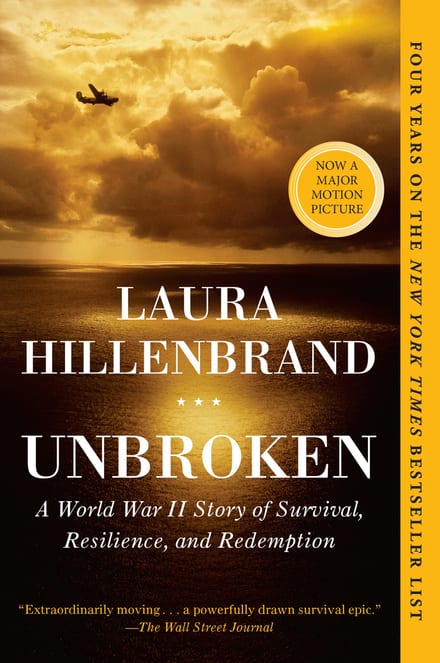
Unbroken: A World War II Story of Survival, Resilience, and Redemption
A World War II Story of Survival, Resilience, and Redemption
The full book runs ~500 pages — roughly 9 hours of reading. You get the key ideas here in 5 minutes.
The key ideas
- A Torrance pie thief became the fastest high school miler in America.
- Forty-seven days adrift on albatross, shark liver, and rain caught in canvas.
- Mac ate all the chocolate, imagined no future, and died on day thirty-three.
- Watanabe, denied an officer's rank, spent two years trying to break one prisoner.
- Stolen sugar and sabotage preserved dignity, and dignity kept men breathing.
- Postwar he planned to murder his guard; instead he shook his hand.
The summary
Naoetsu prison camp, summer 1945. A sergeant the prisoners called the Bird handed Louie Zamperini a six-foot wooden beam, ordered him to hold it overhead, and posted a guard to club him if his arms dropped. Louie’s arms went numb and his thoughts came apart until one sentence was left in him: He cannot break me. When Watanabe finally knocked him down, another prisoner checked the camp clock. Thirty-seven minutes.
The delinquent’s stubbornness turned out to be the useful part
Louie grew up in Torrance stealing pies off bakery cooling racks, telling stories that all ended the same way: “…and then I ran like mad.” His brother Pete talked the principal into letting him onto the track team, then rode a bicycle behind him with a stick.
At seventeen Louie ran a 4:21.3 mile, a national high school record that stood for nineteen years. At nineteen he was in Berlin, far too green for the 5,000 meters, and finished eighth — but he closed his last lap in 56 seconds, when the era’s best milers rarely broke 58. Hitler leaned down from his box: “Ah, you’re the boy with the fast finish.” The 1940 Games were canceled; Louie became a B-24 bombardier instead.
Hope decided who lived and who died
On May 27, 1943, a worn-out bomber called Green Hornet lost an engine on a search mission and fell into the Pacific. Three of eleven men surfaced: Louie, pilot Russell Allen Phillips, and tail gunner Francis McNamara. They had two rafts, a few tins of water, a flare gun, and several chocolate bars — which Mac, panicking, ate in a single night.
They drifted two thousand miles in forty-seven days. Louie caught albatrosses by hand, hauled small sharks aboard by the tail for their livers, and patched the rafts with the cut edge of a signal mirror after a Japanese bomber left forty-eight holes in the rubber.
But what Hillenbrand keeps returning to isn’t the fishing. Louie and Phil quizzed each other for hours on their childhoods and cooked his mother’s spaghetti aloud in such detail that the others corrected him when he skipped an ingredient. Mac barely spoke; he couldn’t picture a future. He died on the thirty-third day, though not before beating two sharks off the raft and saving Louie’s life. Same crash, same rations. The two men who could imagine going home went home.
Dignity is as necessary as water
Capture was worse than the ocean. On Kwajalein — Execution Island — Louie lay in a cell where nine marines had carved their names before being killed, and was injected four times with an unidentified solution while aides clicked stopwatches. Then Ofuna, a secret camp on no Red Cross roster, where captives were told flatly: “They can kill you here. No one knows you’re alive.” Then Omori, and Mutsuhiro Watanabe.
The Bird was wealthy, university-educated, and had been refused an officer’s commission — a humiliation Hillenbrand traces through everything that followed. He fixed on Louie, an officer and a famous Olympian, and beat him almost daily, once swinging a brass belt buckle at his head like a hammer throw. He ordered a hundred enlisted men to punch Louie and several other officers in the face, one after another; each absorbed roughly 220 punches.
The prisoners answered with theft: a “University of Thievery,” the same canal barge sunk twice, sugar smuggled out in four-foot socks. It was never really about food. Dignity, Hillenbrand writes, “is as essential to human life as water, food, and oxygen,” and stealing from your captor was proof you still existed.
Coming home was its own captivity
Louie’s family had been sent a death notice in 1944. He came home in October 1945, and when his sister played a record of his Japanese radio broadcast, he screamed at her to smash it. In 1946 he ran the fastest two miles on the Pacific coast, then destroyed his war-damaged ankle and lost the Olympics for good.
Then he drank. Decades later, one study found more than 85 percent of former Pacific POWs still carried PTSD. Louie’s damage had a specific shape: get back to Japan and kill Watanabe. Every night the Bird whipped him in his sleep; every night he closed his hands around the man’s throat. One night he woke straddling his pregnant wife, strangling her. “In seeking the Bird’s death to free himself,” Hillenbrand writes, “Louie had chained himself, once again, to his tyrant.”
Forgiveness is what actually ended it
Cynthia had already decided to divorce him when she wandered into Billy Graham’s revival tent in Los Angeles in 1949. She got Louie there by telling him the sermons were full of science. He bolted the first night. The second night, halfway up the aisle to leave, a buried memory surfaced: the raft, the empty water tins, the promise he had thrown at the sky — If you will save me, I will serve you forever. He turned around. That night he poured his liquor down the drain, and the Bird never entered his dreams again.
In 1950 he stood before 850 of his former guards at Sugamo Prison and felt something he hadn’t expected: pity. When the men were invited forward, he ran down the aisle to shake their hands. Watanabe, it turned out, had survived seven years in hiding and become a prosperous insurance man; he refused to meet Louie. In 1998, Louie carried the Olympic torch through the town where Naoetsu once stood.
The bottom line
What nearly killed Louie wasn’t starvation or sharks but the deliberate removal of his dignity — and revenge turned out to be a trap dressed as a cure, binding him to the man who hurt him. He survived the raft on defiance and stubborn imagination; he survived the peace only when he stopped needing Watanabe to suffer. Read it for the best-told survival story of the war, or if you’re carrying something you can’t put down.
Fact check
Popular books repeat findings that later research has complicated. Where Unbroken makes a testable claim, here's what the evidence actually shows.
More than 85 percent of former Pacific POWs still carried PTSD decades after the war.
The figure is close to a real number, but it describes lifetime rather than current PTSD. In a community study of 262 former POWs assessed by clinician interview, 84% of those held by the Japanese met lifetime criteria for PTSD and 59% still met criteria at the time of assessment. An earlier clinical comparison of 36 Pacific POW survivors about 40 years on found 78% lifetime and 70% current, against 29% and 18% for combat veterans who were never captured; a 2009 survey of 157 WWII POWs put current PTSD at 34% for the Pacific theater versus 12% for Europe. The book's underlying point holds: Pacific captivity produced damage far beyond ordinary combat exposure, and it persisted for decades.
- Engdahl B, Dikel TN, Eberly R, Blank A Jr. Posttraumatic stress disorder in a community group of former prisoners of war: a normative response to severe trauma. Am J Psychiatry. 1997;154(11):1576-81. PubMed
- Sutker PB, Allain AN Jr, Winstead DK. Psychopathology and psychiatric diagnoses of World War II Pacific theater prisoner of war survivors and combat veterans. Am J Psychiatry. 1993;150(2):240-245. PubMed
- Rintamaki LS, Weaver FM, Elbaum PL, Klama EN, Miskevics SA. Persistence of traumatic memories in World War II prisoners of war. J Am Geriatr Soc. 2009;57(12):2257-2262. PubMed
Forgiveness, rather than revenge, is what actually resolved Zamperini's trauma — letting go of the wish to see his captor suffer ended the nightmares and the drinking.
Forgiveness interventions do produce measurable psychological improvement, though trials measure distress rather than PTSD remission. A meta-analysis of 54 studies (N = 2,323) found people given explicit forgiveness treatment gained more forgiveness than untreated controls (Δ+ = 0.56) and improved more on depression, anxiety and hope. A separate systematic review of interventions after interpersonal harm reported reductions in depression (SMD -0.37), anger and hostility (-0.49), and stress and distress (-0.66). These are moderate effects from structured multi-session programs, so the direction of the book's argument is sound; the overnight reversal it describes is one man's account rather than evidence of how the mechanism usually works.
- Wade NG, Hoyt WT, Kidwell JEM, Worthington EL Jr. Efficacy of psychotherapeutic interventions to promote forgiveness: a meta-analysis. J Consult Clin Psychol. 2014;82(1):154-170. PubMed
- Akhtar S, Barlow J. Forgiveness therapy for the promotion of mental well-being: a systematic review and meta-analysis. Trauma Violence Abuse. 2018;19(1):107-122. PubMed
Frequently asked questions
What is Unbroken about?
It follows Louie Zamperini, a Torrance delinquent turned Olympic runner, whose bomber crashed into the Pacific in 1943. He drifted two thousand miles on a raft for forty-seven days, was captured by the Japanese, and spent two years in prison camps under a guard who set out to destroy him. The book argues that what nearly killed him wasn't hunger or sharks but the deliberate stripping of his dignity — and that he only got free of it after the war, through forgiveness.
What are the key takeaways from Unbroken?
Three ideas carry the book. First, hope is practical: Louie and his pilot kept their minds working on the raft with endless quizzes and imaginary meals, while the crewmate who couldn't picture a future died on day thirty-three. Second, dignity is a survival need, not a luxury — prisoners stole sugar and sabotaged cargo less for the goods than for proof they still existed. Third, revenge keeps you tied to the person who hurt you; Louie's plan to hunt down and kill his tormentor wrecked his marriage and nearly his life until he let it go.
Who should read Unbroken?
Anyone who wants a gripping true survival story, and anyone interested in how people endure extremity and what happens to them afterward. It's especially worth reading if you're carrying an old grievance you can't set down.
Is Unbroken worth reading?
Yes — Hillenbrand reports in extraordinary detail and writes the raft and camp sections with real narrative force, and the postwar half, which most survival books skip, is the strongest part. Be warned that the prison-camp chapters are relentlessly brutal, and the ending turns on a religious conversion, which some readers will find moving and others abrupt. If you want a tidy war history rather than one man's story, look elsewhere.