Book summary
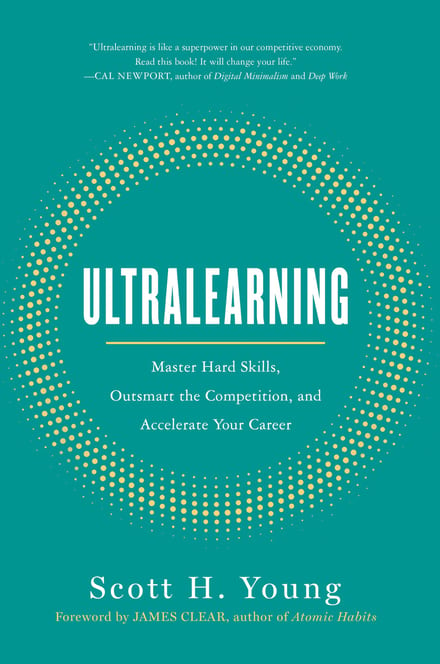
Ultralearning: Master Hard Skills, Outsmart the Competition, and Accelerate Your Career
Master Hard Skills, Outsmart the Competition, and Accelerate Your Career
The full book runs ~304 pages — roughly 6 hours of reading. You get the key ideas here in 5 minutes.
The key ideas
- Practice the thing directly — build the website badly, have the conversation now.
- Map the skill before you grind; Roger Craig mined the J! Archive first.
- Drill the bottleneck in isolation, then fold it back into real practice.
- Test yourself instead of rereading — retrieval is the studying, not the measurement.
- Build a real feedback loop early; Montebello gave 80 to 100 speeches.
- Expect the guidance to run out and start running your own experiments.
The summary
In October 2011 Scott Young opened MIT’s OpenCourseWare and started working through the computer science degree. Twelve months later he had finished 33 classes — the same credit load as the four-year program — writing the final exam for each one and grading it against MIT’s own answer key. He never enrolled, never earned the degree, never had a professor. Ultralearning is what came after: he went looking for other people who learn like this, found them scattered across languages, game shows and public speaking, and pulled out the nine things they do in common. The strategy is self-directed, because you build the curriculum, and aggressive, because at every fork you take the version of practice that’s harder and less pleasant.
What you learn in a classroom mostly stays there
Young’s starting complaint is transfer. The research keeps finding that much of what we set out to learn never reaches the situations we needed it for — students earn high marks in a subject and then can’t apply it once the context shifts even slightly. Years of French, no conversation. A semester of statistics, no ability to read a study.
His antidote is directness: practice the thing you actually want to be able to do. A learning project, he argues, should involve something you do or make, not just something you study. Want French? Have conversations in French. Want to build websites? Build one now, badly.
He tested this on himself in September 2013, when he and his friend Vat Jaiswal spent a year abroad under a single rule: no English. Roughly three months each in Spain, Brazil, China and Taiwan, and South Korea, with English permitted only for under an hour of work a week, calls home, and emergencies. They came out at an intermediate level in all four languages, having broken the rule occasionally in China and Korea, where the difficulty and the fatigue caught up with them. The itinerary isn’t the lesson. Immersion is just directness with nowhere to hide.
Map the territory, then attack the bottleneck
Before Roger Craig went on Jeopardy!, he treated the show as a data problem. He pulled down the J! Archive of past clues, used data mining and text clustering to work out which topics actually come up, built himself a tool to quiz on them, and watched where his answers fell apart. On September 14, 2010, he won $77,000 in a single game, taking Ken Jennings’s record by two thousand dollars. His seven-game run brought $231,200, and he won the Tournament of Champions the year after.
That front-loaded research is what Young calls metalearning: work out how the skill is structured, what has to be mastered, and how other people got there, before you spend a single hour grinding. It’s the step that decides whether everything else is aimed at anything. Focus, the principle beside it, is far less glamorous — hard skills need concentrated hours, and Young has since said the distraction problem has only worsened since he wrote the book.
Once the map exists, drill. Break the skill into components, find the one holding the whole thing back, work it in isolation, then fold it straight back into real practice so you can check whether the gain survives contact with the task. Nigel Richards is the extreme case: in 2015 he won the French-language World Scrabble Championship 565–434, after eight or nine weeks spent memorizing the French dictionary from word lists and dictionary pages. He doesn’t speak French. He drilled one component of the game to the exclusion of the language it’s played in.
A test is a tool, not a verdict
Most people treat a quiz as a measurement — the thing that tells you whether the studying worked. Ultralearners treat it as the studying. Craig’s spaced-repetition decks in Anki weren’t checking his progress; dragging an answer out of memory is how the answer got fixed there in the first place. Rereading your notes feels productive and does little. Recalling them with the notes shut feels like failing and does most of the work.
Feedback gets the same treatment, and Young’s rule of thumb is that it’s useful roughly in proportion to how much it stings — a heuristic the research doesn’t really bear out, though the underlying advice to go and get some is sound. Tristan de Montebello had close to no speaking experience when he started. Seven months and about 500 hours later he was a finalist at the World Championship of Public Speaking, on stage in front of 3,000 people. He got there by giving 80 to 100 speeches to live audiences — Toastmasters, schools, improv groups, strangers — and running material past his wife, movie directors and improv teachers long before it reached a stage. Comedians work this way because they have to. Most learners never build the loop at all.
Nobody hands you the curriculum
The last principles — retention, intuition, experimentation — all point the same way: sooner or later the guidance runs out and you have to run your own trials. Eric Barone spent roughly four and a half years alone on Stardew Valley, doing the design, programming, art, animation, music and writing himself. He came in with a computer science degree and taught himself the rest as he went — sinking hundreds of hours into pixel art he found genuinely hard, and scoring the game with no formal musical training. He redid the artwork over and over because nobody else was going to tell him when it was finished.
The bottom line
Learning something hard, fast, is a set of choices rather than a gift, and nearly all of those choices cut against instinct: do the real thing before you feel ready, test yourself instead of reviewing, go looking for the feedback you’d rather not hear. The projects in this book look extreme because the method is uncomfortable, not because the people running them were unusually gifted. Read it if you’ve committed to learning something difficult on your own and want a plan sharper than “sign up for a course.”
Fact check
Popular books repeat findings that later research has complicated. Where Ultralearning makes a testable claim, here's what the evidence actually shows.
Testing yourself is how material gets learned, not how it gets checked — rereading notes feels productive and does far less.
This is the sturdiest claim in the book. A monograph for Psychological Science in the Public Interest graded ten common study techniques and gave practice testing and distributed practice its only two high-utility ratings, while placing rereading and highlighting in the low-utility group with the direct recommendation to use practice testing instead. The classic demonstration shows why the intuition misleads: students who reread prose passages recalled more than students who took recall tests when the final test came five minutes later, and substantially less when it came two days or a week later — even though rereading made them more confident. A meta-analysis of the testing effect found the benefit is larger when the practice test demands recall rather than recognition, which is the harder version Young argues for.
- Dunlosky J, Rawson KA, Marsh EJ, Nathan MJ, Willingham DT. Improving Students' Learning With Effective Learning Techniques: Promising Directions From Cognitive and Educational Psychology. Psychol Sci Public Interest. 2013;14(1):4-58. PubMed
- Roediger HL, Karpicke JD. Test-enhanced learning: taking memory tests improves long-term retention. Psychol Sci. 2006;17(3):249-55. PubMed
- Rowland CA. The effect of testing versus restudy on retention: a meta-analytic review of the testing effect. Psychol Bull. 2014;140(6):1432-63. PubMed
What you learn in a classroom mostly stays there — the research keeps finding that knowledge fails to reach the situations you learned it for.
For far transfer specifically the pessimism is earned. Meta-analyses of chess instruction, music instruction and working-memory training found small-to-moderate gains whose effect sizes shrank as the experimental designs improved, and concluded that far transfer of learning rarely occurs; a separate meta-analysis of 87 publications and 145 experimental comparisons of working-memory training found no convincing improvement on far-transfer measures against treated controls, and no evidential value once publication bias was assessed. But the century of research Young invokes does not say transfer fails across the board. The standard review argues that estimating one effect size for far transfer is the wrong question, that evidence for transfer under some conditions is substantial, and that the conditions doing the deciding are largely untested.
- Sala G, Gobet F. Does Far Transfer Exist? Negative Evidence From Chess, Music, and Working Memory Training. Curr Dir Psychol Sci. 2017;26(6):515-520. PubMed
- Melby-Lervåg M, Redick TS, Hulme C. Working Memory Training Does Not Improve Performance on Measures of Intelligence or Other Measures of "Far Transfer": Evidence From a Meta-Analytic Review. Perspect Psychol Sci. 2016;11(4):512-34. PubMed
- Barnett SM, Ceci SJ. When and where do we apply what we learn? A taxonomy for far transfer. Psychol Bull. 2002;128(4):612-37. PubMed
Feedback is useful roughly in proportion to how much it stings, so go looking for the harsh kind.
What decides whether feedback helps is how much information it carries, not how much it hurts. A meta-analysis of 435 studies — 994 effects, more than 61,000 people — put the average effect of feedback on learning at d = 0.48, and the breakdown by type is the finding: high-information feedback came in at d = 0.99, corrective feedback at 0.46, and reinforcement or punishment, the emotionally loaded kind, at 0.24, the weakest of the three. The older review the field is built on, covering 131 studies and over 12,000 participants, found an average effect of 0.38 with about a third of the effects negative. The half of Young's advice that survives is seeking feedback at all rather than avoiding it; the sting is not the active ingredient, and de Montebello's 500 hours of live audiences delivered information as much as discomfort.
- Wisniewski B, Zierer K, Hattie J. The Power of Feedback Revisited: A Meta-Analysis of Educational Feedback Research. Front Psychol. 2019;10:3087. PubMed
- Kluger AN, DeNisi A. The effects of feedback interventions on performance: A historical review, a meta-analysis, and a preliminary feedback intervention theory. Psychol Bull. 1996;119(2):254-284. Source
Frequently asked questions
What is Ultralearning about?
It's a method for learning hard skills fast on your own, drawn from Scott Young's own experiment: starting in October 2011 he worked through MIT's OpenCourseWare computer science curriculum, finishing 33 classes in twelve months, writing each final exam and grading it against MIT's answer key without ever enrolling. He then found other people who learn this way and pulled out the nine things they share. The strategy is self-directed because you build the curriculum, and aggressive because at every fork you take the harder, less pleasant version of practice.
What are the key takeaways from Ultralearning?
The starting problem is transfer, since much of what people study never reaches the situations they needed it for. Directness is the antidote: practice the actual thing, and make a project out of something you do or make rather than only study. Metalearning comes first, mapping how the skill is structured before grinding, the way Roger Craig mined the J! Archive before winning $77,000 in a single Jeopardy! game. Then drill the component holding everything back and fold it straight back into real practice. Retrieval beats review, so testing yourself is the studying rather than a measurement of it, and feedback matters most when you actually build a loop for it, as with Tristan de Montebello giving 80 to 100 speeches in seven months on his way to a world championship final.
Who should read Ultralearning?
It's for anyone who has committed to learning something difficult on their own and wants a plan sharper than signing up for a course.
Is Ultralearning worth reading?
The case studies do real work here, from Young's no-English year across Spain, Brazil, China and Taiwan, and South Korea to Nigel Richards winning the French World Scrabble Championship without speaking French. The reassuring message underneath is that these people weren't unusually gifted, the method is just uncomfortable. Anyone looking for gentle, low-effort study tips will find the opposite, since nearly every principle cuts against instinct.