Book summary
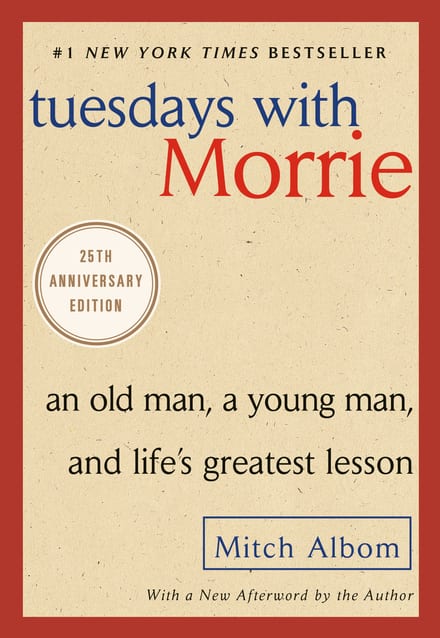
Tuesdays with Morrie: An Old Man, a Young Man, and Life's Greatest Lesson
An Old Man, a Young Man, and Life's Greatest Lesson
The full book runs ~224 pages — roughly 4 hours of reading. You get the key ideas here in 5 minutes.
The key ideas
- Rehearse the ending: assume the tap could come today, then notice what you'd stop doing.
- Ration your self-pity — Morrie took a few minutes of grief each morning, then stopped.
- Treat the culture's defaults as optional and build your own code around love and community.
- Give time and attention rather than money; Morrie held that the substitution never takes.
- Say the eulogies while the person can still hear them — Morrie held his own funeral early.
- Let an emotion all the way in; his detachment meant feeling it fully, then setting it down.
The summary
Morrie Schwartz spent his last year pressing an argument most people arrange their lives to avoid: that you cannot work out how to live until you have looked straight at dying, and that a culture which hides death leaves you improvising your biggest decisions in the dark. He had reason to press it. In 1994 he was diagnosed with ALS, which kills the motor neurons that carry orders from brain to muscle until the body stops answering. Most people with it die of respiratory failure, and median survival from the first symptoms runs somewhere between two and four years. Patients stay awake and oriented throughout — thinking is affected more often than the popular picture allows, but Morrie’s was not — so they watch the whole thing happen. Morrie, a sociologist by trade, decided to teach from inside it.
Mitch Albom had been his student at Brandeis, promised to stay in touch, then didn’t for nearly twenty years — years he spent as a Detroit sports columnist, working constantly, telling his wife they would get to children eventually. He recognized Morrie’s voice one night on Nightline, where Ted Koppel interviewed him three times across 1995 after a March feature by Jack Thomas in the Boston Globe ran under the headline “A Professor’s Final Course: His Own Death.” Albom flew to West Newton, Massachusetts, and kept flying back. Fourteen Tuesdays, one topic each, tape recorder running: the world, self-pity, regret, death, family, emotions, the fear of aging, money, how love goes on, marriage, our culture, forgiveness, the perfect day, goodbye. They called it a last class and the book their final thesis.
Rehearse the ending and the middle gets clearer
Morrie’s method was blunt: assume the shoulder tap could come today, and notice what you’d stop doing. He gave himself a fixed ration of self-pity each morning — a few minutes of grief for what the disease had taken — and then made himself stop and get on with the day. When Albom asked what he’d do with twenty-four hours of restored health, the answer wasn’t Paris or a last great feat. It was breakfast, a swim, lunch with friends, dinner, a walk. An ordinary Tuesday. That’s the whole lesson compressed: the perfect day was already available, and Morrie’s point was that his younger self had been too busy to spend one.
He also refused the standard script for the ending. After a colleague’s funeral he came home flattened by the waste of it — everyone saying the good things to a room the man couldn’t hear — so he gathered friends and family while he was still alive and let them eulogize him to his face. He cried; they cried; he answered back. He kept a running set of aphorisms as his body failed, seventy-five by the time the Globe wrote him up, including the one that got him out of the sheets each morning: “When you’re in bed, you’re dead.”
The culture is not neutral, so build your own
The most durable idea in the book is Morrie’s claim that the values you absorb by default — earn more, own more, look younger, stay number one — are not laws of nature but a particular culture’s product, and a poor one for the end of a life. His prescription was to take what’s useful and quietly construct your own code around love, community and generosity. It wasn’t posturing. As a Brandeis professor he once stood up in a packed gym mid-chant and asked what was wrong with being number two.
Money got the same treatment. Morrie argued that people reach for possessions and status when what they actually want is love, and that the substitution never takes — you stay hungry. What he told Albom to give instead was time and attention, the things that can’t be delegated. He was harder on himself than on anyone else here: on the twelfth Tuesday he wept over a friend named Norman, who had reached out repeatedly after a rift and whom Morrie had refused to forgive until it was too late. Forgive others, he said, and forgive yourself — the second one first.
Detachment means going all the way in
The subtlest lesson is easy to misread. Morrie borrowed a Buddhist idea of detachment, but insisted it does not mean numbing out or standing back. It means letting an emotion — terror during a coughing fit, grief, loneliness — come in completely, feel it fully, and only then be able to set it down. His guiding line came from Auden, trimmed to “Love each other or perish.” He cried openly and told Albom to do the same, on the theory that emotions you refuse to enter are the ones that own you.
Where the warmth thins out
Be clear about what this book is. It is a couple of hundred pages of a dying man’s aphorisms filtered through a sportswriter’s ear, not a worked-out philosophy — Kirkus called it sincere and skillful while noting it “stops just short of the maudlin and the mawkish,” and that you will not actually learn the meaning of life here. Albom gives polished distillations rather than the arguments behind them, and the advice on marriage, aging and children is broad enough to fit almost anyone. Critics have called it sentimental for thirty years and they have a point; Albom’s answer is that he chooses hope on purpose and has stopped apologizing for it. Worth knowing too: it started as a way to help cover Morrie’s medical bills, then sold nearly 18.5 million copies across more than fifty territories.
The bottom line
Morrie’s case was that most of what exhausts you — the status, the accumulation, the postponed phone calls — dissolves on contact with your own mortality, and that the people who love you are the only durable thing you build. Read it if you want that put plainly by someone who had run out of time to hedge. Skip it if you want an argument rather than a voice; this is a short, warm, simple book, and it does not pretend otherwise.
Fact check
Popular books repeat findings that later research has complicated. Where Tuesdays with Morrie makes a testable claim, here's what the evidence actually shows.
ALS usually kills through respiratory failure, three to five years after the first symptoms.
The cause of death is right. In a prospective German population-based registry, respiratory failure from weakness of the breathing muscles was the single most common cause among 148 ALS deaths (91 cases, 61%), with pneumonia accounting for another 9%. The timeline is more compressed than "three to five years" suggests: a systematic review of prognostic studies put median survival from symptom onset to death at 20 to 48 months, so a large share of patients die inside three years — though 10-20% live longer than a decade.
- Wolf J, Safer A, Wöhrle JC, Palm F, Nix WA, Maschke M, Grau AJ. [Causes of death in amyotrophic lateral sclerosis : Results from the Rhineland-Palatinate ALS registry]. Nervenarzt. 2017;88(8):911-918. PubMed
- Chiò A, Logroscino G, Hardiman O, Swingler R, Mitchell D, Beghi E, Traynor BG; Eurals Consortium. Prognostic factors in ALS: A critical review. Amyotroph Lateral Scler. 2009;10(5-6):310-23. PubMed
ALS attacks the body while leaving reasoning and memory intact, so patients stay mentally whole and watch the decline happen.
Patients do stay awake, oriented and aware of what is happening, and ALS is not primarily a dementing illness — but "usually intact" understates how often thinking is affected. A 2022 Lancet seminar puts cognitive or behavioural change at 35-50% of patients, with roughly 15% meeting diagnostic criteria for frontotemporal dementia. An Italian population-based series found only 49.7% of 188 tested patients cognitively normal, with 12.6% having ALS-FTD, and a meta-analysis of 44 studies (1,287 patients against 1,130 matched controls) found measurable deficits in fluency, language, social cognition, executive function and verbal memory even among patients who were not demented.
- Feldman EL, Goutman SA, Petri S, Mazzini L, Savelieff MG, Shaw PJ, Sobue G. Amyotrophic lateral sclerosis. Lancet. 2022;400(10360):1363-1380. PubMed
- Montuschi A, Iazzolino B, Calvo A, Moglia C, Lopiano L, Restagno G, Brunetti M, Ossola I, Lo Presti A, Cammarosano S, Canosa A, Chiò A. Cognitive correlates in amyotrophic lateral sclerosis: a population-based study in Italy. J Neurol Neurosurg Psychiatry. 2015;86(2):168-73. PubMed
- Beeldman E, Raaphorst J, Klein Twennaar M, de Visser M, Schmand BA, de Haan RJ. The cognitive profile of ALS: a systematic review and meta-analysis update. J Neurol Neurosurg Psychiatry. 2016;87(6):611-9. PubMed
Letting a painful emotion in completely is what allows you to set it down; the feelings you refuse to enter are the ones that end up owning you.
The second half holds up better than the first. A meta-analysis of 306 experimental comparisons found that deliberately concentrating on an emotion left people slightly worse off (d = -0.26), while distraction helped (d = 0.27) and suppressing the outward expression of an emotion actually reduced negative feeling in the moment (d = 0.32) — none of which matches "feel it fully and then it passes." What does track with Morrie's advice is the cost of avoidance: across 331 samples, acceptance and mindfulness went with a higher tolerance for distress, while experiential avoidance and repetitive negative thinking went with a lower one.
- Webb TL, Miles E, Sheeran P. Dealing with feeling: a meta-analysis of the effectiveness of strategies derived from the process model of emotion regulation. Psychol Bull. 2012;138(4):775-808. PubMed
- Naragon-Gainey K, McMahon TP, Chacko TP. The structure of common emotion regulation strategies: A meta-analytic examination. Psychol Bull. 2017;143(4):384-427. PubMed
Frequently asked questions
What is Tuesdays with Morrie about?
Mitch Albom lost touch with Morrie Schwartz, his Brandeis sociology professor, for nearly twenty years, then recognized him on a Nightline broadcast after Morrie was diagnosed with ALS. He flew to West Newton and kept flying back for fourteen Tuesdays, one topic each — regret, family, money, forgiveness, the perfect day — with a tape recorder running. Morrie's claim across all of it was that you cannot work out how to live until you look straight at dying, and that a culture which hides death leaves you improvising your biggest decisions.
What are the key takeaways from Tuesdays with Morrie?
Morrie gave himself a fixed ration of self-pity each morning, then made himself stop; asked what he'd do with twenty-four healthy hours, he described breakfast, a swim, lunch with friends and a walk — the perfect day was already available. He argued that the values you absorb by default (earn more, own more, look younger) are one culture's product rather than laws of nature, and that people reach for possessions when what they want is love, so give time and attention instead. He held his own funeral while he could still hear it. And his version of detachment meant letting an emotion in completely and feeling it fully, not numbing out.
Who should read Tuesdays with Morrie?
Read it if you want your priorities put plainly by someone who had run out of time to hedge — particularly if work has quietly crowded out the people and phone calls you keep postponing.
Is Tuesdays with Morrie worth reading?
It's short, warm and honest about what it is: a couple of hundred pages of a dying man's aphorisms filtered through a sportswriter's ear. Albom gives polished distillations rather than the reasoning behind them, and the advice on marriage, aging and children is broad enough to fit almost anyone — critics have called it sentimental for thirty years and they have a point. Skip it if you want a worked-out philosophy; read it if you want the voice.