Book summary
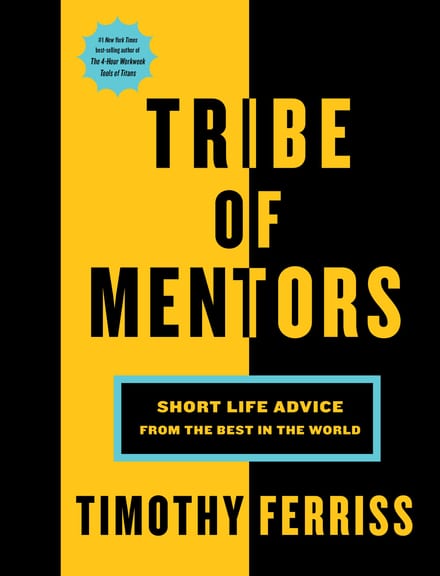
Tribe Of Mentors
Transformative Wisdom From Icons and Innovators to Help You Navigate Life's Challenges
The full book runs ~624 pages — roughly 11 hours of reading. You get the key ideas here in 18 minutes.
The key ideas
- Focus means saying no to a hundred good ideas.
- Ask: would you say yes if it were tomorrow?
- Know your worth; refuse to work for exposure.
- Judge yourself by effort you control, not results.
- Simplify ruthlessly—perfection is nothing left to remove.
- Life is the obstacles, not the gaps between them.
The summary
Ask a hundred accomplished people how they got where they are and the surface answers scatter in every direction. Drill down, though, and Tim Ferriss finds the same handful of convictions surfacing over and over, phrased a dozen ways but pointing at the same truths: refuse most of what’s offered so a few things get your full attention, measure yourself by effort rather than outcome, and treat obstacles as the substance of a life rather than interruptions to it.
Saying no is the actual work
Steve Jobs put the first idea most bluntly. Focus, he said, doesn’t mean saying yes to the thing you’ve chosen — it means saying no to the hundred other good ideas. “I’m actually as proud of the things we haven’t done as the things I have done.” The designer Debbie Millman condenses it further: “Busy is a decision.” Most people treat their calendars as something that happens to them, but every yes is a no to something else, and the investor Esther Dyson offers a test for catching yourself: “Would you say yes if this were next Tuesday?” It’s easy to commit to things weeks out, when the schedule still looks open.
The corollary is knowing your worth and refusing to work for vapor. The product manager Veronica Belmont keeps one blunt house motto — some version of “pay me” — because exposure and “reaching new audiences” don’t cover the rent. And you can’t please everyone anyway. The journalist Herbert Bayard Swope said he couldn’t offer a formula for success but could offer one for failure: try to please everybody all the time. As the dancer Dita Von Teese put it, you can be a ripe peach and someone still won’t like peaches.
Judge yourself by effort, not outcome
The people Ferriss interviews keep drawing the line between what they control and what they don’t. Marcus Aurelius, quoted more than anyone else in the book, held that the pain of an external event comes from your estimate of it, and that estimate you can revoke at any moment. The physicist-turned-writer Janna Levin takes it somewhere useful: “I used to resent obstacles along the path, thinking, ‘If only that hadn’t happened life would be so good.’ Then I suddenly realized, life is the obstacles. There is no underlying path.”
That reframing changes what a win looks like. Naval Ravikant calls self-esteem “the reputation you have with yourself” — you always know whether you gave your best or cut corners. The CrossFit champion Katrín Tanja Davíðsdóttir counts her absolute best as the win, whatever the scoreboard says. Machiavelli, from five centuries away, agrees the goal isn’t to avoid danger, which is impossible, but to calculate risk and act decisively — to make mistakes of ambition rather than mistakes of sloth. And Franklin Leonard describes spending his first 33 years avoiding failure before realizing he wasn’t risking it enough, because there’s almost no failure he can’t survive. Peter Guber adds the practical coda: most of what gives you angst never happens, so evict it and stop letting it live rent-free in your brain.
Simplify, eliminate, get specific
The other recurring instinct is subtraction. Bruce Lee described cultivation as daily decrease rather than daily increase, the height of it running to simplicity. William of Ockham said it’s vain to do with more what can be done with less, and Antoine de Saint-Exupéry defined perfection as the point where there’s nothing left to take away. Ralph Waldo Emerson supplies the reason it matters: methods may number in the millions, but principles are few, and the person who grasps principles can pick their own methods, while the one who chases methods without principles is sure to have trouble.
Information gets the same treatment. Steven Pressfield diagnoses the era’s disease as living on the surface — “we’re like the Platte River, a mile wide and an inch deep.” The novelist Robert Sawyer calls learning to ignore things one of the great paths to inner peace, and Neil Strauss compresses the whole idea into three words: “Learn more, know less.” Even desire, several of them suggest, should be specific. The athlete Kyle Maynard notes that thinking about what makes him happy never gives him the clarity that thinking about what gives him bliss does. Joseph Campbell reaches the same edge from another direction, arguing that what we’re really after isn’t a meaning for life but an experience of being alive.
The bottom line
Life is the obstacles, not the gaps between them — so say no to almost everything, give your whole attention to the few things that matter, and grade yourself on the effort you control rather than the result you don’t. Read this if you suspect you’re doing too much and feeling too little, and you want permission from people who’ve been there to stop.
Frequently asked questions
What is Tribe Of Mentors about?
Tim Ferriss asked a hundred accomplished people how they got where they are, and beneath the scattered surface answers he found the same few convictions surfacing again and again. The book distills them into a handful of ideas: refuse most of what's offered so a few things get your full attention, measure yourself by effort rather than outcome, and treat obstacles as the substance of a life rather than interruptions to it.
What are the key takeaways from Tribe Of Mentors?
Saying no is the real work: focus means declining a hundred good ideas, and "busy is a decision." Judge yourself by effort, not outcome, since self-esteem is "the reputation you have with yourself" and you always know whether you gave your best. Life is the obstacles, not the gaps between them, so make mistakes of ambition rather than sloth. And subtract relentlessly: simplify, eliminate, "learn more, know less," and get specific about what actually gives you bliss.
Who should read Tribe Of Mentors?
Read it if you suspect you're doing too much and feeling too little, and you want permission from people who've been there to stop and give your whole attention to the few things that matter.
Is Tribe Of Mentors worth reading?
It gathers blunt, quotable wisdom from a wide range of accomplished people and keeps returning to a few durable truths, so it reads fast and sticks. Because it's a distillation of many voices rather than one sustained argument, anyone wanting a single deep framework may find it scattered, but that breadth is also the point.