Book summary
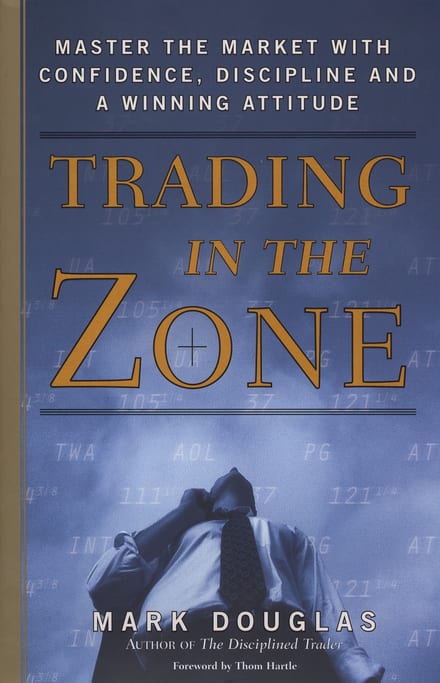
Trading in the Zone: Master the Market with Confidence, Discipline, and a Winning Attitude
Master the Market with Confidence, Discipline, and a Winning Attitude
The full book runs ~240 pages — roughly 4 hours of reading. You get the key ideas here in 5 minutes.
The key ideas
- Accept five truths: anything can happen, and every market moment is unique.
- Expect wins and losses in random order, never in neat proportion.
- Name four fears: being wrong, losing money, missing out, leaving profit.
- Accept risk behaviorally — no nudged stops, no loss felt as injury.
- Take the next 20 signals exactly as written, without improvising.
- Know the argument rests on coaching experience, not a track record or study.
The summary
Most people losing money in the markets are not losing because their method is bad. That is the claim Mark Douglas builds everything on, and it’s harder than it sounds. He began coaching traders in 1982 and published The Disciplined Trader in 1990, one of the first books to put trading psychology in front of the industry, and he kept meeting the same person: someone with a workable edge who couldn’t execute it. They knew the setup. They took it a size too large anyway, slid the stop, or sat out the one signal that would have paid for the month. Buying more analysis never fixed it, because analysis wasn’t the broken part.
The market’s job is not to be predictable
Douglas reduces the problem to five statements he calls the fundamental truths, which read almost like an apology on the market’s behalf: anything can happen; you don’t need to know what will happen next to make money; there is a random distribution between wins and losses for any given set of variables that define an edge; an edge is nothing more than an indication of a higher probability of one thing happening over another; every moment in the market is unique.
The third truth is the one that empties accounts. A setup that wins 60 percent of the time does not hand you six wins in every ten. It produces roughly 60 wins across a large enough sample, in whatever order the market pleases — including the run of eight losses that shows up exactly when your confidence is thinnest. His comparison is a coin flip. Ten heads in a row doesn’t make the coin unfair, and no study tells you what the eleventh toss does. If researching a coin is obviously silly, he asks, why expect research to settle the next candle?
The fifth truth does quieter damage. Two charts can look identical while the people behind them are different people with different orders, so the pattern that paid last month promises nothing this month. Reading the shape is easy. Believing the shape owes you an outcome is expensive.
Four fears, and what they do to what you see
Douglas names four fears that run underneath almost every trading error: being wrong, losing money, missing out, and leaving money on the table. He puts 95 percent of trading errors down to those attitudes — his estimate, not a measured figure, though the mechanism he describes is specific.
Fear rarely announces itself as fear. It arrives dressed as judgment. The setup looks weak today. I’ll wait for confirmation. I’ll bank this one early, it’s been a rough week. What’s actually happening, in his account, is that fear edits your perception before you get to decide anything — information that threatens what you want stops registering, so you don’t override your rules so much as stop seeing what they were written for.
The fix isn’t more willpower. It’s accepting risk, which he calls the most important skill a trader can learn, and he treats it as behavioral rather than verbal. Everyone says they accept the risk. The ones who mean it don’t nudge the stop, don’t hover, don’t feel a loss as an injury. What’s left when the acceptance is real he calls a carefree, objective state of mind — carefree not because you stopped caring, but because you’ve removed your own capacity to read market information as a threat.
The casino doesn’t need to win this hand
The house has no idea which hand is coming. It knows what several thousand hands do, and that’s enough to run a business on. A gambler sits down believing he won’t lose; the owner opens the doors knowing some players walk out ahead tonight, and that this says nothing about the year.
From that stance Douglas derives seven principles he claims a consistent winner genuinely believes: identify your edges objectively, predefine the risk on every trade, accept that risk completely or let the trade go, act on your edges without hesitation, pay yourself as the market makes money available, keep monitoring your own susceptibility to error, and never violate any of the above. As rules they’re unremarkable — most traders would nod at all seven. His point is that nodding isn’t believing, and behavior follows belief. Underneath sits one sentence he treats as the foundation: what you need is “a strong virtually unshakeable belief in an uncertain outcome with an edge in your favor.” Both halves carry weight. Certainty about the outcome makes you brittle; no edge makes you a gambler.
Belief has to be installed, not agreed with
Since agreement changes nothing, the book ends in a drill. Pick a liquid market you can afford, define your edge precisely enough that entry, stop and target are unambiguous, and take the next 20 signals exactly as written — no skipping, no improvising, no widening. Decide before you start that you can live with losing all 20. It isn’t really a test of the strategy; it’s a way to catch the moment you want to deviate, with nothing else to blame.
He frames the longer arc as three stages. The mechanical stage is rules you don’t get to argue with, where self-trust is manufactured. The subjective stage is discretion, once earned. The intuitive stage is acting on what you see without the rational mind talking you out of it. Skipping ahead is the standard failure.
The bottom line
Consistency, in this book, is a mental position rather than a better indicator — an argument, not a proven result. Douglas offers no track record or study, and none of it makes a bad edge profitable; it addresses the narrower problem of why someone with a real edge still loses. Read it if you already have a tested method and keep overriding it, and pair it with The Psychology of Money for the same lesson at investor timescales. If you’re still looking for the method, this isn’t the book.
Fact check
Popular books repeat findings that later research has complicated. Where Trading in the Zone makes a testable claim, here's what the evidence actually shows.
Traders with a workable method lose because of what they do at the moment of execution, and roughly 95 percent of trading errors trace to four fears.
The premise that active retail traders lose is solid. Among 66,465 US households at a discount broker between 1991 and 1996, those that traded most earned 11.4 percent a year against a market return of 17.9 percent, while the average household earned 16.4 percent. European regulators reviewing contracts for difference reported that 74 to 89 percent of retail accounts lose money, with average losses per client between 1,600 and 29,000 euros. The 95 percent figure is Douglas's own estimate and no study measures it. Where researchers have named a driver they have usually pointed to overconfidence and the trading costs it generates rather than to fear.
- Barber BM, Odean T. Trading is hazardous to your wealth: the common stock investment performance of individual investors. J Finance. 2000;55(2):773-806. Source
- European Securities and Markets Authority. ESMA agrees to prohibit binary options and restrict CFDs to protect retail investors. Press release ESMA71-98-128; 27 March 2018. Source
Wins and losses from a real edge arrive in random order, so a run of losses tells you nothing about the next trade.
The statistics are not in dispute, and the error Douglas warns about - treating a streak as due for a reversal - shows up in professionals with far more riding on the call than a retail trader. Across asylum court rulings, bank loan-application reviews and baseball umpire pitch calls, researchers found decisions negatively autocorrelated for reasons unconnected to the case at hand: umpires were 1.5 percentage points less likely to call a pitch a strike straight after calling one, loan officers 8 percentage points less likely to approve after an approval, and judges 5.5 percentage points less likely to grant asylum after two grants than after two denials. The distortion was strongest among the less experienced decision makers and after longer streaks.
- Chen D, Moskowitz TJ, Shue K. Decision-making under the gambler's fallacy: evidence from asylum judges, loan officers, and baseball umpires. NBER Working Paper 22026, 2016; published in Q J Econ. 2016;131(3):1181-1242. Source
Fear of being wrong keeps traders in losing positions too long and pushes them out of winners too early.
Trading records for 10,000 discount-brokerage accounts from 1987 to 1993 show the pattern plainly: investors realised 14.8 percent of their paper gains but only 9.8 percent of their paper losses. The gap survives controls for portfolio rebalancing and for the higher costs of trading low-priced stocks, and it cost them money, because the winners they sold went on to outperform the losers they kept. Whether fear is the right name for it is a separate question, but the behaviour Douglas builds the book around is real and measurable.
- Odean T. Are investors reluctant to realize their losses? J Finance. 1998;53(5):1775-1798. Source
Frequently asked questions
What is Trading in the Zone about?
Mark Douglas's claim is that most people losing money in the markets aren't losing because their method is bad — they know the setup and take it too large, slide the stop, or skip the one signal that would have paid for the month. The broken part is the mind's demand for certainty in a place that can't supply it. Consistency, in this book, is a mental position rather than a better indicator.
What are the key takeaways from Trading in the Zone?
Five fundamental truths sit at the base: anything can happen; you don't need to know what happens next to make money; wins and losses are randomly distributed within any edge; an edge is only a higher probability; every moment in the market is unique. Four fears drive most errors — being wrong, losing money, missing out, and leaving money on the table — and they work by editing what you perceive before you get to decide anything. The antidote is genuinely accepting risk, which shows up in behavior rather than words, and the casino stance: the house has no idea which hand is coming, only what several thousand hands do. The book ends in a drill — take the next 20 signals exactly as written, having decided up front you can live with losing all 20.
Who should read Trading in the Zone?
Traders who already have a tested method and keep overriding it. If you're still looking for the method, this isn't the book.
Is Trading in the Zone worth reading?
It's precise about one narrow, expensive problem: why someone with a real edge still loses, and how a losing run inside a winning system feels like proof the system is broken. What it offers is an argument, not a proven result — Douglas presents no track record or study, and none of it makes a bad edge profitable. Read it for the psychology, not for a strategy.