Book summary
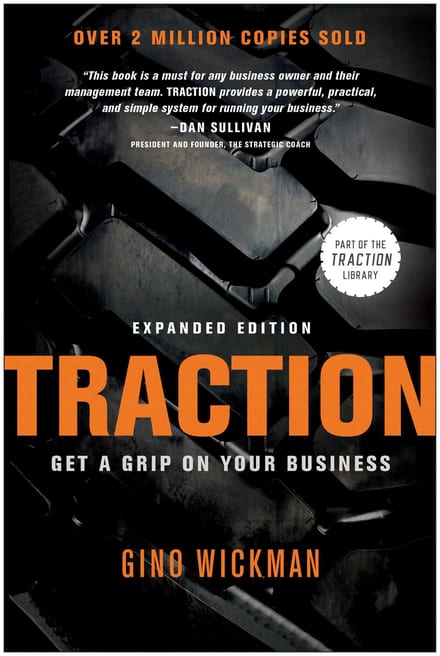
Traction: Get a Grip on Your Business
Get a Grip on Your Business
The full book runs ~239 pages — roughly 4 hours of reading. You get the key ideas here in 5 minutes.
The key ideas
- Compress everything you believe about the company onto a two-page V/TO.
- Separate right people from right seats: core values first, then GWC.
- Track five to fifteen weekly activity numbers, each owned by one person.
- Kill issues with IDS — identifying the real one eats most of the time.
- Document seven core processes at the 20/80 level, then train your Way.
- Work in 90-day chunks: three to seven Rocks, one Level 10 Meeting weekly.
The summary
Most of what frustrates a business owner is a symptom. You don’t control your time. Your people don’t listen. There isn’t enough profit. Growth has stalled at a ceiling, and every fix wore off. Gino Wickman’s claim is that all five complaints trace back to the same six places in any company, and that the cure isn’t another strategy — it’s an operating system. He calls his the Entrepreneurial Operating System, built over 20 years and more than 1,300 full-day sessions with leadership teams. One line carries the book: vision without traction is merely hallucination.
Six components, not a hundred worries
- Vision — everyone seeing the same picture of where you’re going.
- People — the right people in the right seats.
- Data — a few weekly numbers that give you a real pulse.
- Issues — naming problems and killing them.
- Process — your way of doing business, documented and followed by all.
- Traction — priorities and a meeting rhythm.
Most companies score below 50 percent on Wickman’s twenty-question Organizational Checkup; when they succeed, it’s in spite of themselves.
The whole vision on two pages
The first tool is the Vision/Traction Organizer: everything you believe about your company compressed onto two pages, structured as eight questions. Your core values — three to seven, and you hire, fire, review, reward and recognize against them. Your core focus: the purpose behind the company plus the niche you actually win in. Your 10-year target. Your marketing strategy, in four parts: the target market (“The List” of ideal prospects), your Three Uniques (Southwest’s are low fares, on-time flights, having fun), a proven process drawn on one page, and a guarantee if you can find one worth making. Then a three-year picture, a one-year plan, this quarter’s Rocks, and the issues in your way.
All that compression exists to stop you chasing shiny stuff. And writing the vision isn’t the hard part; sharing it is. People need to hear it seven times before they hear it once.
Right people, right seats
Two separate tests, and blurring them is why personnel problems drag on for years. The right people share your core values, measured with the People Analyzer: rate each person plus, plus/minus, or minus on every value. With five values, the bar Wickman recommends is three pluses, two plus/minuses, never a minus. Below it comes the three-strike rule — name the problem, give 30 days, repeat once, then part ways. Most people who don’t fit leave before the third strike.
The right seat is structural. The Accountability Chart fixes it: structure first, names second, one owner per major function — when more than one person is accountable, nobody is. Under the three universal functions (sales and marketing, operations, finance and administration) sits an integrator who runs the day-to-day; above, about half the time, a visionary with ten ideas a week, one of which is usually good.
Whether someone belongs in a seat comes down to GWC: do they get it, want it, have the capacity to do it? A no on any one means wrong seat. And when someone does have to go, expect what one client called 36 hours of pain.
Numbers you can act on, issues you actually kill
A profit and loss statement is a trailing indicator; by the time it tells you something, you can’t change it. The Scorecard is five to fifteen weekly, activity-based numbers — leads generated, appointments held — each owned by one named person. Wickman’s example is CompStat: the NYPD swapped lagging arrest and 911-response figures for daily crime activity, and over eight years murders fell almost 70 percent. Push the idea far enough and everyone has a number; one receptionist’s was two — two rings good, three rings bad.
Problems then get solved with IDS: identify, discuss, solve. Identify eats most of the time, because the stated problem is rarely the real one — the complaint that a customer is too demanding turns out to be a warehouse manager without the capacity for his seat. Say what you think once — more than once is politicking — and call “Tangent Alert” when someone drifts from sales to letterhead in five hops. Then decide, and not by consensus, which Wickman says will eventually put you out of business.
Your Way, and the 90-day world
Process is the component entrepreneurs skip. Every company runs on about seven core processes — HR, marketing, sales, operations, accounting, customer retention — each documented at the 20/80 level, six pages rather than thirty, because the real damage is people quietly skipping steps. Package them under your company name and the word “Way,” then train everyone on it.
Traction is two habits. Ninety days is roughly as long as a person stays focused, so the company works in 90-day chunks. Each quarter the leadership team sets three to seven Rocks — priorities specific enough that done or not done is unarguable (“close $1 million in new business,” not “start working on the customer service process”) — each with a single owner. The rhythm is the Level 10 Meeting: same day, same time, same agenda, ninety minutes, start and end on time. Scorecard, Rocks, headlines and last week’s to-dos get reported as on track or off track — and everything off track drops into the final hour, which is IDS.
The bottom line
Each component has a tool, and none is clever alone. The value is that they interlock and that you run them quarter after quarter, until the business stops depending on what you carry in your head. His clients average about 18 percent revenue growth a year, and Wickman is blunt about the failure mode: going to the doctor isn’t the same as taking the medicine.
Read it if you run a small or mid-sized company (his typical client: $2 to $50 million, 10 to 250 employees) and you’re tired of plans that die between the off-site and Monday morning.
Fact check
Popular books repeat findings that later research has complicated. Where Traction makes a testable claim, here's what the evidence actually shows.
Switching the NYPD from lagging measures to weekly activity-based crime tracking drove New York's murders down almost 70 percent in eight years.
The count is close to right, and it comes from the department's own books: the NYPD's historical table shows 1,927 murders in 1993, the year before CompStat launched, against 649 in 2001 — a 66 percent fall. What the measurement system contributed is the contested part, because crime fell across the United States over the same years. Levitt's review of the 1990s decline credits four causes — more police officers, a larger prison population, the receding crack epidemic and legalised abortion — and finds other common explanations far less important. A precinct-level study of New York gun homicides through the decade tied the drop mainly to falling cocaine and alcohol consumption and to receipt of public assistance, with only a small association for misdemeanour policing.
- New York City Police Department, CompStat Unit. CompStat Citywide report, volume 33 number 31, Historical Perspective table (calendar-year murder counts for 1990, 1993, 1998 and 2001). Archived 3 August 2026. Source
- Levitt SD. Understanding Why Crime Fell in the 1990s: Four Factors that Explain the Decline and Six that Do Not. Journal of Economic Perspectives. 2004;18(1):163-190. Source
- Cerdá M, Messner SF, Tracy M, Vlahov D, Goldmann E, Tardiff KJ, Galea S. Investigating the effect of social changes on age-specific gun-related homicide rates in New York City during the 1990s. Am J Public Health. 2010;100(6):1107-15. PubMed
Working in 90-day chunks — three to seven specific Rocks, each with one owner, reported on as on track or off track every week — gets more out of a team than telling it to do its best.
This is the best-evidenced idea in the book. A meta-analysis of group goal setting found specific, difficult goals lifted group performance well above non-specific ones, d = 0.80 across 23 effect sizes, with an overall effect of d = 0.56 across all 49 group-goal comparisons. A separate meta-analysis of 384 effect sizes from 16,523 people found goal setting worked best when the goal was difficult, set publicly and set for a group — a fair description of the Level 10 Meeting's weekly roll call. The same group analysis carries a caveat worth keeping: individual goals aimed at maximising a person's own output dragged group performance down, d = -1.75, so cutting Rocks from the company's one-year plan rather than from personal wish lists is doing real work.
- Kleingeld A, van Mierlo H, Arends L. The effect of goal setting on group performance: a meta-analysis. J Appl Psychol. 2011;96(6):1289-304. PubMed
- Epton T, Currie S, Armitage CJ. Unique effects of setting goals on behavior change: Systematic review and meta-analysis. J Consult Clin Psychol. 2017;85(12):1182-1198. PubMed
Frequently asked questions
What is Traction about?
Gino Wickman's claim is that the usual owner complaints — no control of your time, people who don't listen, thin profit, growth stalled at a ceiling — are symptoms that trace back to six places in any company: vision, people, data, issues, process and traction. The cure isn't another strategy but an operating system, his Entrepreneurial Operating System, with one tool per component. The line the book turns on: vision without traction is merely hallucination.
What are the key takeaways from Traction?
The Vision/Traction Organizer compresses everything you believe about the company onto two pages through eight questions — core values, core focus, 10-year target, marketing strategy, three-year picture, one-year plan, quarterly Rocks, issues. People splits into two separate tests: the right people share your core values (rated with the People Analyzer) and the right seat is settled by GWC — do they get it, want it, have the capacity? The Scorecard replaces the trailing P&L with five to fifteen weekly activity numbers, each owned by one named person. Issues get killed with IDS: identify, discuss, solve. Process means about seven core processes documented at the 20/80 level and packaged as your company's "Way." Traction itself is 90-day chunks: three to seven Rocks a quarter plus a weekly Level 10 Meeting, same day, same time, same agenda.
Who should read Traction?
Read it if you run a small or mid-sized company — Wickman's typical client does $2 to $50 million with 10 to 250 employees — and you're tired of plans that die between the off-site and Monday morning.
Is Traction worth reading?
It earns its keep as a manual: every component comes with a specific tool, and the tools interlock rather than standing alone. Wickman's clients average about 18 percent revenue growth a year. The caution is his own — going to the doctor isn't the same as taking the medicine, and the value only shows up if you run the system quarter after quarter. If you want a book of ideas rather than a system to install, this isn't it.