Book summary
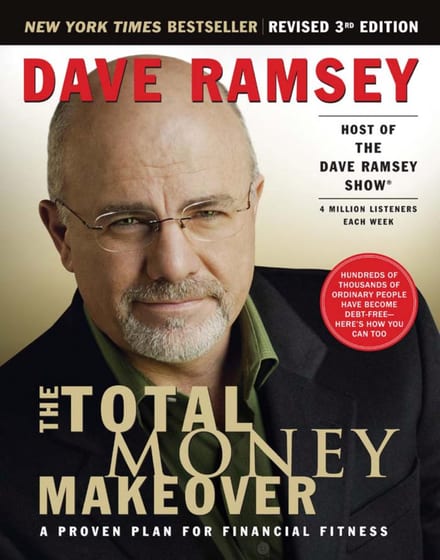
The Total Money Makeover: A Proven Plan for Financial Fitness
A Proven Plan for Financial Fitness
The full book runs ~240 pages — roughly 4 hours of reading. You get the key ideas here in 5 minutes.
The key ideas
- Treat debt as risk, not a tool — the risk collects over a lifetime.
- Write the budget before the month starts: income minus outgo equals zero.
- Run the seven Baby Steps in order, one at a time.
- Attack the smallest balance first; momentum beats optimal interest math.
- Bank $1,000, then three to six months of expenses, before investing.
- Check the 12 percent assumption — the early steps don't rest on it.
The summary
Money is not a math problem. Dave Ramsey’s plan rests on the claim that personal finance is 80 percent behavior and 20 percent head knowledge — most people already know they should spend less than they make, and knowing it changes nothing. By twenty-six Ramsey held real estate worth over $4 million, and he was better at borrowing money than at buying buildings; three years later he was bankrupt with a toddler and a newborn at home. The quest that followed ended somewhere uncomfortable: his mirror.
The problem is the person in the mirror
Denial is the first obstacle, and easy to sustain because financial fat doesn’t show. One reader knew the Wall Street Journal’s finding that 70 percent of Americans live paycheck to paycheck and assumed she was in the other 30 percent — until her job went, and $45,000 of the household’s $75,000 income with it.
The second obstacle is the audience you’re performing for. Tom Stanley’s The Millionaire Next Door found the typical millionaire lives in a middle-class home, drives a paid-for car two years old or older, and buys blue jeans at Wal-Mart. Compare a couple in Ramsey’s counseling office making $93,000 a year: a $400,000 home they owe $390,000 on, two $30,000 leased cars, $52,000 in credit-card debt, $2,000 in savings. Hence the motto printed across the bottom of every page: live like no one else now, and later you can live like no one else.
Debt is not a tool
Ramsey was taught in real estate training that debt is a fulcrum and lever, letting you lift what you otherwise couldn’t. His answer: debt carries enough risk to cancel whatever advantage it buys, and given a lifetime, the risk collects. Of the Forbes 400, 75 percent said the best way to build wealth is to become and stay debt-free.
The numbers are the argument. A new $28,000 car loses about $17,000 of value in its first four years — roughly a $100 bill thrown out the window every week on your commute — and the average car payment, per the Federal Reserve, runs $495 over sixty-four months. And the credit score everyone protects is 35 percent payment history, 30 percent debt levels, 15 percent length of debt, 10 percent new debt, 10 percent type of debt: every input is borrowing. It’s an “I Love Debt” score, Ramsey says, and his own is zero.
Give every dollar a name, then take the steps in order
Before any of it works, you write a budget every month, before the month starts. Income minus outgo equals zero — every dollar gets an assignment, categories like groceries get funded with cash in envelopes, and married couples both sign off before a dollar moves.
Then seven steps, one at a time, each to the exclusion of the others:
- Save $1,000 fast — $500 if your household income is under $20,000.
- The debt snowball — clear every debt except the house.
- Finish the emergency fund — three to six months of expenses, usually $5,000 to $25,000.
- Invest 15 percent of gross income for retirement, company match not counted.
- Save for college in an ESA or 529.
- Pay off the mortgage — never more than a fifteen-year fixed at 25 percent of take-home pay.
- Build wealth, have fun with it, and give it away.
The order matters. A fifty-five-year-old with nothing saved wants to jump to step four; skipping ahead, Ramsey argues, makes retiring with dignity less likely, because the first emergency gets funded by cashing out that new plan.
The snowball is deliberately bad math
List every debt but the house smallest balance to largest, ignoring interest rates — rate breaks ties only when two payoffs are close. Pay minimums on everything but the smallest, throw every spare dollar at that one, then roll its payment onto the next.
Ramsey knows this isn’t optimal: he used to start with the math, and concluded that motivation matters more here. Pay off a $52 medical bill and a $122 cell-phone bill in the first week and nothing has changed mathematically, but you’ve seen the plan work and you’ll keep going. “If you were so fabulous with math, you wouldn’t have debt.” The step runs on what he calls gazelle intensity: the gazelle survives the cheetah by outmaneuvering it, not outrunning it. He’ll have you stop 401(k) contributions here even when your employer matches them 100 percent. Expect eighteen to twenty months for steps one and two, and about seven years to the day the mortgage dies.
Everything downstream rests on 12 percent
Ramsey’s projections assume good growth-stock mutual funds return 12 percent long-term, and he opens the book defending it, because it draws the most fire. His support: the S&P 500’s 11.67 percent annual average over the last eighty-plus years as of writing, including the 2008 crash, plus a fund he owns averaging 12.03 percent since 1934.
Look what rides on it. A $495 car payment invested from twenty-five to sixty-five becomes $5,881,799.14. A couple on the average household income of $50,233 investing $625 a month from thirty to seventy ends with $7,588,545, tax-free. Retirement income assumes 12 percent earned, 4 percent lost to inflation, and 8 percent to live on — so $500,000 funds $40,000 a year forever. Ramsey’s own defense cuts both ways: “What if I’m half wrong? What if I’m six times wrong?” Halve the returns and the behavioral core survives intact. The retirement arithmetic doesn’t.
The bottom line
Getting out of debt is a discipline problem wearing a math costume, and Ramsey’s fix is a written monthly budget, cash instead of credit, and a payoff order built for momentum rather than lowest interest cost. His figures for the far end rest on an assumption worth checking; the first three steps don’t depend on it at all. Read it if you have consumer debt and already tried the optimized version and quit.
Fact check
Popular books repeat findings that later research has complicated. Where The Total Money Makeover makes a testable claim, here's what the evidence actually shows.
Good growth-stock mutual funds return about 12 percent a year over the long run, which makes it safe to live on 8 percent of a nest egg every year in retirement — 12 percent earned, 4 percent lost to inflation — without ever touching the principal.
The 12 percent figure sits close to the simple average of the S&P 500's yearly returns with dividends, which is 11.9 percent across 1928 through 2025. Savings, though, grow at the compounded rate, and over those same 98 years that is 10.0 percent — before fund fees and before inflation — which is why the same starting dollar reaches a very different place over a 40-year projection. The gap bites hardest at the withdrawal end: Bengen's foundational study of historical returns found a 4 percent inflation-adjusted first-year withdrawal never drained a portfolio in under 33 years, called 5 percent risky and 6 percent 'gambling', and did not chart 7 percent or higher because capital ran out too quickly to be practical. An 8 percent draw is roughly double what that literature treats as durable.
- Damodaran A. Historical Returns on Stocks, Bonds and Bills: 1928-2024. NYU Stern School of Business data set, annual returns through 2025, updated January 5, 2026. Source
- Bengen WP. Determining Withdrawal Rates Using Historical Data. Journal of Financial Planning. October 1994 (reprinted by the Financial Planning Association, 2004). Source
Paying off debts smallest balance first, ignoring interest rates, gets more people out of debt than paying the highest rate first, because momentum matters more than the arithmetic.
The behavioral half of this holds up. A field study of indebted consumers with multiple accounts, backed by three experiments, found that concentrating repayment into a single account rather than spreading it across several raised motivation and led people to repay more aggressively — and the effect was strongest when the money went to the smallest balance, because people read their overall progress from the largest proportional drop in any one account. Separately, in data from a debt settlement firm, the share of accounts a person had closed predicted whether they eliminated their debt, while the dollar balance of what they closed did not. None of this repeals the interest arithmetic: ignoring rates does cost money, so the snowball wins on follow-through rather than on total cost.
- Kettle KL, Trudel R, Blanchard SJ, Häubl G. Repayment Concentration and Consumer Motivation to Get Out of Debt. Journal of Consumer Research. 2016;43(3):460-477. Source
- Gal D, McShane BB. Can Small Victories Help Win the War? Evidence from Consumer Debt Management. Journal of Marketing Research. 2012;49(4):487-501. Source
People spend less when they pay with cash than with a card, which is why spending categories should be funded with cash in envelopes.
The direction is right, but the effect is smaller than the envelope system's reputation suggests. A 2024 meta-analysis pooling 392 effect sizes from 71 papers found a small though statistically significant cashless effect — more spending on cards than on cash — that is strongest for conspicuous purchases meant to signal status, weakest for pro-social spending such as donations and tipping, and generally weaker over time as card use became routine. The early experiment that made the idea famous put willingness to pay as much as 100 percent higher when people were told to use a credit card, which is far above the pooled estimate.
- Schomburgk L, Belli A, Hoffmann AOI. Less cash, more splash? A meta-analysis on the cashless effect. Journal of Retailing. 2024;100(3):382-403. Source
- Prelec D, Simester D. Always Leave Home Without It: A Further Investigation of the Credit-Card Effect on Willingness to Pay. Marketing Letters. 2001;12(1):5-12. Source
About 70 percent of Americans live paycheck to paycheck.
No federal survey measures anything near 70 percent. In the Federal Reserve's 2024 Survey of Household Economics and Decisionmaking, 63 percent of adults said they could cover a surprise $400 expense entirely with cash or its equivalent, leaving about 37 percent who could not, and 51 percent reported spending less than their income in the month before the survey — meaning roughly half spent all of it or more. The strain the figure points at is real, and about half of adults genuinely run without margin in a given month. But 70 percent comes from private surveys in which respondents decide for themselves what the phrase means, and the number moves with the wording.
- Board of Governors of the Federal Reserve System. Economic Well-Being of U.S. Households in 2024 — Executive Summary. Survey of Household Economics and Decisionmaking, May 2025. Source
Frequently asked questions
What is The Total Money Makeover about?
Dave Ramsey's plan rests on the claim that personal finance is 80 percent behavior and 20 percent head knowledge — most people already know they should spend less than they make, and knowing it changes nothing. So the book targets the person in the mirror: denial, the audience you're performing for, and the belief that debt is a useful tool. What replaces them is a written monthly budget and seven steps taken strictly in order.
What are the key takeaways from The Total Money Makeover?
Debt isn't a lever — it carries enough risk to cancel whatever advantage it buys, and 75 percent of the Forbes 400 said staying debt-free is the best way to build wealth. Budget before the month starts, with income minus outgo equal to zero, cash in envelopes for categories like groceries, and both spouses signing off. Then the seven Baby Steps: $1,000 saved fast, the debt snowball, a three-to-six-month emergency fund, 15 percent of gross income invested, college savings, the mortgage, then building wealth and giving it away. The snowball is deliberately bad math — smallest balance first, interest rates ignored — because paying off a $52 medical bill in week one proves the plan works and keeps you going. Expect eighteen to twenty months for the first two steps.
Who should read The Total Money Makeover?
Read it if you have consumer debt and already tried the mathematically optimized version and quit. It's written for people who need momentum more than they need the lowest interest cost.
Is The Total Money Makeover worth reading?
The behavioral core is solid, and the first three steps work regardless of what markets do. The part worth checking is the 12 percent long-term return Ramsey assumes for good growth-stock mutual funds, because his headline numbers ride on it — a $495 car payment invested from twenty-five to sixty-five becoming $5,881,799.14. As he puts it himself, what if he's half wrong? Halve the returns and the discipline survives intact; the retirement arithmetic doesn't. Skip it if you want nuanced investing advice rather than a debt-payoff plan.