Book summary
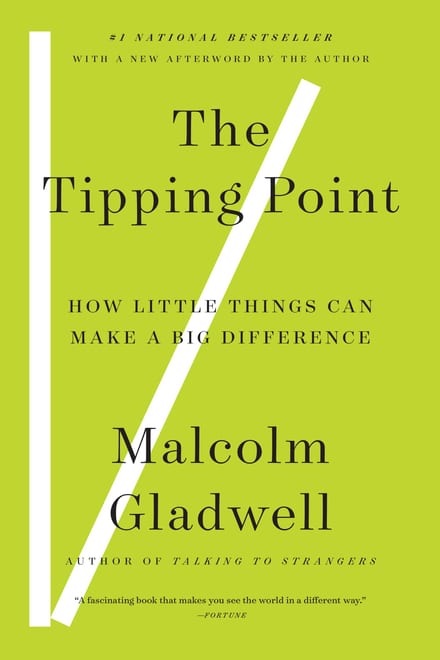
The Tipping Point: How Little Things Can Make a Big Difference
The full book runs ~288 pages — roughly 5 hours of reading. You get the key ideas here in 3 minutes.
The key ideas
- Trends creep quietly, then explode past a critical threshold.
- Connectors, Mavens, and Salesmen drive disproportionate viral spread.
- Small tweaks make messages memorable and impossible to ignore.
- Environment shapes behavior more powerfully than character.
- Fixing trivial disorder can collapse an entire crime epidemic.
- Groups stay cohesive only up to about 150 people.
The summary
A fashion craze, a crime wave, a new gadget — Malcolm Gladwell’s insight is that they all spread the way a virus does. Growth creeps along almost invisibly, then crosses a threshold and detonates. Hush Puppies sat near death until a few downtown Manhattan hipsters started wearing them, and within two years sales leapt by about two million pairs. Sharp’s affordable fax machine grew quietly from its 1984 launch until 1987, when enough people owned one that everyone without a fax suddenly needed to buy in, and the sales curve turned straight up. That moment, when a trend stops creeping and becomes an epidemic, is the tipping point, and Gladwell argues it hinges on three things: the people carrying the message, the message itself, and the conditions around it.
The Law of the Few
Epidemics don’t spread evenly; a tiny minority does most of the work. It’s the familiar 80-20 pattern — 20% of employees do 80% of the work, 20% of drinkers down 80% of the beer — except that viral spread runs to even sharper extremes. The early US AIDS epidemic, Gladwell notes, traces substantially to a single flight attendant who had sex with more than 2,500 people. In social epidemics the equivalent super-spreaders come in three kinds. Connectors are the people with an unusual number of ties across many different worlds, and because they bridge otherwise separate circles, they’re the ones who carry an idea from one milieu to the next — their casual weak ties turn out to matter more for spreading than a few close friendships. Mavens are the information collectors: they hoard knowledge and feel driven to share it, and though their network may be small, the people in it trust their recommendations completely. Salesmen supply the persuasion, winning people over with energy, enthusiasm, and a kind of emotional expressiveness that builds trust fast. To move an idea, you don’t have to reach everyone — you have to reach these few.
The Stickiness Factor
Even the right messengers fail if the message doesn’t lodge in memory. Stickiness isn’t about volume; it’s about finding the small tweak that makes something impossible to shake. Winston became the best-selling cigarette in America partly on a slogan with a deliberate grammatical error — “Winston tastes good like a cigarette should,” where “like” should have been “as” — because the wrongness made it catch. Sesame Street only became a phenomenon once its producers made one structural change: instead of keeping the human actors and the Muppets in separate segments, they mixed them into the same scenes, and children couldn’t look away. Tiny adjustments, enormous outcomes — as long as you find the right lever.
The Power of Context
Behavior is shaped by immediate circumstances far more than we like to admit. In one experiment, seminary students were sent across campus to give a talk; some were told they had plenty of time, others that they were already late. Each passed a man collapsed in their path. Among the unhurried, 64% stopped to help; among the rushed, only 10% did. The variable wasn’t character — it was whether they felt behind schedule. The Stanford Prison Experiment made the same point more disturbingly: twenty-four healthy men were randomly cast as guards and prisoners in a mock jail, and within six days the guards had turned abusive and the prisoners were breaking down, forcing the study to shut down early. If artificial conditions can do that, small real ones can too — which is why New York City’s crime epidemic of the 1990s receded after authorities went after graffiti and subway fare-jumping. Scrubbing the trains and stopping turnstile jumpers signaled that disorder was being watched, and serious crime fell as the context shifted.
The Rule of 150
There’s a natural ceiling on all of this. Gladwell puts the number of stable relationships a person can maintain at roughly 150. Push a community, a club, or a company team past that size and it starts to fracture, because the informal social pressure that holds a group together depends on people actually knowing one another. Beyond 150, you can’t keep track of everyone well enough to care what they think, and they can’t know you well enough to hold you accountable — so cohesion quietly breaks down.
The bottom line
Things catch on when three forces line up: a handful of exceptionally connected, knowledgeable, or persuasive people carry a message that’s been made memorable, and the surrounding context tips people toward acting on it. Get all three right and slow growth flips into wildfire. Read this if you want to understand why some ideas explode while others, no better, never move at all.
Fact check
Popular books repeat findings that later research has complicated. Where The Tipping Point makes a testable claim, here's what the evidence actually shows.
New York City's 1990s crime epidemic receded because authorities cracked down on graffiti and subway fare-jumping.
Levitt's accounting credits four factors for the 1990s decline — more police officers, a larger prison population, the receding crack epidemic and legalized abortion — and places policing strategy among the six that do not explain it. New York's crime drop began in 1990, three years before Giuliani took office, and the NYPD grew 45% between 1991 and 2001, about three times the national average; adjusting for that headcount alone turns the city's 73.6% homicide decline into roughly 55.6%, close to average among large cities. Cities that adopted nothing resembling the disorder crackdown recorded comparable drops. Something in New York's policing may have helped, but the evidence points at how many officers there were rather than at graffiti and turnstiles.
- Levitt SD. Understanding why crime fell in the 1990s: four factors that explain the decline and six that do not. J Econ Perspect. 2004;18(1):163-190. Source
The Stanford Prison Experiment showed that ordinary people randomly assigned to be guards spontaneously turn abusive, proving situation overrides character.
The archive shows the guards were coached rather than spontaneously corrupted by the role. Le Texier's review of Zimbardo's papers and interviews with surviving participants documents explicit instructions to guards to act tough, strong demand characteristics, selective data collection, and a design lifted from an earlier student-run prison study. Haslam and colleagues read the same material and conclude the cruelty followed experimenter leadership that framed harshness as serving a worthwhile cause. The broader point that circumstances shape behavior rests on other evidence; this study does not carry it.
The early US AIDS epidemic traces substantially to one flight attendant, the 'Patient Zero' who had sex with more than 2,500 people.
Genetic sequencing settled this. Worobey's team recovered eight complete HIV-1 genomes from 1978-79 US serum samples along with the genome of the man labelled 'Patient 0', and found neither biological nor historical evidence that he was the primary case. HIV-1 reached the United States from a pre-existing Caribbean epidemic around 1970 and had already diversified extensively across the country before he was ever identified, with New York City as the hub. He was one early case among many, not the source.
- Worobey M, Watts TD, McKay RA, et al. 1970s and 'Patient 0' HIV-1 genomes illuminate early HIV/AIDS history in North America. Nature. 2016;539(7627):98-101. PubMed
People can maintain roughly 150 stable relationships, and groups larger than that start to fracture.
The number 150 does not survive re-analysis of the data it came from. Lindenfors and colleagues re-ran the primate brain-size-to-group-size extrapolation and obtained 69-109 using Bayesian methods and 16-42 using phylogenetic ones, with 95% confidence intervals spanning 4-520 and 2-336 — ranges wide enough that the authors conclude naming any single figure is futile and that a cognitive ceiling on human group size cannot be derived this way. That social capacity has limits is not in dispute; the precise threshold, and the claim that cohesion breaks down just past it, is far less firm than the book presents it.
- Lindenfors P, Wartel A, Lind J. 'Dunbar's number' deconstructed. Biol Lett. 2021;17(5):20210158. PubMed
Frequently asked questions
What is The Tipping Point about?
Fashions, crime waves, and new gadgets all spread the way a virus does: growth creeps along almost invisibly, then crosses a threshold and detonates. That moment when a trend stops creeping and becomes an epidemic is the tipping point, and it hinges on three things, the people carrying the message, the message itself, and the conditions around it.
What are the key takeaways from The Tipping Point?
Three rules drive epidemics. The Law of the Few says a tiny minority does most of the spreading, split into Connectors who bridge many worlds, Mavens who hoard and share information, and Salesmen who persuade. The Stickiness Factor is the small tweak that makes a message impossible to forget, like Sesame Street mixing Muppets into human scenes. The Power of Context says immediate circumstances shape behavior more than character, as in New York's crime drop after cracking down on graffiti and fare-jumping. And the Rule of 150 sets a natural ceiling on how many stable relationships a group can hold.
Who should read The Tipping Point?
Anyone who wants to understand why some ideas explode while others, no better, never move at all.
Is The Tipping Point worth reading?
It gives you a memorable vocabulary, Connectors, Mavens, Stickiness, Context, for how things catch on, carried by sticky stories like Hush Puppies and the fax machine. Some of its case studies, such as the Stanford Prison Experiment, have drawn later scrutiny, so treat the examples as illustration rather than settled proof.