Book summary
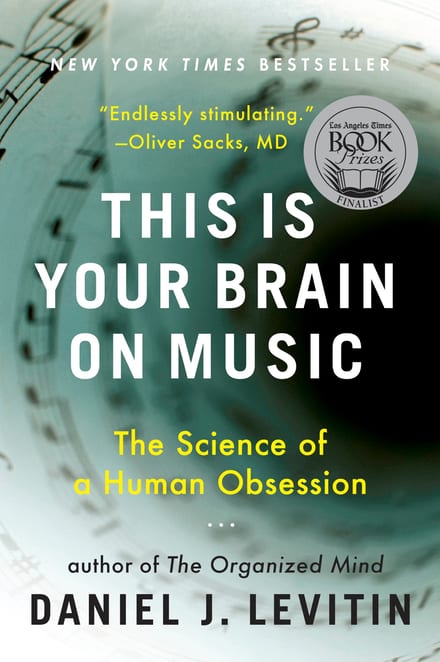
This Is Your Brain on Music: The Science of a Human Obsession
The full book runs ~320 pages — roughly 6 hours of reading. You get the key ideas here in 3 minutes.
The key ideas
- Predict: your brain guesses the next melody, rhythm, and harmony.
- Surprise: violated expectations release dopamine and give you chills.
- Recognize: songs fire the same neurons, unlocking buried memories.
- Build: pitch, rhythm, timbre, and contour engage the whole brain.
- Practice: 10,000 hours matters far more than raw talent.
- Lock in: musical taste forms early and hardens by 18.
The summary
Music moves you because your brain never stops guessing what comes next. We’re wired to detect patterns and forecast the future, and a piece of music is a running series of predictions about which chord, melody, or rhythm should arrive. Composers understand this intuitively and play with it. When the music sets up an expectation and then bends it—resolving in a way that’s surprising but somehow feels right—the brain rewards the moment with a hit of dopamine, the same neurotransmitter that fires for food, drugs, and sex. That’s the whole trick behind why a chord change or a held pause can raise the hairs on your arm. The emotional force of music isn’t mystical; it’s a prediction machine being surprised in exactly the right way. And the art of composition, Levitin argues, is keeping that balance—too predictable and you’re bored, too chaotic and you’re lost—by building tension, toying with the melody’s pull back toward its starting note, and then releasing it in a way that feels both unexpected and inevitable.
What music is made of, and how much of you it uses
Levitin breaks music down into a set of building blocks, each one a separate dimension your brain tracks:
- Pitch — which note is played, a C or a G.
- Rhythm — the spacing of time between notes.
- Tempo — how fast the piece moves.
- Contour — the shape of the melody as it rises and falls.
- Timbre — the tonal color that makes a piano and a guitar sound different on the same note, and makes your voice yours.
- Loudness — how much energy the sound carries.
- Reverberation — the sense of distance or room size it conveys.
What’s striking is how much of the brain this engages. Modern imaging shows that nearly every region, from the evolutionarily newest structures to the most primitive, switches on when you process music—the auditory cortex, the motor cortex, the amygdala, the hippocampus—all working in parallel to handle pitch, rhythm, melody, harmony, and lyrics at once. That may be why music appears in every human society despite having no obvious survival value. Levitin notes the debate over its origins, between those who see it as a mere pleasurable by-product of language and the majority who suspect an evolutionary basis, perhaps as a forerunner of speech or a courtship display that advertised health, affluence, and sexual vigor. Whatever its source, it sharpens attention, perception, and problem-solving, and it activates circuits tied to empathy, trust, and cooperation.
Why a song reopens a memory, and why a groove makes you move
The prediction engine also explains why a few notes are enough to name a tune. Each time you hear a song, a specific set of neurons fires and leaves an imprint, and when you hear it again—or just imagine it—the same pattern lights up. Because the brain uses the same regions to hear music and to remember it, songs get bound to particular moments and become keys that reopen whole scenes from your past. Then there’s groove, the palpable momentum you feel when a beat really locks in. Perceiving groove activates the cerebellum, the region that governs balance and movement, which is direct evidence that human emotion and motion are wired together. Composers exploit groove the same way they exploit melody, using it to set up expectations and then break them to communicate feeling.
Skill is hours, and taste is exposure
Two of the book’s most freeing claims are about where musical ability and preference actually come from. Expertise, Levitin says, depends overwhelmingly on practice: the most skilled players are simply the ones who have logged the most time, on the order of 10,000 hours, and perceived “talent” is largely beside the point. Genetics and environment matter—scientists’ best guess is around 50%, so large hands and good hand-eye coordination help a pianist, while poor nutrition and an unstable childhood hold a musician back—but the dominant variable is time spent practicing. Taste, meanwhile, is mostly familiarity. Your preferences begin before birth, since babies prefer music they heard in the womb, and they harden as you associate songs with good experiences, usually settling by around age 18. There’s no true cutoff for learning to love something new, but it gets harder, and you tend to gravitate toward music that feels safe, because listening leaves you a little vulnerable—and toward the sweet spot that’s neither so simple it bores you nor so complex you can’t predict where it’s going.
The bottom line
Music grips us because the brain is a prediction machine, and composers trigger dopamine by violating its forecasts in controlled, satisfying ways. Your taste is largely a matter of early exposure and familiarity, and your skill is largely a matter of hours logged rather than any innate gift. Read this if you’ve ever wondered why a song can make you cry, or why you still love the music you first heard as a teenager.
Fact check
Popular books repeat findings that later research has complicated. Where This Is Your Brain on Music makes a testable claim, here's what the evidence actually shows.
Music produces chills because violating the brain's musical expectations triggers a dopamine release.
PET imaging caught endogenous dopamine release in the striatum at peak emotional arousal during music listening, with the caudate engaged during anticipation and the nucleus accumbens during the peak itself. A later double-blind drug study in 27 people made the link causal: levodopa raised music-evoked pleasure and motivation, risperidone lowered both. The expectation half holds as well — accumbens activity tracks formally modeled musical reward prediction errors — though one 2019 study found the accumbens reflected uncertainty while the amygdala, hippocampus and auditory cortex carried the surprise, so the circuitry is less tidy than a single dopamine hit.
- Salimpoor VN, Benovoy M, Larcher K, Dagher A, Zatorre RJ. Anatomically distinct dopamine release during anticipation and experience of peak emotion to music. Nat Neurosci. 2011;14(2):257-262. PubMed
- Ferreri L, Mas-Herrero E, Zatorre RJ, et al. Dopamine modulates the reward experiences elicited by music. Proc Natl Acad Sci U S A. 2019;116(9):3793-3798. PubMed
- Gold BP, Mas-Herrero E, Zeighami Y, Benovoy M, Dagher A, Zatorre RJ. Musical reward prediction errors engage the nucleus accumbens and motivate learning. Proc Natl Acad Sci U S A. 2019;116(8):3310-3315. PubMed
The most skilled musicians are simply the ones who logged the most hours — roughly 10,000 — and innate talent is largely beside the point.
Deliberate practice explained 21% of the variance in music performance in a meta-analysis spanning every major expertise domain, leaving roughly four-fifths of the difference between players to other factors. A study of 10,500 Swedish twins found the practice-ability link was mostly genetic rather than causal: identical twins who differed in how much they practiced did not differ in rhythm, melody or pitch discrimination, and propensity to practice was itself 40-70% heritable. Hours clearly matter; the round 10,000 figure and the dismissal of talent do not hold.
- Macnamara BN, Hambrick DZ, Oswald FL. Deliberate practice and performance in music, games, sports, education, and professions: a meta-analysis. Psychol Sci. 2014;25(8):1608-1618. PubMed
- Mosing MA, Madison G, Pedersen NL, Kuja-Halkola R, Ullén F. Practice does not make perfect: no causal effect of music practice on music ability. Psychol Sci. 2014;25(9):1795-1803. PubMed
Musical taste begins before birth and is essentially locked in by around age 18.
The prenatal half has real support: infants whose mothers played them a melody five times a week through the third trimester showed stronger brain responses to that melody at birth and still at four months, with response size tracking the amount of exposure. The age-18 cutoff is tighter than the evidence. The musical reminiscence bump spans late adolescence and early adulthood rather than stopping at 18, and young adults rating five decades of hits showed an equally strong peak for their parents' generation's music — picked up in childhood, long before the supposed formative window.
Frequently asked questions
What is This Is Your Brain on Music about?
Music moves you because your brain never stops guessing what comes next. A piece of music is a running series of predictions about which chord, melody, or rhythm should arrive, and when it sets up an expectation and then bends it in a way that's surprising but somehow feels right, the brain rewards the moment with a hit of dopamine. The emotional force of music isn't mystical; it's a prediction machine being surprised in exactly the right way.
What are the key takeaways from This Is Your Brain on Music?
Music breaks into building blocks your brain tracks separately, pitch, rhythm, tempo, contour, timbre, loudness, and reverberation, and processing it switches on nearly every region of the brain at once. Songs get bound to specific moments and become keys that reopen memories, while groove links emotion to motion through the cerebellum. Two freeing claims stand out: skill is mostly hours logged, on the order of 10,000, rather than innate talent, and taste is mostly early exposure and familiarity, usually settling by around age 18.
Who should read This Is Your Brain on Music?
Anyone who has ever wondered why a song can make them cry, or why they still love the music they first heard as a teenager.
Is This Is Your Brain on Music worth reading?
It connects real neuroscience to the everyday experience of listening, and its claims about practice over talent and familiarity over "good taste" are genuinely freeing. Some passages get technical about music theory and brain regions, so readers who want pure pop science without the detail may find stretches heavy going.