Book summary
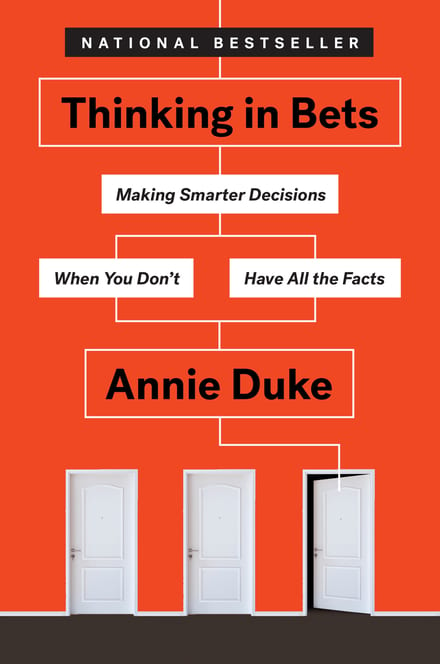
Thinking in Bets: Making Smarter Decisions When You Don't Have All the Facts
Making Smarter Decisions When You Don't Have All the Facts
The full book runs ~276 pages — roughly 5 hours of reading. You get the key ideas here in 5 minutes.
The key ideas
- Separate decision from outcome: Carroll's pass was sound math, killed by a 2% interception.
- Treat choices as bets against every future version of yourself you didn't pick.
- Rate beliefs zero to ten; moving from 58% to 46% costs no ego.
- Sort outcomes honestly: 37% of single-vehicle crash drivers still blamed someone else.
- Recruit a truthseeking pod: experts betting money beat the same experts peer-reviewing.
- Run premortems: dieters who pictured obstacles lost twenty-four more pounds than dreamers.
The summary
Twenty-six seconds left in Super Bowl XLIX, second down on the one-yard line, and Seattle’s Pete Carroll called a pass instead of handing to Marshawn Lynch. It was intercepted; USA Today called it the worst play call in NFL history. Yet none of the sixty-six passes thrown from an opponent’s one-yard line that season had been intercepted, and the fifteen-year rate was 2 percent. A defensible call, a disastrous result. Poker players have a name for what his critics did: resulting — grading a decision by how it turned out. Two things decide how a life goes, decision quality and luck, and most of our errors come from refusing to separate them.
Life is poker, not chess
John von Neumann built game theory on poker, not chess. Real life, he said, “consists of bluffing, of little tactics of deception, of asking yourself what is the other man going to think I mean to do.” Lose at chess and there was a move you missed. Life is the other game: you can run a red light and sail through, or obey every signal and get hit anyway.
Ask executives for their worst decision of the past year and nobody names a well-reasoned choice that flopped. One CEO named firing his president, because sales fell afterward — never mind the benchmarking against competitors, the coach hired for the man, the alternative of splitting the role that was weighed and rejected. Good process, bad result, filed as a mistake. He decided he drove better drunk.
Every decision is a bet on an uncertain future
In the 1990s a Vegas card game talked high-stakes pro John Hennigan into moving to Des Moines for a month for $30,000, confined to one street where everything closed at 10 p.m. Two days in, he called to settle, opening with an offer that they pay him $15,000. Days later he paid them $15,000 to come home.
Strip off the folklore and the analysis is what anyone runs on a job offer: upside, downside, opportunity cost. A bet is “a choice made by thinking about what will probably happen,” which makes parenting, hiring and ordering the chicken bets too. Most aren’t against another person — they’re against every future version of you that you didn’t pick.
Say “I’m not sure,” then put a number on it
Your bets are only as good as your beliefs, and beliefs form carelessly. We assume we hear something, vet it, then believe it; Daniel Gilbert’s experiments found the real order is hear, believe, and only sometimes vet later. Hence the habit of multiplying dog years by seven — a ratio someone made up around the thirteenth century.
Intelligence doesn’t rescue you. Dan Kahan gave people data about a skin cream and the numerate ones read it correctly. Relabel the same numbers as gun control and crime, and the more numerate subjects made more errors than their less numerate allies. The better you are with numbers, the better you are at bending them.
The repair is small and slightly awkward: rate your confidence. Not “Citizen Kane won best picture” but “I’m a six on that.” A scale gives you somewhere to move when evidence arrives. “I was 58 percent, now I’m 46” costs nothing. “I was right and now I’m wrong” costs your self-image, so you fight it.
Luck bucket, skill bucket
Every outcome must be filed: skill, or luck? Duke’s first regular game, in a Billings basement, included a player called Nick the Greek, who reasoned that since everyone expects aces, the mathematically worst hand was the best one to play. When seven-deuce won, brilliance. When it lost, bad luck. He went broke.
We all file like Nick. Robert MacCoun found that 75 percent of drivers describing accidents blamed someone else — 91 percent in multi-car crashes, 37 percent even in single-vehicle ones. For others we flip it: Steve Bartman, one of several fans reaching for the same foul ball, collected a decade of death threats.
The counter-model is Phil Ivey, who spent the dinner after a half-million-dollar win walking another pro through every error he thought he’d made getting there. Duhigg’s rule for habit change — keep the cue and the reward, swap the routine — applies: take your ego hit for being the best credit-giver in the room.
Borrow other people, and other versions of yourself
Duke recommends a small truthseeking pod — three is enough, two to disagree and one to referee — chartered around accuracy, accountability and real disagreement. Erik Seidel put it plainly: ask me about strategy all day, but there’s no point in a poker story about something you couldn’t control. Experts betting real money on which psychology studies would replicate were right 71 percent of the time, against 58 percent for the same experts in ordinary peer review.
Then recruit yourself. Jerry Seinfeld’s Night Guy stays up late because exhaustion is Morning Guy’s problem; Suzy Welch’s 10-10-10 asks how a choice will look in ten minutes, ten months and ten years. Shown an age-progressed face in a Stanford virtual-reality study, people put $178.10 of a hypothetical $1,000 into retirement; shown their current face, $73.90. Bind your hands in advance like Ulysses: a loss limit, an automatic transfer. And run a premortem: write tomorrow’s headline announcing that you failed, then explain why. Gabriele Oettingen’s dieters who fantasized hardest about success lost twenty-four pounds less than those who pictured obstacles.
The bottom line
Grade the process, not the scoreboard: no prediction short of 0 or 100 percent is proven wrong by a single result. The present works like a chainsaw on the tree of possible futures, cutting off every branch that didn’t happen until what did happen looks inevitable — which is why writing the odds down beforehand is the only real defense. Read it if you make consequential calls under uncertainty and you’re tired of being graded on luck.
Fact check
Popular books repeat findings that later research has complicated. Where Thinking in Bets makes a testable claim, here's what the evidence actually shows.
Experts betting real money on which psychology studies would replicate were right 71% of the time, against 58% for the same experts going through ordinary peer review.
The 71% is accurate: prediction markets called 29 of 41 completed Reproducibility Project: Psychology replications correctly. The 58% comparison, however, came from a survey of the same traders' private forecasts collected before the markets opened, not from peer review — the study never measured peer reviewers at all. Markets did beat that survey, and beat an expertise-weighted version of it that scored 50%, so the point about money sharpening judgement survives; the peer-review framing does not.
- Dreber A, Pfeiffer T, Almenberg J, et al. Using prediction markets to estimate the reproducibility of scientific research. Proc Natl Acad Sci U S A. 2015;112(50):15343-15347. PubMed
Drivers recounting their own crashes overwhelmingly blame someone else — about 75% of the time overall, and 37% even when no other vehicle was involved.
Filing your own bad outcomes under bad luck is one of the largest and best-replicated effects in social psychology. A meta-analysis of 266 studies yielding 503 independent effect sizes put the self-serving attributional bias at d = 0.96 and found it in nearly every sample tested. It is not quite universal: it shrank to d = 0.30 in Asian samples and to d = 0.21 among people with depression. The specific driver percentages trace to MacCoun's analysis of motorists' own accident accounts, and sit squarely inside that pattern.
- Mezulis AH, Abramson LY, Hyde JS, Hankin BL. Is there a universal positivity bias in attributions? A meta-analytic review of individual, developmental, and cultural differences in the self-serving attributional bias. Psychol Bull. 2004;130(5):711-747. PubMed
- MacCoun RJ. Blaming others to a fault? Chance. 1993;6(4). Source
Seeing a digitally aged image of your own face makes people commit substantially more money to retirement.
The direction holds, but the headline figure rests on 50 undergraduates in a virtual-reality lab: they put a mean of $172 of a hypothetical $1,000 into a retirement account after meeting their age-progressed selves, against $80 for those shown their current face — with standard deviations of $214 and $130, larger than the means themselves. The same paper's more realistic online and community versions produced far narrower gaps, 6.76% of salary versus 5.20% and 6.17% versus 4.41%. Every allocation was hypothetical; none tracked money actually saved.
- Hershfield HE, Goldstein DG, Sharpe WF, et al. Increasing saving behavior through age-progressed renderings of the future self. J Mark Res. 2011;48:S23-S37. PubMed
Picturing the obstacles in your way beats fantasizing about success when you are trying to reach a goal.
Mental contrasting — imagining the outcome you want, then the concrete obstacle between you and it — does outperform pure positive fantasy, at moderate rather than dramatic size. A meta-analysis of 21 studies and 15,907 participants found g = 0.34 for goal attainment; a separate health-behaviour meta-analysis (N = 1,528) found g = 0.28 at four weeks, rising to g = 0.38 at three months. The larger analysis reports publication bias, so the real effect is likely at the low end of that range.
- Wang G, Wang Y, Gai X. A meta-analysis of the effects of mental contrasting with implementation intentions on goal attainment. Front Psychol. 2021;12:565202. PubMed
- Cross A, Sheffield D. Mental contrasting for health behaviour change: a systematic review and meta-analysis of effects and moderator variables. Health Psychol Rev. 2019;13(2):209-225. PubMed
Frequently asked questions
What is Thinking in Bets about?
Annie Duke, a former professional poker player, argues that only two things determine how your life turns out: the quality of your decisions and luck. Because most choices are made with hidden information, a sound decision can still produce a terrible result, and grading the choice by the outcome is the error poker players call resulting. The book is about telling decision quality and luck apart, and getting better at choosing under uncertainty.
What are the key takeaways from Thinking in Bets?
Treat every choice as a bet on an uncertain future, because picking one path means betting against every other version of you. Say "I'm not sure" and put a number on it: moving from 58 percent to 46 percent when new evidence arrives costs nothing, while going from right to wrong costs your self-image, so you fight it. Sort each result honestly into the luck bucket or the skill bucket instead of claiming the wins and blaming the losses. And bring in outside help: a small truthseeking group, plus tools like 10-10-10, precommitments in the style of Ulysses, and a premortem that imagines failure before you commit.
Who should read Thinking in Bets?
Anyone who makes consequential calls without complete information, from founders and investors to managers, lawyers and coaches. It is also for anyone who replays a bad result at 2 a.m. and assumes they should have seen it coming.
Is Thinking in Bets worth reading?
Yes, if you want a compact and practical way to stop confusing bad outcomes with bad decisions. The poker stories are vivid, the supporting research is real, and the final chapters on scenario planning and premortems give you something you can use on Monday morning. Readers who have already worked through a stack of behavioral-economics books will recognize much of the underlying science; what is fresh here is the execution learned at the table.