Book summary
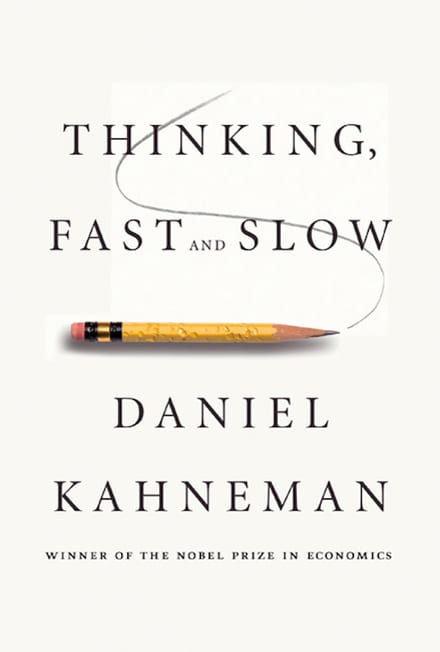
Thinking, Fast and Slow
The full book runs ~528 pages — roughly 10 hours of reading. You get the key ideas here in 5 minutes.
The key ideas
- Two systems drive thought: fast intuition, slow analysis
- Mental shortcuts save effort but warp judgment
- Priming and environment steer you without awareness
- Framing identical facts changes decisions dramatically
- Losses hurt more than equivalent gains feel good
- Remembering self overweights peaks and endings, ignoring duration
The summary
Your mind runs on two systems that don’t cooperate as smoothly as you’d like. System 1 is fast, automatic, and effortless—it turns your head toward a loud bang and reads a face in an instant. System 2 is slow and deliberate—the effortful thinking you use to pick one person out of a crowd or grind through long division. Daniel Kahneman’s central point is that System 1 makes most of your decisions, and System 2, which could catch its mistakes, is lazy and mostly stays out of the way.
Try it: a bat and ball cost $1.10 together, and the bat costs a dollar more than the ball, so how much is the ball? Almost everyone blurts ten cents. The answer is five. System 1 offered something that felt right, and System 2 couldn’t be bothered to check. Kahneman calls this the law of least effort—we spend the minimum mental energy we can get away with—and it’s why we go wrong in such predictable ways. The good news is that deliberately engaging System 2, forcing yourself to slow down and verify, sharpens your thinking over time.
Your environment is always steering you
You are primed by whatever you’ve just encountered, usually without noticing. Read SHOWER, then complete SO_P, and you’ll almost certainly write SOAP; had you just seen FOOD, you’d likely have landed on SOUP. In one famous study, people primed with words about old age—Florida, wrinkles—walked more slowly afterward. Priming reaches your actions, not just your thoughts, which means you’re less in charge of yourself than you assume. Related shortcuts compound the problem. The halo effect lets one pleasant trait stand in for a whole person: you find Bob easy to talk to at a party and later recommend him for a charity drive, though you know almost nothing about him. Confirmation bias makes you wave through anything that fits your existing beliefs and quietly reject the rest.
Shortcuts that mislead
Heuristics are handy until they aren’t. The substitution heuristic answers a hard question by secretly swapping in an easy one—asked whether a tall player is good, you actually answer whether he looks the part. The availability heuristic overweights whatever comes to mind easily: about 80% of people think accidental death is likelier than death by stroke, though strokes kill far more, simply because accidents make the news. Base-rate neglect makes you ignore the underlying odds—see five red taxis in a row and you’ll bet on red again, even though yellow cabs outnumber red four to one. And regression to the mean explains why extremes drift back toward average: five heads in a row doesn’t bend a fair coin, and over enough flips it returns to fifty-fifty.
What you remember isn’t what you felt
You carry two selves. The experiencing self registers how a moment actually feels; the remembering self narrates it afterward—and the remembering self, less accurate but more powerful, is the one that shapes your choices. It falls for the peak-end rule and duration neglect, fixating on the most intense moment and the ending while ignoring how long anything lasted. In one study, patients who sat through a longer colonoscopy remembered it as less painful than those whose shorter procedure ended on a spike of pain. The extra minutes barely registered; the ending was everything. Your mental state matters too. In cognitive ease, System 1 hums along, relaxed and creative but error-prone, while cognitive strain wakes System 2 and makes you careful. You can steer this—repeat a message until it feels familiar and it becomes more persuasive; print a tricky problem in an awkward font and the mild difficulty sharpens your focus.
Framing and the fear of losing
Identical facts sway you differently depending on how they’re dressed. Tell one group a psychiatric patient has a 10% chance of violence and another that 10 of every 100 such patients turn violent, and nearly twice as many in the second group oppose release. Denominator neglect makes a vivid image beat a statistic: “one in 100,000 children will be disfigured” frightens more than “a 0.001% chance,” though they say the same thing. This runs deep enough that Kahneman overturns the old idea that we rationally maximize outcomes. His prospect theory says emotion and reference points rule instead. Loss aversion means losing hurts more than an equal gain pleases—you’d rather simply gain $1,000 than gain $2,000 and then lose $1,000, even though you end up in the same place. Diminishing sensitivity means losing $100 stings less after a $1,000 win than after a $200 one. And because we lean too hard on tidy mental images—picturing summer as hot and wearing a T-shirt into a cold snap—Kahneman recommends reference class forecasting, recalling what actually happened last time, and a long-term risk policy of planning for several outcomes, like packing the sweater just in case.
The bottom line
Most of your judgments come from a fast, confident system that quietly trades hard questions for easy ones, and the deliberate mind that could correct it rarely bothers. The only reliable defense is to notice when a decision matters and force yourself to slow down. Read this if you make decisions, which is to say all of us.
Fact check
Popular books repeat findings that later research has complicated. Where Thinking, Fast and Slow makes a testable claim, here's what the evidence actually shows.
Being exposed to words about old age makes people walk more slowly afterward, showing that priming reaches behavior and not just thought.
The elderly-walking result comes from a 1996 experiment that has not held up. When Doyen and colleagues repeated it using automated infrared timing rather than hand-held stopwatches, the slowdown disappeared; it reappeared only in a second experiment in which the experimenters had been told which participants were primed, pointing at experimenter expectancy rather than the prime. The broader social-priming literature fared no better: a registered replication run across 40 labs found a 0.14% difference in trivia performance between professor-primed and hooligan-primed participants in the 23 labs that met inclusion criteria (N = 4,493), against the 13% advantage reported in the original study.
Printing a problem in an awkward, hard-to-read font creates enough mild strain to sharpen attention and improve performance on it.
Pooling the original experiment with 16 attempts to repeat it produced no effect of disfluent fonts on solution rates for exactly the kind of trick problems the finding was built on. The authors looked for the benefit among higher- and lower-ability participants, across presentation formats, and in lab versus online settings, and found no condition where it appeared. Hard-to-read type does slow readers down a little, but the extra seconds did not turn into more correct answers.
- Meyer A, Frederick S, Burnham TC, et al. Disfluent fonts don't help people solve math problems. J Exp Psychol Gen. 2015;144(2):e16-e30. PubMed
Memory of a painful procedure is set by its worst moment and its ending rather than its length, so a longer colonoscopy with a gentler finish is remembered as less painful.
The original study recorded real-time pain in 154 colonoscopy and 133 lithotripsy patients and found remembered total pain tracked the peak intensity and the last three minutes, while duration added little. A randomized trial of 682 colonoscopy patients then tested the prescription head-on: leaving the scope in place, unmoving, for a brief extra interval lowered remembered final pain (1.7 vs 2.5 on a ten-point scale), overall unpleasantness (4.4 vs 4.9 on a 10 cm scale), and raised the rate of returning for a repeat procedure (odds ratio 1.41). The direction is solid, though the gaps are modest and the method buys a better memory by adding real minutes to the procedure.
Losses hurt roughly twice as much as equivalent gains feel good, which is why people work harder to avoid a loss than to win a matching gain.
The direction holds up; the size is genuinely disputed. A 2024 meta-analysis of 607 estimates drawn from 150 articles across economics, psychology and neuroscience put the loss aversion coefficient at 1.955, with a 95% interval of 1.820 to 2.102 — close to the roughly 2:1 ratio the book works with. A second 2024 meta-analysis, restricted to studies that estimate the parameter from choices between risky gambles, landed near 1.31 (95% CI 1.10 to 1.53), well under the 2.25 figure from Kahneman and Tversky's 1992 paper, and argued that much of the underlying data is too noisy to pin the number down at all.
Frequently asked questions
What is Thinking, Fast and Slow about?
Your mind runs on two systems. System 1 is fast, automatic, and effortless, the part that turns your head toward a bang or reads a face in an instant; System 2 is slow and deliberate, the effortful thinking you use for long division. The central point is that System 1 makes most of your decisions, and System 2, which could catch its mistakes, is lazy and mostly stays out of the way, which is why we go wrong in such predictable ways.
What are the key takeaways from Thinking, Fast and Slow?
The book catalogs the mind's shortcuts and traps: priming, the halo effect, and confirmation bias; the substitution and availability heuristics; base-rate neglect and regression to the mean. It separates the experiencing self from the remembering self, which falls for the peak-end rule and duration neglect. And it explains framing and loss aversion through prospect theory, recommending reference class forecasting and planning for several outcomes. The only reliable defense is to notice when a decision matters and force yourself to slow down.
Who should read Thinking, Fast and Slow?
Anyone who makes decisions, which is to say all of us.
Is Thinking, Fast and Slow worth reading?
It's a landmark, deeply researched tour of how judgment actually works, full of experiments you can try on yourself like the bat-and-ball problem. It's long and dense, and knowing the biases doesn't make you immune to them, so readers wanting a short, quickly actionable guide may find it demanding.