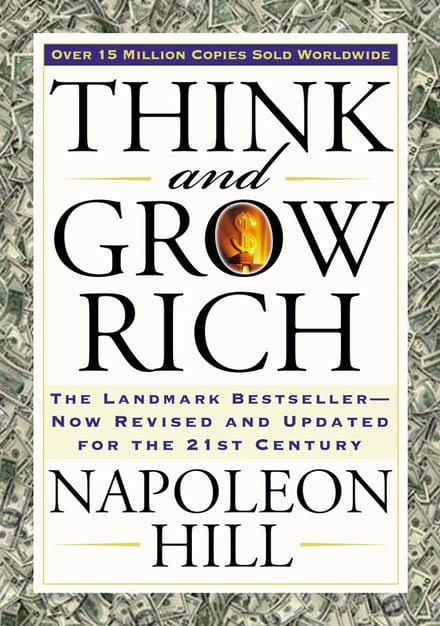
Book summary
Think and Grow Rich
The full book runs ~257 pages — roughly 5 hours of reading. You get the key ideas here in 3 minutes.
The key ideas
- Define wealth as an exact figure with a deadline.
- Feed goals into your subconscious through daily repetition.
- Build faith through auto-suggestion; fear and faith can't coexist.
- Value persistence and specialized knowledge over credentials.
- Decide fast, change slowly, guard your plans.
- Multiply results through a mastermind of uplifting allies.
The summary
Wealth starts as a burning desire, not a wish or a hope. Hill’s first move is to make that desire concrete enough to act on: instead of “get rich,” you name a figure and a deadline, like a specific million dollars in cash or a three-bedroom house in the city, along with the plan and resources to reach it. The sharper the target, the more your mind can organize itself around it. Then you write it down and read it aloud every morning and every night, because that daily repetition is how the desire pushes past your conscious mind and settles into the subconscious, where it quietly begins reshaping what you do.
Faith is the engine, and fear is the brake
Hill traces every notable achievement back to unshakable self-belief. Mahatma Gandhi had no wealth and no army, yet his faith in his power to move his countrymen helped free India. Faith works through what Hill calls auto-suggestion: the mind tends to do whatever it habitually tells itself to do, so persistently visualizing success and convincing yourself the goal will happen nudges your behavior to match. Positive self-talk builds a positive subconscious that produces positive results, and negative self-talk does the reverse. The enemy of all this is fear, which cannot coexist with faith. Hill names six fears that block people most often, of poverty, criticism, illness, old age, loss of love, and death, and insists that because fear is only a state of mind, willpower can master it.
Knowledge, imagination, and stubborn persistence
Formal education matters less than Hill’s contemporaries assumed. What counts is specialized knowledge, organized and applied strategically, plus knowing where to find what you don’t have and building a network of experts who do. Ideas come from two kinds of imagination: creative imagination invents something wholly new, while synthetic imagination recombines existing pieces into fresh forms. Sony turned the journalist’s dictaphone into the Walkman, and Asa Candler turned a headache remedy into Coca-Cola, and both faculties strengthen only when you exercise them like a muscle.
But the trait that actually separates winners is persistence. Thomas Edison ran more than 10,000 failed experiments before the light bulb worked, and the writer Fannie Hurst collected 36 rejections before a newspaper printed her first story. Hill says his own study of over 25,000 people who failed found that lack of persistence, not lack of talent or knowledge, was the leading cause. Persistence pairs with decisiveness, since successful people tend to make decisions quickly and change them slowly. Henry Ford stood behind the Model T through relentless criticism of its looks, and that resolve built one of the largest carmakers in the world.
Guard your circle, and channel your energy
Because we’re naturally prone to laziness and easily dragged down by negativity, Hill urges you to protect your ambitions. Keep your plans to yourself, confiding only in a trusted few, and refuse to let doubters erode your commitment. The positive version of this is the mastermind: a small group of capable, like-minded people who meet regularly to solve problems and hold each other accountable. When they pool their skills, knowledge, and resources toward a shared aim, the combined effect produces more than the sum of the parts, giving you both expertise you lack and a buffer against discouragement.
Hill adds two of his stranger ideas here. Sex transmutation means redirecting sexual energy, which he considers the most powerful human drive, into creative and productive work rather than letting it scatter your focus, potentially unlocking imagination, courage, and willpower. He also describes a “sixth sense,” a creative intuition that alerts successful people to opportunities the five senses miss, and suggests meditation to develop it.
The bottom line
Turning ambition into wealth comes down to a handful of linked disciplines: a burning desire specific enough to name, daily repetition until it sinks into your subconscious, faith strong enough to crowd out fear, persistence through repeated failure, and a mastermind whose combined thinking beats any solo effort. Read this if you want the original blueprint that shaped a century of success writing, keeping in mind it’s a mindset manual for personal growth rather than a step-by-step financial plan.
Fact check
Popular books repeat findings that later research has complicated. Where Think and Grow Rich makes a testable claim, here's what the evidence actually shows.
Repeating your goal aloud every day drives it into the subconscious, and positive self-talk produces positive results.
Positive self-statements help people who already feel good about themselves and backfire on those who don't. In two experiments, participants with low self-esteem who repeated "I'm a lovable person" ended up in a worse mood and rated themselves less favourably than those who repeated nothing, while participants with high self-esteem got a modest lift. The technique has a real effect, but its direction depends on the person using it, and it works least well for the people most likely to reach for it.
- Wood JV, Perunovic WQ, Lee JW. Positive self-statements: power for some, peril for others. Psychol Sci. 2009;20(7):860-6. PubMed
Persistently visualising success and convincing yourself the goal will happen makes it more likely to arrive.
The two halves of that sentence pull in opposite directions, and research has separated them. Across four groups — graduates looking for work, students with a crush, undergraduates facing exams, and patients recovering from surgery — judging success likely predicted more effort and better outcomes, while indulging in positive fantasies about the desired future predicted less effort and less success, on follow-ups running up to two years out. Later experiments found the mechanism: picturing an idealised future lowers physiological arousal and leaves people with less energy for the goal. Expecting to succeed helps; daydreaming about having succeeded substitutes for the work.
Edison ran more than 10,000 failed experiments before the light bulb worked.
The laboratory record documents a far shorter endgame. Once Edison turned back to carbon in October 1879, his team had a working carbon-thread lamp on 22 October; Charles Batchelor carbonised roughly twenty materials on 27 October alone — woods, papers, vulcanised fibre, celluloid, cotton lampwick, flax, cork, coconut hair and shell, fishing line — and by 16 November they had charred-paper filaments with genuine commercial promise, about three weeks in total. Edison's electric-light programme ran for well over a year and consumed a great many trials, so the spirit of the claim survives, but the round 10,000 is a popular attribution rather than a figure from the notebooks.
- Thomas A. Edison Papers, Rutgers University. The carbon-filament lamp. Accessed July 30, 2026. Source
Lack of persistence, rather than lack of talent or knowledge, is the leading cause of failure.
Perseverance predicts success, but weakly enough that calling it the leading cause overshoots. A meta-analysis pooling 584 effect sizes from 88 samples and 66,807 people found grit only moderately related to performance and retention, and correlated so strongly with the personality trait conscientiousness that it explained little beyond it. The perseverance-of-effort component — the part closest to Hill's argument — did outpredict consistency of interest, but the authors concluded that interventions aimed at raising grit are likely to produce only weak gains in performance.
- Credé M, Tynan MC, Harms PD. Much ado about grit: A meta-analytic synthesis of the grit literature. J Pers Soc Psychol. 2017;113(3):492-511. PubMed
Frequently asked questions
What is Think and Grow Rich about?
Wealth starts as a burning desire, not a wish or a hope. The book's first move is to make that desire concrete enough to act on, naming a specific figure and a deadline along with the plan to reach it, then writing it down and reading it aloud every morning and night until it sinks past the conscious mind into the subconscious, where it begins reshaping what you do.
What are the key takeaways from Think and Grow Rich?
Faith is the engine and fear is the brake, both working through auto-suggestion, so persistent visualization nudges behavior to match. Specialized, applied knowledge matters more than formal education, and both creative and synthetic imagination strengthen with use. Persistence is the real separator, from Edison's more than 10,000 failed experiments to Hill's study of 25,000 people who failed mostly for lack of it. Guard your circle, keep your plans to yourself, and form a mastermind whose pooled thinking beats any solo effort. He also adds stranger ideas like sex transmutation and a "sixth sense."
Who should read Think and Grow Rich?
Anyone who wants the original blueprint that shaped a century of success writing.
Is Think and Grow Rich worth reading?
It's the influential template behind modern success literature, and its emphasis on specific goals, persistence, and a mastermind group still holds up. Keep in mind it's a mindset manual for personal growth rather than a step-by-step financial plan, and its stranger claims, like sex transmutation and a sixth sense, read as dated.