Book summary
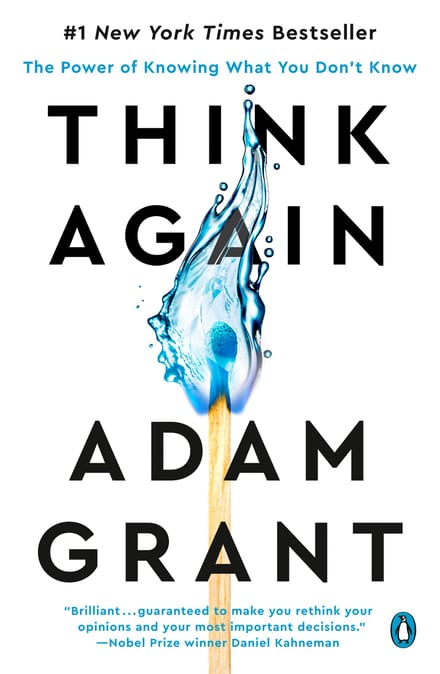
Think Again: The Power of Knowing What You Don't Know
The full book runs ~320 pages — roughly 6 hours of reading. You get the key ideas here in 5 minutes.
The key ideas
- Think like a scientist, not a preacher or prosecutor
- Pair confidence with awareness of what you don't know
- Anchor identity in values, not provisional beliefs
- Ask questions and listen instead of arguing to win
- Expose people to complexity to spark open-minded curiosity
- Build learning cultures that reward rethinking over hiding mistakes
The summary
The smartest people aren’t automatically the best thinkers. A high IQ makes you faster at spotting patterns, which also makes you quicker to fall for stereotypes and slower to update a belief once it’s outdated. What actually matters, Adam Grant argues, is the willingness to be wrong — to hold your opinions as hypotheses you keep testing rather than treasures you defend. In 1949, when a Montana wildfire turned on a crew of smokejumpers, their leader Wagner Dodge survived by lighting an escape fire to burn away the fuel around him; most of his crew thought he’d lost his mind, ran for the ridge, and died in the flames. Dodge lived because he could rethink under pressure. The rest of us rarely face those stakes, but we make the same choice constantly: cling to what we think we know, or stay open to being wrong.
Think like a scientist, not a preacher
When our beliefs get challenged, most of us slide into one of three modes. Preachers double down and evangelize. Prosecutors attack the other side to prove they’re right. Politicians tell the audience whatever will please it. The scientist does something else — treats beliefs as experiments, gathers evidence, and updates when the data demands it. Mike Lazaridis built BlackBerry into an email empire but couldn’t rethink his faith in the physical keyboard, and the company cratered. Steve Jobs resisted making a phone at all until his engineers changed his mind, and the iPhone followed. The gap between them wasn’t intelligence; it was cognitive flexibility, the willingness to move from one position to another as the situation requires.
The sweet spot of confidence
Confidence helps, but only when it’s yoked to an awareness of what you don’t know. The people who assume they know more than everyone else tend to wildly overestimate what they actually know — the Dunning-Kruger effect, where those who can’t simply don’t know they can’t. The antidote is a little doubt. What feels like impostor syndrome can push you to work harder, listen more, and learn faster. When Halla Tómasdóttir, an Icelandic businesswoman with no political experience, was urged to run for president, she embraced her uncertainty instead of faking authority, and finished second with nearly 28 percent of the vote despite almost no budget or press. The sweet spot is being confident you can reach a goal while staying humble about whether you’ve got the right tools right now.
Detach your opinions from your identity
If being right is part of who you are, every mistake feels like a wound. Ted Kaczynski went from mathematics professor to domestic terrorist in part because he was welded to his own conclusions. Grant’s fix is to root your identity in values — fairness, curiosity, integrity — rather than in any particular belief, because values are stable while beliefs should stay provisional. Then being wrong stops being a threat and becomes a discovery: “Hey, I found something.” Admitting and fixing mistakes — a habit of honest self-reflection the Japanese call hansei — tends to raise your reputation, not lower it. It also makes disagreement useful. Task conflict, the friction of arguing over ideas, sharpens decisions; personal conflict, where egos collide, just corrodes them.
The craft of helping others rethink
Changing someone else’s mind is a skill, and bludgeoning them with facts is the wrong one. World-champion debater Harish Natarajan beat IBM’s fact-stuffed debating AI not by overwhelming the room but by finding common ground, asking the audience questions, and admitting some uncertainty — treating the exchange as a dance rather than a war. Daryl Davis, a Black musician, spent years simply talking and listening to KKK members, getting them to see their racism as an accident of birth: if they’d been born into another family, would they believe it? Dozens handed over their robes. The same logic cools rival baseball fans who realize their loyalty is mostly geographic chance. Motivational interviewing formalizes the approach — open-ended questions and reflective listening that let people find their own reasons to change. It helped an empathetic doctor persuade an anti-vaxxer to vaccinate all her children, and helped Ugandan politician Betty Bigombe draw the warlord Joseph Kony toward peace talks. Show people a subject’s full complexity rather than two shouting extremes and they grow curious; and, counterintuitively, experts who admit doubt come across as more persuasive, not less.
Cultures and lives built for rethinking
The same habit scales up. Traditional schooling pours in information and builds confidence but rarely teaches students to question it, even though active learning — discussion and problem-solving — produces far deeper understanding than passive lectures. Organizations face the same fork: performance cultures punish failure, so people bury their mistakes, while learning cultures give people the psychological safety to experiment. NASA’s Columbia disaster grew partly out of a performance culture where past success bred overconfidence and left no room to reexamine risk. We do this to our own lives too, foreclosing on an identity or career path before we’ve tested it, which is why regular “career checkups” matter. Meaning tends to come not from chasing happiness directly but from contributing and pursuing mastery — as it did for Candice Walker, a hospital custodian who crafted her role far beyond its job description, comforting patients and even helping save lives.
The bottom line
Anchor your identity in what you value, not in what you currently believe, and treat every opinion as a claim you might have to revise. Rethinking isn’t a one-time event but a habit, and it’s the one that keeps you adaptable and closer to what’s actually true. Read this if you’re tired of defending old ideas and want to get better at finding better ones.
Fact check
Popular books repeat findings that later research has complicated. Where Think Again makes a testable claim, here's what the evidence actually shows.
People who lack skill systematically overestimate it, because incompetence hides itself — the Dunning-Kruger effect.
Much of the familiar pattern is a measurement artefact. Because test scores and self-estimates are only loosely correlated, splitting people into quartiles by measured skill and plotting their self-ratings produces the classic crossover graph even from random numbers, so the standard analysis cannot establish the metacognitive deficit it is used to demonstrate. When McIntosh and colleagues measured metacognition directly on a matrix-reasoning task, confidence tracked ability in the expected direction — weaker performers were less confident, not more — refuting the dual-burden account specifically. Low scorers do overestimate themselves in raw terms, but the effect is smaller and far less exclusive to the unskilled than the popular telling implies.
- McIntosh RD, Moore AB, Liu Y, Della Sala S. Skill and self-knowledge: empirical refutation of the dual-burden account of the Dunning-Kruger effect. R Soc Open Sci. 2022;9(12):191727. PubMed
- Gignac GE, Zajenkowski M. The Dunning-Kruger effect is (mostly) a statistical artefact: valid approaches to testing the hypothesis with individual differences data. Intelligence. 2020;80:101449. Source
Active learning — discussion and problem-solving — produces deeper understanding than sitting through lectures.
Across 225 studies of undergraduate science, engineering and mathematics courses, exam and concept-inventory scores rose 0.47 standard deviations under active learning, about a 6% gain in average exam marks. The odds of failing the course were 1.95 times higher under traditional lecturing. The advantage appeared in every STEM discipline and at every class size, and was largest in classes of 50 students or fewer.
- Freeman S, Eddy SL, McDonough M, et al. Active learning increases student performance in science, engineering, and mathematics. Proc Natl Acad Sci U S A. 2014;111(23):8410-5. PubMed
Motivational interviewing — open questions and reflective listening — changes minds more effectively than presenting facts, as with vaccine-hesitant parents.
A 2025 systematic review of 118 vaccine-hesitancy studies found the two approaches performed about the same. Pooled vaccination uptake was 45% (95% CI 0.29-0.62) after motivational interventions and 52% (95% CI 0.48-0.56) after educational ones; against usual care in randomised trials, education raised the likelihood of vaccination by 10% (RR 1.10) and motivational approaches by 7% (RR 1.07). Only 10 of the 118 studies tested motivational methods and reporting quality was poor, including how faithfully the technique was delivered, so the question is unsettled rather than settled against it — but the evidence does not yet show it beating information.
- Labbé S, Bacon SL, Wu N, et al. Addressing vaccine hesitancy: A systematic review comparing the efficacy of motivational versus educational interventions on vaccination uptake. Transl Behav Med. 2025;15(1):ibae069. PubMed
Arguing over ideas sharpens a team's decisions, while conflict between personalities corrodes them.
The second half holds; the first is conditional. The first large meta-analysis found task conflict correlated negatively — not positively, as predicted — with both team performance and member satisfaction, and the damage was worse on complex decision-making and project work than on routine production tasks. A 2012 meta-analysis of 116 studies covering 8,880 groups recovered a positive association, but only in particular settings: top-management teams, and outcomes measured as decision quality or financial performance, and mainly where task conflict stayed uncoupled from relationship conflict. Disagreement about ideas helps when a team can keep it from turning personal, which is the hard part.
Frequently asked questions
What is Think Again about?
The smartest people aren't automatically the best thinkers; a high IQ can make you quicker to fall for stereotypes and slower to update a belief once it's outdated. What actually matters is the willingness to be wrong, holding your opinions as hypotheses you keep testing rather than treasures you defend.
What are the key takeaways from Think Again?
Think like a scientist rather than a preacher, prosecutor, or politician, treating beliefs as experiments you update on evidence. Aim for the confidence sweet spot, sure you can reach a goal but humble about whether you have the right tools yet, and watch for the Dunning-Kruger trap. Detach opinions from identity by rooting it in values, so being wrong becomes "I found something." To help others rethink, find common ground and use motivational interviewing instead of bludgeoning them with facts, and build learning cultures with psychological safety rather than performance cultures that punish failure.
Who should read Think Again?
Anyone tired of defending old ideas who wants to get better at finding better ones.
Is Think Again worth reading?
It's a well-told case for intellectual humility, carried by sticky stories like the smokejumper Wagner Dodge, the debater Harish Natarajan, and Daryl Davis talking KKK members out of their robes. If you've already read widely on cognitive bias and persuasion, some ideas will feel familiar, though the framing and examples still land.