Book summary
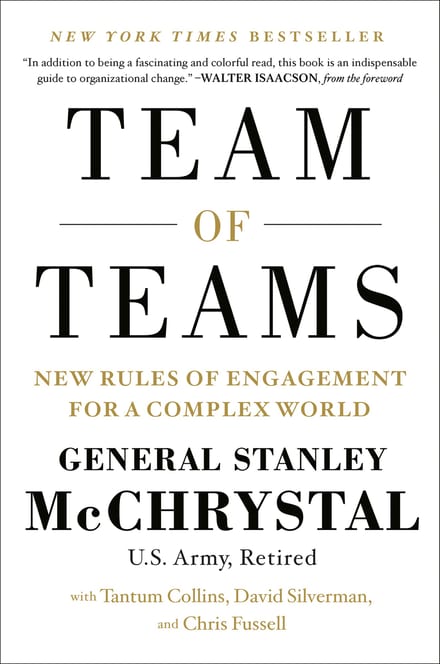
Team of Teams: New Rules of Engagement for a Complex World
New Rules of Engagement for a Complex World
The full book runs ~297 pages — roughly 5 hours of reading. You get the key ideas here in 5 minutes.
The key ideas
- Distinguish complicated problems, which planning solves, from complex ones, which defeat prediction.
- Build shared consciousness: a daily 90-minute brief open to 7,500 people.
- Close the blinks — pass intelligence continuously instead of handing it off in relays.
- Push decisions to whoever sees the problem, and accept a 70 percent solution.
- Lead like a gardener tending conditions, not a chess player moving pieces.
- Note the raid-tempo figures vary by source, and the framework is also a product.
The summary
Efficiency was the wrong thing to be good at. That is the finding underneath Team of Teams, and Stanley McChrystal paid for it in the field. He took command of the Joint Special Operations Command in October 2003, and the task force it ran in Iraq had the best-trained, best-equipped force on the ground and lost ground anyway to Al-Qaeda in Iraq, which had none of those advantages. His people won nearly every engagement they fought. The war went the other way regardless.
The diagnosis he reaches, with co-authors Tantum Collins and two former Navy SEALs, David Silverman and Chris Fussell, is architectural rather than tactical. The task force had been built as a machine: precise, repeatable, every part interchangeable. The enemy was not a machine. It was a network, and the phrase that came out of that realization became the mantra — it takes a network to defeat a network.
Complicated problems yield to planning. Complex ones don’t.
Frederick Winslow Taylor’s scientific management — find the one best way, then have everyone repeat it — built the modern factory and, less obviously, the modern army. Armies, the authors point out, have long drilled and disciplined men into becoming interchangeable parts. That logic holds as long as the world is merely complicated. A jet engine has an enormous number of pieces, but effort and expertise eventually make it predictable.
Complexity is different. It arrives when interactions between the parts multiply past the point where anyone can trace them, and prediction stops working at all. Reviewing the book for Foreign Policy, retired Maj. Gen. David Fastabend credited the book with a thorough treatment of complexity, “carefully distinguishing it from mere complication, and how this phenomenon defeats most adherents to scientific management.”
Shared consciousness is a meeting, not a mood
Visiting a fifteen-man team working out of a white trailer in Mosul, McChrystal found operators piling up hard-won local knowledge with nowhere near the bandwidth to send it anywhere. On the flight back to Baghdad he drew an hourglass on a legal pad — the team at one end, headquarters at the other, meeting at one narrow point.
What he built to widen it was a meeting. The daily Operations and Intelligence brief ran ninety minutes and was open to anyone in the command, roughly 7,500 people worldwide, with more than seventy separate locations dialed in. The design detail matters more than the headcount: in a four-minute slot the update took the first sixty seconds, and the rest went to open-ended discussion. The standard McChrystal set was that everyone knows everything, all the time.
That fed the second repair. The targeting cycle — find, fix, finish, exploit, analyze — had run as a relay in which each group handed the next the minimum it needed. McChrystal’s word for the gaps is “blinks”: pauses where a captured phone went cold before anyone could act on it. Wiring the chain together compressed a cycle of days and weeks into hours and minutes.
Empowered execution means the boss decides less
Shared information alone just produces a very well-briefed bottleneck. The other half of the model hands the decision to whoever can see the problem, and McChrystal’s account of the switch is the honest part: at exactly the moment he finally had the capability to make more decisions, his instinct told him to make fewer. Teams got what he calls smart autonomy: freedom to act toward the strategy as they judged best, provided they told everyone what they were doing. Fastabend calls the arrangement “eyes-on / hands-off,” and notes McChrystal’s insistence that leaders in a complex environment have to settle for a 70 percent solution.
Arithmetic forced the point, though the starting line moves with the telling: by the task force’s own count it ran eighteen raids across Iraq in August 2004 and about 300 a month by August 2006, a starting point McChrystal has elsewhere put at four raids a month when he took command in October 2003, while Liam Collins of West Point’s Modern War Institute counts roughly ten operations against Zarqawi’s network in April 2004 and a tempo that peaked above three hundred a month. The destination is the same either way, and ten raids a night cannot be run through one inbox.
Stop playing chess and start gardening
The metaphor is what survives translation out of uniform. McChrystal admits he wanted to move his forces like chess pieces: “I could be Bobby Fischer or Garry Kasparov, driving my relentlessly aggressive campaign toward checkmate.” The job turned out to be closer to gardening: a gardener cannot actually grow a tomato, only maintain the conditions in which one grows. “Gardeners plant and harvest,” the book says, “but more than anything, they tend.”
What the book leaves out
Fastabend, who served as Multinational Forces Iraq C3 in 2006–07, scores the book’s military perspective about 70 percent right. The narrative leans heavily on the SEALs, and there is no mention of the 160,000 conventional troops sharing that battlespace. Video-conferenced O&I meetings and co-located battle staffs, he adds, had been ordinary in conventional forces since Bosnia in the mid-1990s. One objection stays live for any manager copying the model: authority can be pushed downward, accountability cannot, and the book never says how to hold that tension. Nor does it reckon with the enemy eventually forcing the evacuation of the task force base at Balad. “Strategy still eats organization and process for breakfast.”
The framework is also a product: McChrystal Group sells it to companies as trust, common purpose, shared consciousness and empowered execution.
The bottom line
Speed and interdependence break organizations designed to be efficient, and the repair is not a better plan but a different shape: relentless information sharing at the top, decision rights pushed to the bottom, a leader who tends the system instead of directing it. The trade is real — you give up efficiency to buy adaptability before you can prove it will work. Read it if you run something big and slow that keeps getting beaten by something small and fast.
Fact check
Popular books repeat findings that later research has complicated. Where Team of Teams makes a testable claim, here's what the evidence actually shows.
Rebuilding the task force around shared information and pushed-down decisions raised its raid tempo from about eighteen raids a month in August 2004 to about 300 a month by August 2006.
Both numbers are repeated in the military-professional literature — West Point's Modern War Institute gives eighteen raids across Iraq in August 2004 and three hundred against al-Qaeda in Iraq in August 2006 — but they trace to McChrystal and officers who served with him rather than to released operational records, and the baseline moves between tellings: McChrystal has elsewhere put the starting point at four raids a month in October 2003, while Liam Collins counts about ten operations against Zarqawi's network in April 2004 and dates the peak to more than three hundred operations a month without tying it to a year. Raid count also measures activity rather than result. Reviewing the book, retired Maj. Gen. David Fastabend — Multinational Forces Iraq C3 in 2006-07 — pointed out that the enemy the task force defeated later forced the evacuation of its own base at Balad, and that the account omits both the 160,000 non-special-operations troops sharing that battlespace and the strategy, including the Sunni revolt in Anbar, that opened the window of stability.
- Shultz RH, Clarke RD. Big Data at War: Special Operations Forces, Project Maven, and Twenty-First-Century Warfare. Modern War Institute at West Point. 25 August 2020. Source
- Collins L. Rapid and Radical Adaptation in Counterinsurgency: Task Force 714 in Iraq. Modern War Institute at West Point. 28 September 2021. Source
- Fastabend D. 'Team of Teams': The new McChrystal book is good but a bit heavy on SEAL role. Foreign Policy (Best Defense). 12 May 2015. Source
Pushing information across an organisation so that everyone knows everything, all the time, makes its teams perform better.
Meta-analysis backs this at roughly the strength the book asserts. Pooling 72 independent studies covering 4,795 groups and 17,279 people, Mesmer-Magnus and DeChurch found information sharing positively predicted team performance at every level of every moderator they tested, along with cohesion, decision satisfaction and knowledge integration. A companion meta-analysis of 65 studies and 231 correlations found the shared understanding that sharing produces has strong positive relationships with team performance and still explains additional variance once behavioural and motivational dynamics are controlled. What the research does not supply is McChrystal's method: it measures the effect of information sharing, not how to get a 7,500-person organisation to do it.
Handing decision authority to whoever is closest to the problem improves how an organisation performs.
The direction holds up consistently. A meta-analysis of empowering leadership across 105 samples found positive effects on performance, organisational citizenship behaviour and creativity at both individual and team level, and an earlier meta-analysis found team empowerment positively related to team performance, with psychological empowerment tied to satisfaction, commitment, task performance and lower turnover intentions. Two things sit against the book's version. These are correlations from ordinary workplaces, far short of the step change in throughput the task force describes; and in the 105-sample analysis the team-level effect ran through empowerment itself while knowledge sharing showed no significant indirect effect — the mechanism McChrystal leans on hardest is the one that did not carry the team result there.
- Seibert SE, Wang G, Courtright SH. Antecedents and consequences of psychological and team empowerment in organizations: a meta-analytic review. J Appl Psychol. 2011;96(5):981-1003. PubMed
- Lee A, Willis S, Tian AW. Empowering leadership: a meta-analytic examination of incremental contribution, mediation, and moderation. Journal of Organizational Behavior. 2018;39(3):306-325. doi:10.1002/job.2220. Source
Frederick Taylor's scientific management — find the one best way, then have everyone repeat it — is the demonstrated foundation that legacy factories and armies were built on.
Taylor's influence on how industry and the military organised work is not in dispute; the demonstration the legend rests on is. His account of the Bethlehem Steel pig-iron experiments has been contested since Wrege and Perroni's 1974 reconstruction turned up discrepancies serious enough that some scholars dismissed the episode as no more than a 'pig-tale.' Hough and White, who defend Taylor and argue the discrepancies are minor next to the lesson, still record that the labourer he called Schmidt was a real man named Henry Knolle rather than the character in the story. The efficiency-first architecture the book argues against is real enough; the founding anecdote usually told about it is shakier than either business books or their critics tend to admit.
- Hough JR, White MA. Using stories to create change: the object lesson of Frederick Taylor's 'pig-tale'. Journal of Management. 2001;27(5):585-601. doi:10.1177/014920630102700505. Source
Frequently asked questions
What is Team of Teams about?
Stanley McChrystal took command of the Joint Special Operations Command in October 2003 with the best-trained, best-equipped force on the ground in Iraq, and lost ground anyway to Al-Qaeda in Iraq. His people won nearly every engagement they fought; the war went the other way regardless. The diagnosis he reaches with his co-authors is architectural rather than tactical — the task force had been built as a machine, precise and repeatable, and the enemy was a network. It takes a network to defeat a network.
What are the key takeaways from Team of Teams?
Complicated problems yield to planning and expertise; complex ones, where interactions between the parts multiply past the point anyone can trace them, defeat prediction entirely. The first repair was shared consciousness: a daily ninety-minute Operations and Intelligence brief open to the whole command, roughly 7,500 people, with most of each slot given to open discussion rather than status updates, and the standard that everyone knows everything all the time. The second was empowered execution — decisions handed to whoever could see the problem, with leaders settling for a 70 percent solution — which closed the 'blinks' in the targeting cycle and compressed it from days to hours. The leadership image shifts accordingly: from a chess player moving pieces to a gardener, who cannot grow a tomato and can only tend the conditions in which one grows.
Who should read Team of Teams?
Read it if you run something big and slow that keeps getting beaten by something small and fast — executives, managers and team leads whose problems move faster than their reporting lines. Readers interested in the Iraq campaign get that as the case study running underneath.
Is Team of Teams worth reading?
The complexity chapters are the strongest part, and the trade the book describes is real: you give up efficiency to buy adaptability before you can prove it will work. Retired Maj. Gen. David Fastabend, who served as Multinational Forces Iraq C3 in 2006–07, credits its treatment of complexity but scores the military perspective about 70 percent right — the narrative leans heavily on the SEALs, never mentions the 160,000 conventional troops sharing the battlespace, and video-conferenced briefings had been ordinary in conventional forces since Bosnia. Two things to hold in mind if you're copying the model: the book never says how to push authority downward when accountability can't follow it, and the framework is also a product McChrystal Group sells to companies.