Book summary
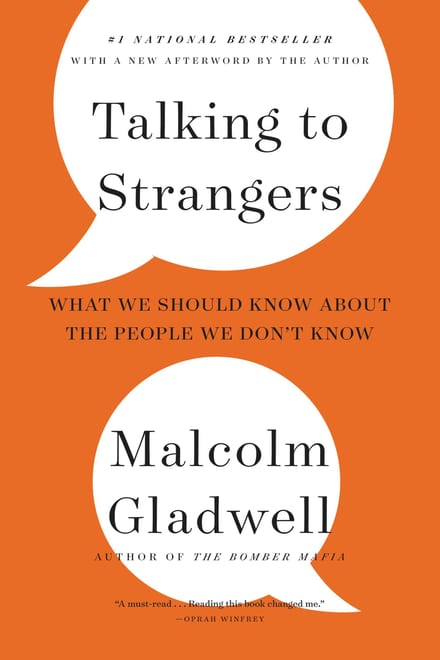
Talking to Strangers: What We Should Know about the People We Don't Know
The full book runs ~386 pages — roughly 7 hours of reading. You get the key ideas here in 2 minutes.
The key ideas
- Default to truth: we believe people until evidence overwhelms us
- Distrust transparency: faces rarely reveal true inner states
- Mistake mismatched demeanor for guilt, as with Amanda Knox
- Beware overconfidence: algorithms outpredict experienced judges reading defendants
- Weigh context: alcohol and tense stops distort judgment
- Accept limits of brief encounters instead of pretending certainty
The summary
Two quiet assumptions govern how you read people you don’t know. You assume they’re telling the truth, and you assume their outward manner reveals what they feel inside. Both defaults serve you well most of the time — they let you move through a world of strangers without paralyzing suspicion. But both fail badly against the rare deceiver, or the person whose face simply doesn’t match their feelings, and when they fail the consequences can be catastrophic.
We default to truth, even when we shouldn’t
In 1938, British Prime Minister Neville Chamberlain met Adolf Hitler in Munich and came away convinced Hitler was trustworthy. Chamberlain wasn’t uniquely foolish; he was doing what we all do, believing people unless there’s overwhelming reason not to. Psychologist Tim Levine demonstrated the pattern by asking professionals — therapists, police officers, judges, even CIA officers — to spot who was lying about cheating on a trivia test. They were right only 54% of the time, because they assumed most people tell the truth and needed an obvious trigger to tip from belief into suspicion.
This default explains real disasters. Ana Montes became one of the most damaging spies in U.S. history while the Defense Intelligence Agency ignored red flags, simply because the human tendency is to believe until the evidence becomes impossible to deny. Bernie Madoff defrauded thousands of investors of more than $60 billion on the same principle. The independent investigator Harry Markopolos saw through him precisely because he didn’t assume everyone tells the truth.
Here’s the catch, though: defaulting to truth is the right strategy for most people most of the time. Lies are genuinely rare, and the vast majority of interactions are honest. A society where everyone treated everyone else as a probable liar would seize up. Madoff and Montes are outliers. The trouble is you can’t tell in advance when you’ve met one.
Transparency is a myth
The second default is transparency — the belief that demeanor reflects true feeling, that surprise looks like surprise and guilt looks like guilt. It isn’t reliable. In one study, when researchers suddenly dropped participants into a completely strange environment, only about five percent produced the face we’d recognize as surprise. People are simply not as transparent as we assume, and when we try to read a stranger’s face, we can get it badly wrong.
Amanda Knox became the prime suspect in the murder of Meredith Kercher despite no physical evidence linking her to the crime. Police read guilt into her because her behavior didn’t match their expectations of a grieving person. But not everyone is transparent; plenty of people’s demeanor is mismatched to what they actually feel. The reverse holds too — many liars look you in the eye and lie with total confidence, while many honest people come across as nervous and shifty. We’re not just bad at reading faces; we’re overconfident about it. When Harvard economist Sendhil Mullainathan compared bail judges to a computer program in 2017, the program, using only age and criminal record, predicted behavior more accurately than judges who had studied defendants in person. Psychologist Emily Pronin caught the same overconfidence in a 2001 experiment: people dismissed their own word-completion choices as meaningless, yet confidently read personality into the identical choices made by strangers. We grant ourselves complexity while flattening everyone else into a type we think we can decode.
Context changes everything
Our misreadings turn dangerous when circumstances are already charged. In 2015, Sandra Bland, a Black woman, was pulled over for failing to signal a lane change. The stop escalated fast; when she grew agitated and lit a cigarette, the officer, Encinia, read her as a threat rather than as someone under stress, and she was violently arrested and found dead in custody three days later. The encounter shows both defaults failing at once — refusing to default to truth, and misreading demeanor as danger instead of fear.
Alcohol distorts the picture further, because it disables our ability to weigh long-term consequences. Gladwell argues it was central to Brock Turner’s sexual assault of an unconscious woman. We routinely underestimate how profoundly alcohol changes behavior, then try to read intoxicated strangers as if they were sober.
The bottom line
We understand strangers far less well than we believe, and our confidence in reading them is itself the danger. The fix isn’t to treat everyone as a liar or to stop interpreting behavior altogether — it’s to accept the real limits of what a brief encounter can tell you, ask more questions, and hold your conclusions loosely. Read this if you make decisions about other people, which is to say, if you’re a person at all.
Fact check
Popular books repeat findings that later research has complicated. Where Talking to Strangers makes a testable claim, here's what the evidence actually shows.
Professionals whose job involves detecting deception — police, judges, therapists, intelligence officers — spot lies only about 54% of the time.
The number holds up across the whole literature, not just the trivia-test experiments Gladwell describes. A meta-analysis of 206 studies covering 24,483 judges found average accuracy of 54%: people correctly flagged 47% of lies and cleared 61% of truths, meaning most of the apparent skill is a bias toward believing people. A second meta-analysis of 247 samples found differences in lie-detection ability between individuals are minute, with measurement-corrected standard deviations under 1%, and that a judgment's outcome depends more on the liar's credibility than on who is doing the judging.
When people are dropped into a strange situation, only about five percent produce the face we would recognise as surprise.
Across eight experiments in which surprise was induced by breaking an established expectation, visible surprise displays appeared in only 4% to 25% of participants, and the full three-component face — raised brows, widened eyes, dropped jaw — was never observed once. Facial EMG confirmed minimal brow movement, yet most participants believed they had shown a strong surprise expression. The summary's five percent sits at the low end of the reported range rather than being the study's single headline number, but the point it is making is exactly what the data show.
- Reisenzein R, Bördgen S, Holtbernd T, Matz D. Evidence for strong dissociation between emotion and facial displays: the case of surprise. J Pers Soc Psychol. 2006;91(2):295-315. PubMed
A computer program working only from a defendant's file predicted behaviour more accurately than bail judges who met the defendant in person.
The study is real and its numbers are striking: analysing New York City bail decisions, Kleinberg, Mullainathan and colleagues estimated that an algorithm could cut crime by up to 24.8% with no change in jailing rates, or shrink jail populations by 42.0% with no rise in crime. But these are policy simulations, and the authors are explicit that outcomes for defendants judges chose to detain are never observed, which is the central inference problem the paper is built to work around — not a head-to-head accuracy contest that the machine won. The general machine-beats-human framing is also weaker than it sounds: Dressel and Farid found the commercial COMPAS risk tool, with 137 inputs, was no more accurate than untrained people recruited online, and that a two-feature model nearly matched it.
- Kleinberg J, Lakkaraju H, Leskovec J, Ludwig J, Mullainathan S. Human Decisions and Machine Predictions. Cambridge, MA: National Bureau of Economic Research; 2017. NBER Working Paper 23180. Source
- Dressel J, Farid H. The accuracy, fairness, and limits of predicting recidivism. Sci Adv. 2018;4(1):eaao5580. PubMed
Frequently asked questions
What is Talking to Strangers about?
Two quiet assumptions govern how you read people you don't know: you assume they're telling the truth, and you assume their outward manner reveals what they feel inside. Both defaults serve you well most of the time, but both fail badly against a rare deceiver or a person whose face doesn't match their feelings, and when they fail the consequences can be catastrophic.
What are the key takeaways from Talking to Strangers?
"Defaulting to truth" means we believe people until the evidence is overwhelming, which is usually right but explains disasters from Chamberlain misreading Hitler to the frauds of Bernie Madoff and the spy Ana Montes. "Transparency," the belief that demeanor reflects true feeling, is a myth, which is why Amanda Knox was wrongly suspected and why a computer using only age and record out-predicted bail judges. And context matters: charged situations plus alcohol, as in the Sandra Bland stop, turn misreadings dangerous. The fix is to accept the limits of a brief encounter, ask more questions, and hold your conclusions loosely.
Who should read Talking to Strangers?
Anyone who makes decisions about other people, which, as the book puts it, is to say anyone who's a person at all.
Is Talking to Strangers worth reading?
It weaves gripping cases into a clear, humbling argument about the limits of reading strangers. If you dislike building a thesis from vivid anecdotes, or you want tidy takeaways, its case-driven style and deliberately loose conclusion may frustrate you.