Book summary
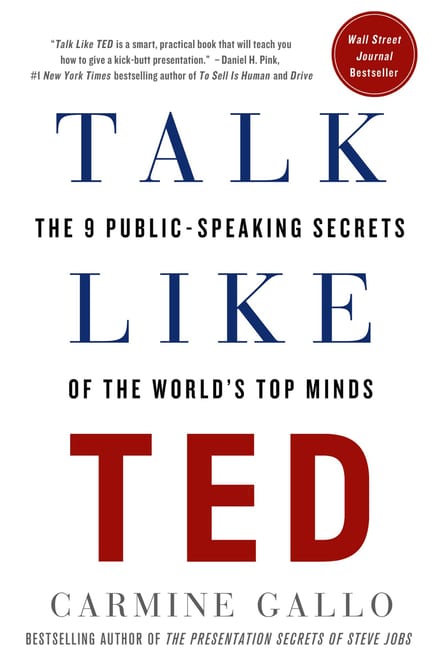
Talk Like TED: The 9 Public-Speaking Secrets of the World's Top Minds
The 9 Public-Speaking Secrets of the World's Top Minds
The full book runs ~288 pages — roughly 5 hours of reading. You get the key ideas here in 5 minutes.
The key ideas
- Name what makes your heart sing, not what you're famous for.
- Spend 65% of a talk on story, 25% on data.
- Teach something genuinely new: novelty releases dopamine, the brain's save button.
- Build one jaw-dropping moment — Gates opened a jar of mosquitoes.
- Cap the talk at 18 minutes, before cognitive backlog exhausts the room.
- Rehearse 200 times, until none of the work shows.
The summary
Carmine Gallo watched more than 500 TED presentations — over 150 hours — hunting for what separates the talks that circle the world from the ones nobody finishes. What he found wasn’t charisma but nine recurring habits, each with a mechanism behind it in cognitive science. The talks that spread are emotional, novel, and memorable, and all three can be built on purpose. Before his first TV interview, Steve Jobs asked where the bathroom was because he thought he’d be sick. Nobody starts good at this.
Passion is the content, not the coating
Gallo stopped asking executives what they were passionate about and started asking what makes your heart sing. The answers change, because the most-watched TED speakers usually aren’t passionate about what they’re famous for. Aimee Mullins, a double amputee who broke three world records at the 1996 Paralympics, doesn’t talk about prosthetics; she talks about human potential. Cameron Russell opened her talk by pulling a wraparound skirt and a turtleneck over her model’s outfit — “I just totally transformed what you thought of me in six seconds” — because what fires her up is the self-esteem of young girls, not fashion.
This isn’t sentiment. Psychologist Howard Friedman sat high and low scorers on his charisma test in a room together for two silent minutes; the charismatic ones shifted the others’ mood without a word, and it never worked in reverse.
Stories do the persuading
Bryan Stevenson earned the longest standing ovation in TED history, and the audience donated a combined $1 million to his Equal Justice Initiative that day. Gallo counted all 4,057 words and sorted them into Aristotle’s three categories. Ethos — credentials, his Supreme Court work — came to 10 percent. Logos, the incarceration statistics, 25 percent. Pathos, the stories about his grandmother, Rosa Parks, and a courthouse janitor, took a full 65 percent — and he didn’t reach his first statistic until five minutes in.
Princeton’s Uri Hasson recorded a graduate student telling an unrehearsed story about her prom, then scanned the brains of eleven listeners. Their responses mirrored hers — when her insula lit up, so did theirs. The coupling vanished when she told it in Russian, which none of them spoke. A bulleted slide activates the language-processing center and stops there; a story pulls in sensory, visual, and motor regions too.
Novelty is the price of attention
The brain won’t spend attention on anything it has already filed. Learning something genuinely new releases dopamine, which Northwestern’s Martha Burns calls the save button — present, and information sticks; absent, and nothing does. So teach people something they don’t know, and package it to survive the trip. Gallo’s test is a Twitter-friendly headline: one sentence, under 140 characters, the single thing you want remembered. He couldn’t find a TED talk title that broke the limit.
Then build one moment worth repeating. Bill Gates opened a jar of mosquitoes on the 2009 TED stage — “There’s no reason only poor people should have the experience.” The stunt used less than 5 percent of his 18 minutes and it’s the part everyone remembers. Neuroscientists call this an emotionally charged event: the amygdala floods the system with dopamine and tags the memory. Same machinery that makes you recall where you were on September 11 but not where you left your keys.
Humor runs on the same wiring. The most popular TED talk ever is Ken Robinson on why schools kill creativity — over 15 million views for a talk about education reform — and it’s funny from the first line. But the top TED speakers do not tell jokes. They use anecdotes, observations, analogies, and other people’s funny quotes — Jerry Seinfeld spent two years on a single Pop-Tart joke, and you don’t have two years.
Eighteen minutes, made vivid
Every TED talk is capped at 18 minutes — Gates, Robbins, everyone. Chris Anderson calls it long enough to be serious, short enough to hold attention, and the length of a coffee break, which is why the videos get forwarded. The reason is cognitive load: listening accumulates what researchers call cognitive backlog, and an hour-long talk leaves your audience without the energy to think about your idea, let alone act on it. The constraint forces clarity — David Christian narrated the entire history of the universe in 17 minutes and 40 seconds.
Inside that window, aim at more than one sense. In Richard Mayer’s experiments, students given text plus pictures plus animation always recalled more than those who only read or listened — always, not usually. Hear information on its own and you’ll retain about 10 percent three days later; add a picture and recall climbs to 65 percent.
Rehearse until it sounds unrehearsed
Jill Bolte Taylor rehearsed “My Stroke of Insight” 200 times. Amanda Palmer spent four months on 12 minutes, performing it at a potluck dinner in a friend’s living room, then to art students, then over Skype. Authenticity doesn’t happen naturally; it gets built.
What the practice buys is pace. Stevenson speaks at 190 words a minute — slightly faster than a well-read audiobook, about the speed of someone talking to a friend over dinner. Tony Robbins runs at 240, near auctioneer territory. Henry Kissinger managed 90, and nobody ever accused him of charisma.
Then stay in your lane. When a young woman told Oprah Winfrey she wanted to be the next Oprah, the answer was “No, you don’t.” A week out, Bolte Taylor’s best friend told her the ending was informative but not vulnerable, so she rewrote it to close with what the stroke had actually felt like. That choice is why people still watch it.
The bottom line
An inspiring talk isn’t a performance of confidence. It’s a passion you can name, carried by story rather than data, built around one surprise worth repeating, held to 18 minutes, and rehearsed until none of the work shows. Read this if you ever have to move people with your voice — a pitch, a keynote, a job interview.
Fact check
Popular books repeat findings that later research has complicated. Where Talk Like TED makes a testable claim, here's what the evidence actually shows.
Talks should be capped at 18 minutes because attention runs out beyond that, leaving listeners with too much cognitive backlog to act on the idea.
As a production rule the cap works — it forces speakers to cut, and shorter videos do get shared more. The cognitive rationale is where it thins out. A 2016 review in Advances in Physiology Education went looking for the primary data behind the widely repeated 10-to-15-minute attention limit and found almost none: the source cited most often for it barely discusses student attention at all, and the studies that do measure attention rely largely on subjective observation. The most consistent finding in that literature is that attention varies far more between teachers than between formats — which supports the discipline Gallo prescribes more than it supports the clock.
- Bradbury NA. Attention span during lectures: 8 seconds, 10 minutes, or more? Adv Physiol Educ. 2016;40(4):509-513. PubMed
Stories should make up roughly 65% of a talk because narrative persuades more effectively than data does.
Which format wins depends on what you want to move. A meta-analysis of health messages found statistical evidence had the stronger effect on beliefs and attitudes, while narrative evidence had the stronger effect on intention — roughly the gap between convincing someone and getting them to act. A larger 2023 meta-analysis pooling 50 studies, 65 experimental pairs and 13,113 participants found no overall difference between the two (r = 0.016, 95% CI -0.014 to 0.045), with a narrative advantage showing up only for health messages promoting prevention behavior. The 65/25 split itself comes from Gallo's own word count of a single talk, not from this body of research.
- Zebregs S, van den Putte B, Neijens P, de Graaf A. The differential impact of statistical and narrative evidence on beliefs, attitude, and intention: a meta-analysis. Health Commun. 2015;30(3):282-9. PubMed
- Xu J. A Meta-Analysis Comparing the Effectiveness of Narrative vs. Statistical Evidence: Health vs. Non-Health Contexts. Health Commun. 2023;38(14):3113-3123. PubMed
One emotionally charged moment gets tagged for memory the way people remember exactly where they were on September 11.
Emotion reliably buys vividness and confidence. It does not buy accuracy. Duke researchers who recorded 54 students' accounts on September 12, 2001 and retested them up to 32 weeks later found the flashbulb memories lost consistency at the same rate as memories of an ordinary event — only the ratings of vividness and belief in accuracy stayed high. A ten-year consortium follow-up found the same shape: rapid forgetting inside the first year, then a curve that barely moved for a decade, with confidence undimmed and inconsistent details more likely to be repeated than corrected. For a speaker that is close to good news — a jarring moment does keep getting retold — but it is being retold, not recorded.
- Talarico JM, Rubin DC. Confidence, not consistency, characterizes flashbulb memories. Psychol Sci. 2003;14(5):455-61. PubMed
- Hirst W, Phelps EA, Meksin R, et al. A ten-year follow-up of a study of memory for the attack of September 11, 2001: Flashbulb memories and memories for flashbulb events. J Exp Psychol Gen. 2015;144(3):604-23. PubMed
Pairing words with pictures always improves recall — hearing information alone leaves about 10% retained after three days, against 65% when an image is added.
Pictures really are remembered better than words, and have been since the effect was named in the 1970s. What doesn't hold is the word always, or a jump of that size. In four experiments the picture advantage in recognition vanished once words were made physically distinctive through font, size, color and capitalization — the benefit tracks distinctiveness rather than an automatic second channel in the brain. And when these multimedia effects were tested outside the lab on 111 university students, adding visual cues helped only weakly and replacing on-screen text with narration actually lowered both retention and transfer, reversing the laboratory result. The practical advice survives; the six-fold number doesn't.
- Ensor TM, Surprenant AM, Neath I. Increasing word distinctiveness eliminates the picture superiority effect in recognition: Evidence for the physical-distinctiveness account. Mem Cognit. 2019;47(1):182-193. PubMed
- Tabbers HK, Martens RL, van Merrienboer JJ. Multimedia instructions and cognitive load theory: effects of modality and cueing. Br J Educ Psychol. 2004;74(Pt 1):71-81. PubMed
Frequently asked questions
What is Talk Like TED about?
Carmine Gallo watched more than 500 TED presentations — over 150 hours — to work out why some talks circle the world and others stall. What he found wasn't charisma but nine recurring habits, each with a mechanism behind it in cognitive science. The talks that spread are emotional, novel and memorable, and all three can be built on purpose.
What are the key takeaways from Talk Like TED?
Lead with what makes your heart sing, not with what you're known for. Let stories carry about 65% of the talk and statistics about 25% — the split Gallo counted in Bryan Stevenson's record-setting TED appearance. Teach the audience something genuinely new, since novelty releases dopamine and dopamine is what makes information stick. Then build one jaw-dropping moment worth repeating, cap the whole thing at 18 minutes, pair words with pictures, and rehearse until none of the rehearsal shows.
Who should read Talk Like TED?
Anyone who has to move people with their voice — a pitch, a keynote, a job interview. It's most useful if you already know what you want to say and want the delivery to carry it rather than get in the way.
Is Talk Like TED worth reading?
It's concrete where speaking advice is usually vague: named talks, real numbers, and a reason each habit works. The reassurance alone earns its place — Steve Jobs asked where the bathroom was before his first TV interview because he thought he'd be sick, and Jill Bolte Taylor rehearsed her talk 200 times. The examples all come from one narrow form, the 18-minute conference talk, so if your job is running long workshops or persuading one person across a table, you'll have to adapt more than you copy.