Book summary
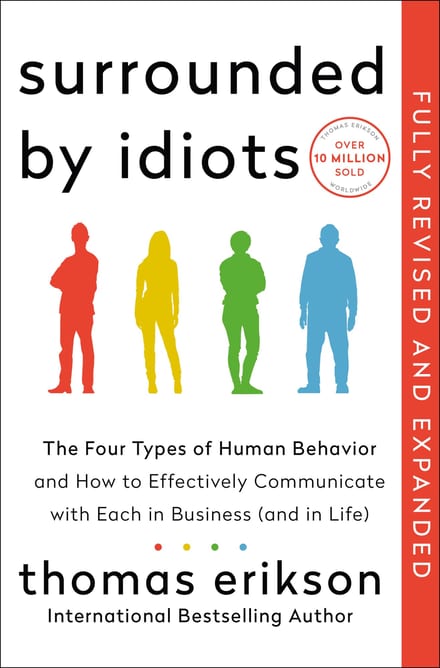
Surrounded by Idiots
The Four Types of Human Behavior and How to Effectively Communicate with Each in Business (and in Life)
The full book runs ~304 pages — roughly 6 hours of reading. You get the key ideas here in 5 minutes.
The key ideas
- Communication lands on the listener's terms, not yours
- Four colors: Red drives, Yellow charms, Green steadies, Blue perfects
- Reds and Yellows decide fast; Greens and Blues take their time
- Almost nobody is one pure color — most blend two
- Read body language before anyone speaks
- Adapt your style; you're always in the minority
The summary
The person who never returns your emails, the one who talks for twenty minutes without landing a point, the colleague who needs three days to make a decision you’d make in three seconds — Thomas Erikson’s argument is that none of them are idiots. They’re just wired differently than you are. And here’s the uncomfortable part: to them, you’re the difficult one. Communication, Erikson insists, happens on the listener’s terms. Everything you say gets filtered through the other person’s biases and frames of reference, and what survives that filter is the only message that actually lands. You can’t change how someone receives you. You can only change how you send.
To make that practical, Erikson uses a behavior model that goes by the acronyms DISA and DISC — Dominance, Inducement (or Inspiration), Submission, and Analytic ability (or Compliance). It traces back to William Moulton Marston’s 1928 book Emotions of Normal People, and it maps neatly onto the four temperaments Hippocrates named centuries earlier: choleric, sanguine, phlegmatic, melancholic. Erikson gives each a color, because colors are easier to remember when you’re standing at a party trying to read a stranger. He’s used the tool for over twenty years, and, per the American Journal of Business Education, more than 50 million assessments have been made with it.
The four colors
Erikson sorts behavior into four types, each with its own color and its own default speed:
- Red (Dominant) — task-oriented extroverts. Fast decisions, competitive, blunt, comfortable taking the lead. The loudest voice and the first to answer. It’s not unusual for a CEO to run heavily Red.
- Yellow (Inspiring) — the optimists. Talkative, warm, entertaining, the person everyone flocks to at a party. They decide on gut feeling — “it just felt right.”
- Green (Stable) — the most common type, and the calmest. Patient, loyal, easygoing, a genuinely good listener who won’t offend you or pick a fight.
- Blue (Analytical) — the perfectionists. Reserved, detail-obsessed, precise. They see errors and risks everywhere and rarely speak before they’re sure.
A quick reality check before you start labeling everyone: almost nobody is one pure color. About 80 percent of people run on a combination of two, roughly 5 percent are dominated by a single color, and the rest blend three. Erikson describes the colors individually because they’re the ingredients — but real people are the finished cake. Green, alone or combined, is the most common profile; pure Red is the rarest.
Red and Yellow move fast
Reds and Yellows share a tempo. Both decide quickly and act quickly, but for opposite reasons. A Red is driven by results and competition — Erikson’s neighbor Pelle didn’t even like gardening, but once he heard people praise Erikson’s garden, he dug new flower beds and cultivated his lawn to golf-course standard purely to win. Reds say exactly what they think, skip the small talk, and find details boring. Their weakness is baked into their strength: quick, but often frightfully wrong, because they rush ahead of the group and get annoyed when no one keeps pace.
Yellows move just as fast but chase fun instead of victory. They talk constantly, answer questions no one asked, and turn any gathering into a party. Erikson’s sister Marita once explained a strange remark with a burst of laughter: “Thinking? I wasn’t!” That’s the Yellow gift and the Yellow trap — decisions made on feeling because no thought was ever involved. They’re arguably the most popular color, and their optimism is contagious.
Green and Blue slow down
Where Reds and Yellows start in top gear, Greens and Blues take their time. A Green is the balanced average of all the colors — calm, supportive, allergic to conflict and to sudden change. A Green friend won’t forget your birthday, won’t compete with you, and won’t kick up a fuss. The flip side is passivity: he won’t take command unless told to, and he’d rather not rock the boat at all.
A Blue slows down for a different reason — he wants to get it right. You know you’ve met one when the hooks by the door are labeled and the dinner menu on the fridge is planned in six-week intervals. In a restaurant debate, the Blue is the one who gently corrects the Red’s Super Bowl statistic and knows exactly which book proves it. He’s a pessimist — sorry, a realist — who sees the risks the others miss.
Reading the room and adapting to it
The colors show up in the body before anyone speaks. A Red keeps his distance, grips your hand a little too hard, leans in aggressively, and points palm-down. A Yellow is tactile and close, hugs on impulse, and smiles even when there’s nothing to smile about. A Green stays relaxed, leans back, and keeps gestures small. A Blue holds back and barely gestures at all.
Adapting doesn’t mean surrendering to whoever’s in front of you. It means giving them a secure arena so they spend their energy understanding you instead of reacting to your style. Flexibility is the whole game — because whatever color you are, the majority of people around you function differently, which means you are always, permanently, in the minority.
The bottom line
The single shift Erikson wants from you is this: stop reading difference as defect. The people who exhaust you aren’t broken — they’re running a different operating system, and once you can name it, you can meet them where they are instead of demanding they meet you. Read it if you manage people, sell to them, live with them, or keep wondering why perfectly reasonable conversations keep going sideways.
Fact check
Popular books repeat findings that later research has complicated. Where Surrounded by Idiots makes a testable claim, here's what the evidence actually shows.
Human behaviour sorts into four colour-coded types, and identifying someone's type tells you how to deal with them.
The traits the four colours describe are real and measurable, but they run on continuous scales rather than falling into boxes. A review of 311 taxometric findings from 533,377 participants estimated the true prevalence of genuinely categorical latent structure at roughly 14%, with little support for categories anywhere in normal personality. Erikson half-concedes this himself when he says about 80 percent of people are a blend of two colours — at which point the types are descriptive shorthand, not a classification the data support.
- Haslam N, Holland E, Kuppens P. Categories versus dimensions in personality and psychopathology: a quantitative review of taxometric research. Psychol Med. 2012;42(5):903-920. PubMed
More than 50 million assessments have been made with the DISC model, according to the American Journal of Business Education.
The citation is real: Jones and Hartley's 2013 paper in that journal does state the DISC test has been taken by more than 50 million people. But the figure is credited to a 2009 newspaper piece that never appears in the paper's own reference list, and the surrounding accuracy percentages come from a DISC vendor's materials and measure how accurate people felt the profile was, not whether it predicted anything. The paper's actual study is 89 undergraduates in one classroom: five of its eight predicted DISC–Big Five correlations reached significance, none exceeded 0.39, and DISC's own Compliance/Conscientiousness scale failed to correlate with Big Five conscientiousness at all.
- Jones CS, Hartley NT. Comparing correlations between four-quadrant and five-factor personality assessments. American Journal of Business Education. 2013;6(4):459-470. Source
You can read a person's type from their posture, handshake and gestures before they say a word.
Strangers do converge on real information from appearance alone, but on a much narrower band than four types. Across three studies with 259 participants, Albright and colleagues found consensus that matched targets' self-ratings on only two of five dimensions — extraversion and conscientiousness — and agreement on extraversion turned out to be largely mediated by physical attractiveness rather than by any behavioural signal. There is also little sign of a general people-reading skill: accuracy on one trait correlates very weakly with accuracy on the others, which suggests separate narrow judgements rather than one readable profile.
- Albright L, Kenny DA, Malloy TE. Consensus in personality judgments at zero acquaintance. J Pers Soc Psychol. 1988;55(3):387-395. PubMed
- Hall JA, Back MD, Nestler S, Frauendorfer D, Schmid Mast M, Ruben MA. How do different ways of measuring individual differences in zero-acquaintance personality judgment accuracy correlate with each other? J Pers. 2018;86(2):220-232. PubMed
Frequently asked questions
What is Surrounded by Idiots about?
The people who exhaust you aren't idiots; they're wired differently than you are, and to them you're the difficult one. The book's premise is that communication happens on the listener's terms, so instead of expecting others to change, you learn to read four behavior types and adapt how you send your message.
What are the key takeaways from Surrounded by Idiots?
It sorts behavior into four colors drawn from the DISA and DISC model: Red (dominant, fast, blunt, results-driven), Yellow (inspiring, talkative, optimistic, decides on feeling), Green (stable, calm, loyal, conflict-averse), and Blue (analytical, precise, and detail-obsessed). Reds and Yellows move fast while Greens and Blues slow down, and almost nobody is a pure color, with about 80 percent blending two. You read the type from body language and speech, then give people a secure arena so they spend energy understanding you instead of reacting to your style.
Who should read Surrounded by Idiots?
Anyone who manages people, sells to them, lives with them, or keeps wondering why perfectly reasonable conversations go sideways.
Is Surrounded by Idiots worth reading?
It's an accessible, example-filled way to stop reading difference as defect and to flex your own communication style. The four-color model is a simplification, one the book itself admits by noting real people are blends, so treat it as a practical lens rather than settled science.