Book summary
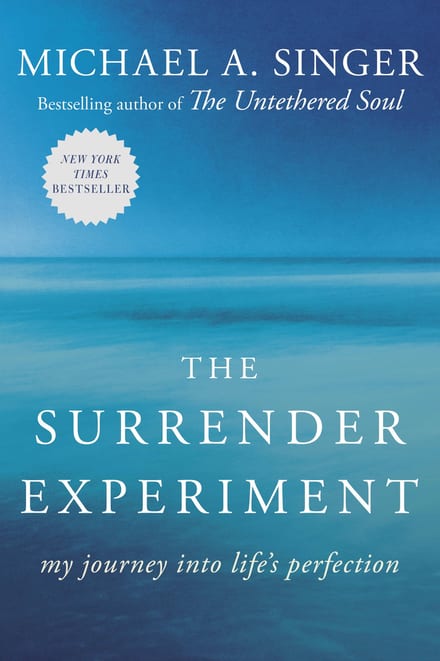
The Surrender Experiment: My Journey into Life's Perfection
My Journey into Life's Perfection
The full book runs ~252 pages — roughly 5 hours of reading. You get the key ideas here in 5 minutes.
The key ideas
- Treat the reflexive yes or no as noise left by the past.
- Say yes to what shows up — that's the whole method, run for forty years.
- Watch a hermit's meditation practice build a public software company.
- Hold the same stance through an IPO and a federal investigation.
- Notice the survivorship problem: one man, one happy ending, no control group.
- Test the small version — your preferences know less than they claim.
The summary
Michael Singer ran one experiment for four decades, and it had a single rule: when life puts something in front of you, the part of you that likes or dislikes it doesn’t get a vote. Not the fears, not the ambitions, not the quiet preference for a quiet afternoon. If The Untethered Soul is the theory — that you are the awareness behind the voice in your head, not the voice — this book is the lab notebook. Singer decided the running commentary of preference was noise, stopped consulting it, and let circumstance pick his life instead. What came out the other end is either a spiritual argument or the strangest career in American software.
The rule is not “do whatever you want”
Surrender gets confused with drifting, and Singer’s version is close to the opposite. He had a deep inner awakening in 1971 while working on a doctorate in economics at the University of Florida, and what he wanted was solitude — he moved out to the woods near Gainesville and never left. Then the economics department chairman asked him to tutor the president of a local community college through his doctorate, a favor the governor had requested. “There was nothing inside of me that wanted to do this,” Singer has said of that moment. “I just wanted to get back out to the woods and meditate.” He said yes anyway.
That is the entire method, repeated for forty years. The instruction isn’t to follow your bliss; it’s to notice that the “no” rising in your chest is a reflex assembled out of old discomfort, and to act regardless of it. Singer puts it bluntly: the desires and fears you’re obeying are impressions left by the past, not readings of the present. Saying yes is how you find out what’s doing the catching.
A man who wanted to be a hermit built a billion-dollar company
The consequences pile up almost comically. His meditation group grew, so he built a cedar temple, which in 1975 became Temple of the Universe, open to people of any belief. Neighbors asked him to build them houses in the same style, so he started a construction company. In 1978 he got curious about an early TRS computer at a Radio Shack, taught himself BASIC, and wrote an accounting program for the building business. In 1979, two Florida doctors called the same week asking whether he could do something similar for a medical practice.
He spent two years writing The Medical Manager. It ended up in more than 120,000 doctors’ offices, and the company went public in 1997, leaving the meditating carpenter worth more than $275 million. It became a WebMD subsidiary in 2000. His own bio now describes him as founding CEO of a billion-dollar public company whose work sits in the Smithsonian. He applied for none of it. In one of the book’s sharper scenes he is aboard a private jet, flying to meet a chairman about a merger he doesn’t want, treating the whole enterprise as karma yoga — work handed to him rather than chosen.
The real test arrived with the FBI
A story of accumulating good fortune would prove nothing, and the second half knows it. An FBI raid hit the company, and Singer was indicted with other Medical Manager executives in a South Carolina securities-fraud case built on earnings inflated between 1997 and 2003.
Here is exactly how it ended for him. Singer was never convicted. According to the Justice Department’s own announcement of the case, on January 11, 2010 he entered a deferred prosecution agreement and agreed to forfeit $2.5 million. He complied with its terms, and on July 26, 2010 the court granted the government’s unopposed motion and dismissed the indictment against him with prejudice. He has maintained throughout that he had no knowledge of the accounting scheme, and the official description of the book calls the accusations unfounded. Six other executives pleaded guilty in separate proceedings; two more were convicted at trial in 2010, only for the judge to enter a judgment of acquittal after finding the charges fell outside the statute of limitations. Either way, that was their case, not his.
What the book does with those years is the part worth reading. Singer’s claim is that he practiced the same thing under federal investigation that he practiced alone in the woods: watch the fear arrive, decline to be run by it, and deal with what is actually happening rather than with the version you would have preferred.
Is this wisdom or survivorship bias?
Ask it, because the book won’t. All the evidence here comes from one man for whom letting go produced a fortune, a following, and a happy ending. Everyone who surrendered their preferences and ended up broke, exploited, or quietly stuck did not get a book deal. As proof that life arranges itself perfectly, a sample of one proves nothing.
Singer’s honest defense is that the outcomes were never the point. He insists he’d have been equally content staying in a hut, and the private-jet scene supports him — he isn’t enjoying his success so much as carrying it. Read the book that way and the claim shrinks to something you can actually test: your preferences are less informed than they feel, and obeying them costs you experiences you can’t picture in advance. That’s worth trying at small scale. “Trust the universe with your mortgage” is not the same proposition.
The bottom line
The instruction organizing this whole life is small. When something lands in front of you, notice the reflexive yes or no, set it aside, and respond to the situation rather than to your reaction. Singer’s forty years suggest a person can hold that stance through a hermitage, an IPO, and a federal indictment without much changing inside. Read it if The Untethered Soul landed for you and you want to watch the ideas carry weight — and read it as one man’s case study, not as a law of the universe.
Frequently asked questions
What is The Surrender Experiment about?
It's the lab notebook for one experiment Michael Singer ran for four decades under a single rule: when life puts something in front of you, the part of you that likes or dislikes it doesn't get a vote. Where The Untethered Soul argues the theory — that you are the awareness behind the voice in your head, not the voice — this book follows what happened when he stopped consulting his preferences and let circumstance pick his life instead.
What are the key takeaways from The Surrender Experiment?
Surrender here is close to the opposite of drifting: the instruction is to notice that the "no" rising in your chest is a reflex assembled out of old discomfort, and to act regardless of it. As Singer puts it, "Your needs, your desires, your likes or dislikes are the reflection of where you're caught" — saying yes is how you find out what's doing the catching. The consequences pile up almost comically. A tutoring favour he had no wish to do led to a meditation group, a cedar temple that became Temple of the Universe in 1975, a construction company, a self-taught detour into BASIC on an early Radio Shack computer, and finally The Medical Manager, software that ended up in more than 120,000 doctors' offices and went public in 1997. He treats all of it as karma yoga — work handed to him rather than chosen.
Who should read The Surrender Experiment?
It's for readers of The Untethered Soul who want to watch those ideas carry weight across an actual life, and for anyone curious whether their own preferences deserve the authority they claim.
Is The Surrender Experiment worth reading?
It's a genuinely strange and readable story, and Singer's honest defence is that the outcomes were never the point — he insists he'd have been equally content staying in a hut, and he comes across as carrying his success rather than enjoying it. The obvious problem is survivorship bias: all the evidence comes from one man for whom letting go produced a fortune and a happy ending, and everyone who surrendered their preferences and ended up stuck didn't get a book deal. Read it as one man's case study rather than a law of the universe — the testable version, that your preferences are less informed than they feel, is worth trying at small scale.