Book summary
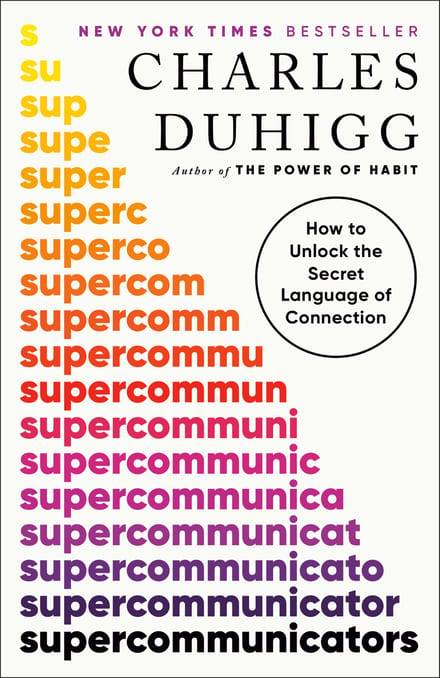
Supercommunicators: How to Unlock the Secret Language of Connection
How to Unlock the Secret Language of Connection
The full book runs ~320 pages — roughly 6 hours of reading. You get the key ideas here in 5 minutes.
The key ideas
- Match the track — practical, emotional, or social; a mismatch reads as not listening.
- Loop for understanding: ask, repeat back, then check whether you got it right.
- Ask deep questions about values and experience, not shallow ones about facts.
- Expect deep talk with strangers to go far better than you predict.
- Watch dominant talkers — they buy public agreement and lose real alignment.
- Treat all of it as behavior you can practice, not personality you were issued.
The summary
Two people can both be listening hard and still walk away from a conversation feeling unheard. Charles Duhigg’s explanation is that they were having different conversations and neither one noticed. Every discussion runs on one of three tracks — practical (What’s this really about?), emotional (How do we feel?), and social (Who are we?) — and understanding happens only when both people are on the same track at the same moment. He calls this the matching principle, and it quietly demotes charisma. The people who connect easily aren’t more magnetic than you. They’re better at noticing which conversation is actually underway.
Three conversations, and they switch without warning
A friend complaining about their boss could be in any of the three. If it’s a practical conversation, they want help thinking through options and they’ll ask direct questions. If it’s emotional, they want to be understood rather than fixed, and advice will land as dismissal. If it’s social, they’re working out who they are at that company and how colleagues see them. Nothing announces the switch, and a single exchange can move through all three.
Most communication failures are this mismatch rather than a shortage of facts or goodwill. Duhigg follows Behfar Ehdaie, a surgeon at Memorial Sloan Kettering who kept failing to talk low-risk prostate cancer patients out of an operation they didn’t need. The medicine is sound. The conversation isn’t: he’s answering a question about probabilities while his patients are asking one about fear. Once you start looking for the mismatch you see it everywhere — in performance reviews, in arguments about the dishes, in every exchange where both sides just repeat themselves louder.
Alignment shows up in the brain, and dominant talkers wreck it
The claim isn’t only metaphorical. Dartmouth neuroscientist Beau Sievers, working with Thalia Wheatley, scanned 49 volunteers while they watched confusing, silent film clips, sorted them into nine small groups to argue their way toward a shared reading of what they’d seen, then scanned them again. Groups that reached real consensus came out with measurably more similar brain activity than they went in with — and the resemblance held up on new clips they had never discussed. The findings ran in Nature Communications in 2024.
Who produced that alignment is the surprise. Not the confident, high-status members: groups dominated by them had the most lopsided turn-taking and the least neural synchrony, buying public agreement without private buy-in. The people who pulled a group into sync talked less than the dominant ones. They asked ten to twenty times as many questions as the average participant, repeated other people’s ideas back to them, and were quick to admit when they were confused. Those are behaviors, not personality traits — which is Duhigg’s whole case for why any of this is learnable.
Proving you listened beats appearing to listen
Nodding and eye contact demonstrate nothing; anyone can fake attention. Duhigg’s replacement is a three-step move he calls looping for understanding: ask a question, repeat back what you heard in your own words, then ask whether you got it right. People skip that third step, and the third step is the one that does the work. In a conflict, the other person has no way of knowing whether you’re listening or just waiting for your turn. The check-in settles it, and it builds trust even when you still disagree.
The questions themselves matter too. Duhigg separates shallow questions about facts from deep questions about values, beliefs, and experience. “What do you do?” gets you a job title; “Do you love what you do?” gets you a person. He says three rounds of why will usually reach something real. And the worry that this is too forward for a stranger turns out to be a miscalibration — Michael Kardas, Amit Kumar and Nicholas Epley found that people consistently expect deep conversations with strangers to be more awkward than they actually are, because we underestimate how much others care about what we tell them.
Emotions travel even when nobody names one
You broadcast mood constantly, and matching it is most of the work. Terry McGuire, NASA’s lead psychiatrist for manned spaceflight, screened astronaut candidates for exactly this. He’d walk in, spill a stack of papers as if by accident, then laugh a big boisterous laugh — and watch closely to see whether the candidate laughed with him. Technical brilliance was abundant among applicants. Emotional pickup was rare, and inside a small capsule on a long mission it mattered more.
Laughter is a useful tell precisely because it’s barely about humor. Robert Provine’s field studies of ordinary conversation found that only 10 to 15 percent of the remarks that trigger a laugh are even remotely funny, and that speakers laugh about 46 percent more often than their listeners. Laughing together is a bid to match, not a verdict on the joke.
The same logic scales up to conversations that look hopeless. In 2018 the group Essential Partners brought gun-control advocates and gun-rights supporters together in Washington, DC — among them Melanie Jeffcoat, former law enforcement officer Jon Godfrey, and David Preston — trained them in a structured dialogue method, then sent them home to keep the argument going in a private Facebook group. It went badly at first — online, the same people slid into name-calling — and recovered only once they were reminded of the skills they’d practiced in the room and shown how to adapt them for a screen. Agreeing on the rules and the purpose is what makes the hard part survivable, and it has to be re-established every time the setting changes.
The bottom line
Connection is a set of moves, not a personality. Work out whether the person in front of you wants a decision, an ear, or recognition, then have that conversation instead of the one you’d rather be having — asking more questions than feels natural and proving you heard the answers. Read it if the conversations that matter most to you, with a partner or a team or a difficult relative, keep ending in the same stalemate.
Fact check
Popular books repeat findings that later research has complicated. Where Supercommunicators makes a testable claim, here's what the evidence actually shows.
When people talk their way to a shared understanding, their brain activity physically aligns — and that alignment is what mutual understanding looks like from the inside.
The Dartmouth study the book leans on is real and reports what Duhigg describes: 49 people watched silent, narratively ambiguous film clips in a scanner, argued toward consensus in nine small groups, and came out with measurably more similar brain activity, an alignment that carried over to clips they had never discussed. Groups with unequal turn-taking and dominant high-status members were the least aligned, which is the counterintuitive part the summary reports correctly. Earlier fMRI work found the same coupling between a single speaker and listener, and there the greater the listener's anticipatory coupling, the better their comprehension. What the evidence does not establish is that aligning brains produces connection rather than accompanying it, and both results come from small scanner samples rather than a body of replications.
- Sievers B, Welker C, Hasson U, Kleinbaum AM, Wheatley T. Consensus-building conversation leads to neural alignment. Nat Commun. 2024;15(1):3936. PubMed
- Stephens GJ, Silbert LJ, Hasson U. Speaker-listener neural coupling underlies successful communication. Proc Natl Acad Sci U S A. 2010;107(32):14425-30. PubMed
People systematically overestimate how awkward a deep, personal conversation with a stranger will be, which is why they retreat to small talk.
Across twelve experiments, strangers assigned to discuss personal questions found the conversation less awkward, happier and more connecting than they had predicted beforehand, and the misjudgment was much larger for deep questions than for shallow ones — in one experiment the gap between expected and experienced awkwardness was d = 2.23 in the deep condition against d = 0.55 in the small-talk condition. The mechanism the researchers isolate is the one the book names: people underestimate how much a stranger actually cares about what they disclose, which is why the error shrinks with close friends and family whose interest is already known. A separate field experiment pointed the same way, with commuters told to strike up a conversation on a train or bus reporting a more positive ride than either they or non-talking commuters expected.
Laughter is mostly a social signal rather than a response to humor: only 10 to 15 percent of the remarks that trigger a laugh are remotely funny, and speakers laugh 46 percent more than their listeners.
Both numbers come from Robert Provine, who logged roughly 1,200 naturally occurring laughs by eavesdropping in shopping malls, on sidewalks and in student unions, and the core finding is not in dispute — laughter tracks the social relationship rather than the joke, and speakers really do laugh more than the people listening to them. The precision is softer than the figures imply. Provine himself described the approach as "sidewalk neuroscience," public observation of when people laugh rather than a controlled experiment, and the exact percentages have never been replicated at that scale by anyone else. Read 46 percent and 10 to 15 percent as one researcher's field estimates, not as measured constants.
Being good at conversation is a set of learnable behaviors — asking more questions, repeating back what you heard, matching the other person's mood — rather than an inborn personality trait.
The "not personality" half holds up well. In the stranger-conversation experiments, the tendency to misjudge a conversation was not moderated by extraversion, and Big Five traits did not consistently predict who got it wrong, so the skill is not simply a proxy for being outgoing. The "learnable" half has real but modest support: a Cochrane review of 17 randomized trials covering about 1,240 doctors and nurses found that communication training produced small gains in empathic responses (SMD 0.18) and in the use of open questions (SMD 0.25), while showing no clear effect on eliciting patients' concerns or on patient satisfaction. The reviewers also could not determine whether any of the gains persisted after the course ended, which is the part the book's optimism glosses over.
- Moore PM, Rivera S, Bravo-Soto GA, Olivares C, Lawrie TA. Communication skills training for healthcare professionals working with people who have cancer. Cochrane Database Syst Rev. 2018;7(7):CD003751. PubMed
- Kardas M, Kumar A, Epley N. Overly shallow?: Miscalibrated expectations create a barrier to deeper conversation. J Pers Soc Psychol. 2022;122(3):367-398. PubMed
Frequently asked questions
What is Supercommunicators about?
Every discussion runs on one of three tracks — practical (what's this really about?), emotional (how do we feel?), and social (who are we?) — and understanding happens only when both people are on the same track at the same moment. Charles Duhigg calls this the matching principle, and it quietly demotes charisma: the people who connect easily aren't more magnetic than you, they're better at noticing which conversation is actually underway. Most communication failures are that mismatch rather than a shortage of facts or goodwill.
What are the key takeaways from Supercommunicators?
Work out which of the three conversations is happening before you answer, since a friend complaining about their boss might want options, an ear, or help working out who they are at that company. Prove you listened rather than appear to: looping for understanding means asking a question, repeating back what you heard in your own words, then checking whether you got it right, and the check is the step people skip. Ask deep questions about values and experience instead of shallow ones about facts — "Do you love what you do?" gets you a person where "What do you do?" gets a job title. And match emotions, which travel whether or not anyone names them; Robert Provine found only 10 to 15 percent of the remarks that trigger a laugh are even remotely funny, because laughing together is a bid to match.
Who should read Supercommunicators?
Read it if the conversations that matter most to you, with a partner or a team or a difficult relative, keep ending in the same stalemate.
Is Supercommunicators worth reading?
Its best move is treating connection as a set of behaviors rather than a personality, which is why the research holds up: in the Sievers and Wheatley scanning study, the people who pulled a group into neural sync asked ten to twenty times as many questions as average and were quick to admit confusion, while dominant talkers bought public agreement without private buy-in. The reported stories — the surgeon losing patients to a conversation about fear, NASA screening astronauts for emotional pickup — make it vivid. It is essentially one principle demonstrated many times over, so readers who grasp the matching idea in the first chapter will find much of the rest is illustration.