Book summary
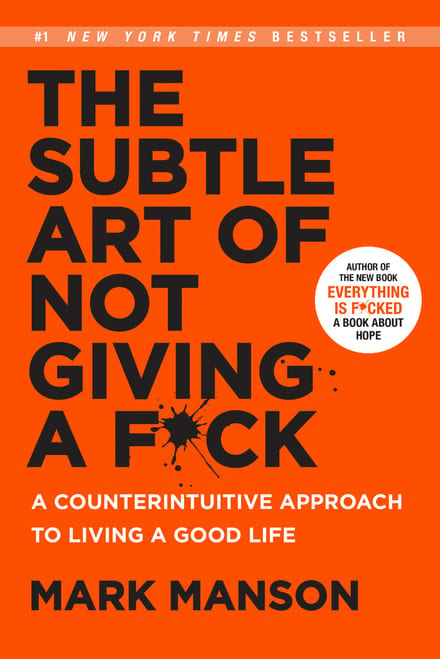
The Subtle Art of Not Giving a F*ck: A Counterintuitive Approach to Living a Good Life
The full book runs ~224 pages — roughly 4 hours of reading. You get the key ideas here in 5 minutes.
The key ideas
- Embrace the backwards law: chasing positive feelings breeds negativity.
- Choose good problems worth struggling for, not vague ambitions.
- Reject entitlement; accepting an ordinary life is liberating.
- Pick values you control: honesty, responsibility, kindness over wealth and popularity.
- Take responsibility for your circumstances even when they aren't your fault.
- Commit selectively: if it isn't 'fuck yes,' say no.
The summary
Wanting to be happier might be exactly what’s making you miserable. Mark Manson opens from what he calls the backwards law: chasing positive experiences is itself a negative experience, and accepting negative experiences is itself a positive one. The harder you grip for happiness, the more it slips away. His blunter version is that you only have so many fucks to give—your capacity to care is finite—so the real question isn’t how to care about everything, it’s which few things deserve the caring. Whether you notice it or not, you’re always choosing.
Life is suffering, so choose your problems
Manson borrows the Buddhist idea of Dukkha: life is a form of suffering, no exceptions. The rich suffer over their riches, the poor over their poverty; people with families suffer because of them, people without suffer their absence. You don’t get to opt out of pain—you only get to choose which pain is worth it. So the useful question becomes: what are you willing to struggle for? Happiness doesn’t come from a life without problems; it comes from solving problems you actually care about, which means the goal is to trade your current problems for better ones.
Charles Bukowski, a drunk and a self-described lowlife, became a celebrated writer not by doing everything right but by finding a struggle he was willing to suffer through. That’s the pattern. Pick a goal you’re genuinely passionate about and the grind that comes with it starts to feel worthwhile. But vague ambitions like “be happy” or “be successful” give you nothing to push against. Manson’s filter for what’s worth your finite attention is deliberately crude: if the answer isn’t “fuck yes,” it’s a no. Everything else is noise, and modern life hands you an infinite supply of it—so much choice that you burn out trying to be everything to everyone.
Entitlement and the values you can actually control
Consumer culture and social media keep whispering that you’re special and owed something. Manson calls this exceptionalism, and it curdles into two forms of entitlement: grandiose narcissism, where you’re better than everyone and deserve special treatment, and victim narcissism, where you’re more wronged than everyone and deserve it for that. Both are equally self-absorbed dead ends. He traces his own teenage arrest for dealing drugs to that sense of entitlement. The freeing alternative is to accept that most of your life will be ordinary and unremarkable—which sounds bleak but takes the pressure off.
What you can control are your values, and Manson argues most people pick bad ones. Pleasure is a poor master; chase it as the goal and you drift toward addiction, and research links people who prize pleasure most with more anxiety and depression. Material wealth stops improving happiness once your basic needs are met. Popularity is worst of all, because you can’t control what other people think of you. Dave Mustaine sold tens of millions of records with Megadeth and still counted himself a failure, because he measured himself against Metallica, the band that fired him. Good values run the other way: honesty, kindness, responsibility—things grounded in reality, useful to others, and within your power.
Take responsibility, hold your identity loosely
Manson draws a sharp line between fault and responsibility. If you get cancer, it isn’t your fault, but it’s still your responsibility to deal with it. People conflate the two and use “it’s not my fault” as a reason to do nothing. When his girlfriend dumps Bob, Bob can decide she’s hateful and doesn’t understand him, or he can take responsibility, ask what went wrong, and grow. Only the second road goes anywhere, and it comes with a bonus: the more you own your circumstances, the more power you have to change them.
The last thing standing in the way is often your own identity. We cling to a story about who we are and it quietly costs us—the artist who won’t show their work in case it proves they’re not great, the executive who won’t go home in case it dents the image of the driven professional. Manson leans on the Buddhist notion that these identities are mental constructs, illusions we can set down. Being wrong threatens that story, which is why we defend our convictions so hard; usually the conviction is armor over an insecurity. Facing the uncomfortable truth stings in the moment but beats a lifetime of repressing it.
The bottom line
Stop trying to feel good all the time and start choosing which problems and which pain are worth your limited capacity to care. Anchor to a few values you can actually control, take responsibility even for what isn’t your fault, and hold your identity loosely enough to keep learning. Read this if you’re tired of the relentless pursuit of happiness and want a more honest, sturdier way to live.
Fact check
Popular books repeat findings that later research has complicated. Where The Subtle Art of Not Giving a F*ck makes a testable claim, here's what the evidence actually shows.
People who most prize pleasure and happiness end up more anxious and depressed than people who care less about feeling good.
The backfire is real but conditional. Mauss and colleagues found women who valued happiness more reported lower happiness under low life stress but not under high stress, and an experimental group induced to value happiness reacted less positively to a happy emotion induction, an effect explained by disappointment in their own feelings. A twelve-author study spanning the United States, Germany, Russia and East Asia then found the direction flips with culture: wanting to be happy predicted lower well-being in the US, showed no relationship in Germany, and predicted higher well-being in Russia and East Asia, apparently because people there pursue happiness in socially engaged ways. Chasing happiness misfires in a specific, individualistic way rather than as a general law.
- Mauss IB, Tamir M, Anderson CL, Savino NS. Can seeking happiness make people unhappy? Paradoxical effects of valuing happiness. Emotion. 2011;11(4):807-815. PubMed
- Ford BQ, Dmitrieva JO, Heller D, et al. Culture shapes whether the pursuit of happiness predicts higher or lower well-being. J Exp Psychol Gen. 2015;144(6):1053-1062. PubMed
Once your basic needs are covered, more money stops making you happier.
The cut-off does not sit anywhere near basic needs. Across 1,725,994 experience-sampling reports from 33,391 employed US adults, both experienced and evaluative well-being rose linearly with log(income), with the same slope for high earners as for low earners and no plateau even at $75,000 a year. A 2023 adversarial collaboration between the authors of the two conflicting studies confirmed a plateau only for the least happy people; for everyone else happiness kept rising with income, and rose fastest in the happiest group. The gains are logarithmic, so each additional step costs progressively more money, but they do not stop.
Accepting negative experiences instead of fighting them is itself good for you.
Three studies point the same way. In a survey of 1,003 people, habitually accepting one's own emotions and thoughts without judging them predicted higher well-being and life satisfaction and fewer depressive and anxiety symptoms, holding constant reappraisal, rumination and other mindfulness facets; in a lab study of 156 people it predicted weaker negative reactions to a standardized stressor. A six-month longitudinal study of 222 people found acceptance predicted less negative emotion during daily stressors, which in turn accounted for its link to psychological health half a year later. The designs are observational, so they show that accepters fare better rather than proving a decision to accept causes the gain, but the accepting half of the backwards law matches the evidence.
- Ford BQ, Lam P, John OP, Mauss IB. The psychological health benefits of accepting negative emotions and thoughts: laboratory, diary, and longitudinal evidence. J Pers Soc Psychol. 2018;115(6):1075-1092. PubMed
Frequently asked questions
What is The Subtle Art of Not Giving a F*ck about?
Wanting to be happier can be exactly what's making you miserable. The book opens from the "backwards law," that chasing positive experiences is itself a negative experience while accepting negative ones is itself positive. Since your capacity to care is finite, the real question isn't how to care about everything but which few things deserve it.
What are the key takeaways from The Subtle Art of Not Giving a F*ck?
Life involves suffering no matter what, so choose problems worth solving and ask what you're actually willing to struggle for. Anchor to values you can control, like honesty, kindness, and responsibility, rather than pleasure, wealth, or popularity. Separate fault from responsibility, since a problem can be not your fault but still your job to handle, and hold your identity loosely so being wrong becomes a discovery instead of a wound. The crude filter: if it isn't a "fuck yes," it's a no.
Who should read The Subtle Art of Not Giving a F*ck?
Anyone tired of the relentless pursuit of happiness who wants a more honest, sturdier way to live.
Is The Subtle Art of Not Giving a F*ck worth reading?
It reframes happiness in a bracing, memorable way, and the distinction between fault and responsibility is genuinely useful. The blunt, profane style and the habit of restating a few core ideas can wear thin, and readers who want gentle, step-by-step guidance may bounce off the tone.