Book summary
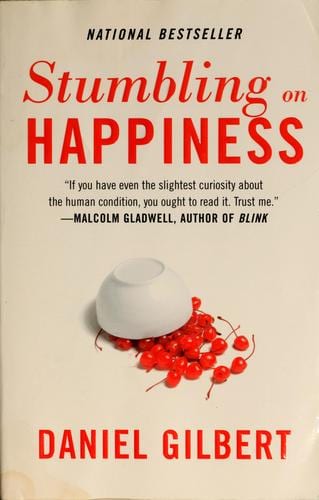
Stumbling on Happiness
The full book runs ~310 pages — roughly 6 hours of reading. You get the key ideas here in 7 minutes.
The key ideas
- Imagination fills future scenarios with your present feelings and moods
- Previews omit the mundane details that dominate real experience
- Your psychological immune system rationalizes bad outcomes faster than you expect
- Memory reconstructs the past to match your current theories
- Distant events look hazy; future-you feels them in high resolution
- Ask someone living that life; you're less unique than you think
The summary
You are a poor predictor of your own future feelings, and Daniel Gilbert’s book is a tour of exactly why. The human frontal lobe, a relatively recent evolutionary addition, gives us something no other animal has: the ability to mentally simulate tomorrow, plan for it, and preview how it will feel. We use that power constantly, spending roughly 12% of our thoughts imagining future events, largely because we crave control over what happens to us. The catch is that the simulator is systematically buggy. When you picture how happy the promotion, the move, or the breakup will make you, you’re running a preview riddled with predictable errors — and the errors all pull in ways you don’t notice.
Imagination fills the gaps with today’s feelings
When you imagine a future event, your brain doesn’t pull up a file marked “how I’ll feel then.” It builds the forecast out of whatever is handy, which is usually how you feel right now. Gilbert calls this presentism, and it quietly poisons prediction. Worse, we’re not even reliable narrators of our present emotions. In a famous study, a woman approached men either on a swaying suspension bridge or after they’d safely crossed, handing out a survey and offering her number. The men she met mid-bridge — hearts pounding from the height — were far more likely to call, having misread fear-driven arousal as attraction. The brain is built to answer “What should I do?” before “What is it?”, trading accuracy for speed. If we can confuse fear with desire in the moment, it’s no surprise that asking present-you to speak for future-you goes wrong.
It skips the details that will actually dominate
Gilbert’s second problem is that we don’t notice absences. Sherlock Holmes cracked the Silver Blaze case by noticing the dog that didn’t bark, and most of us would have missed it entirely. When you imagine the corner office, you see the title and the view; your imagination simply doesn’t render the tedious budget meetings and the endless email that will actually fill your days. Those unrendered details are often the ones that decide how the experience really feels.
The same blindness distorts time. Distant events look less detailed than near ones, the way distant objects look smaller, and we forget to correct for it. Most people would rather receive $20 in a year than $19 in 364 days, because a one-day delay in the far future looks trivial from here — yet those same people would rather take $19 today than $20 tomorrow, because a one-day wait in the near future feels like torment. Future-you will live that delay in high resolution, not the hazy sketch you’re looking at now.
Your mind rationalizes bad outcomes faster than you expect
The largest error is that we underestimate our own resilience. People routinely overpredict how long a job loss or a breakup will flatten them, forgetting that they run a psychological immune system that quietly goes to work after something bad happens. The mind exploits ambiguity, “cooking the facts” by seeking out interpretations that make an experience bearable, which is why many people who’ve survived real trauma later say it improved their lives. Tellingly, this machinery works better on things that happened than on paths not taken: we regret inaction more than action, even when the action turned out badly, because we can wring meaning from an experience we actually had but can only speculate about the road we skipped.
The immune system is so effective that it sabotages foresight. You forecast years of misery and don’t realize future-you will have reframed and moved on within months. Memory then covers the tracks, because it isn’t playback but reconstruction — the brain keeps a few peak moments and the ending, then fills the rest in with your current beliefs about how you should have felt. After the 2000 U.S. presidential election, partisans predicted the Supreme Court’s decision would strongly affect their happiness, and months later remembered that it had; in truth the impact was far smaller than they either predicted or recalled. Because the forecast and the memory were wrong in the same direction, no one learned anything. We also over-recall unusual moments over typical ones, remembering the sunset and the food poisoning from a trip rather than the ordinary hours, which makes us overrate rare events and underrate how pleasantly mundane most of life is.
Ask someone already living it
There is a fix, and it’s almost insultingly simple: instead of imagining, find someone who is currently living the life you’re contemplating and ask them how it feels. Studies show that using a randomly chosen surrogate predicts your future emotions better than your own imagination, because people’s reactions are far more alike than we assume. The evidence is everywhere, including money: Americans earning $50,000 are much happier than those earning $10,000, but Americans earning $5 million are not much happier than those earning $100,000. Yet we stubbornly refuse the shortcut, certain we’re too unique for another person’s experience to apply. We aren’t. As Gilbert puts it, if you are like most people, then like most people, you don’t know you’re like most people.
The bottom line
Your imagination distorts every forecast of future happiness — it fills gaps with today’s mood, omits the details that will actually dominate, and forgets how quickly you’ll rationalize whatever goes wrong. The most accurate way to know how something will feel is to ask someone already in that situation, though your belief in your own uniqueness will fight you the whole way. Read this if you’ve ever been startled that getting what you wanted didn’t deliver the happiness you expected, or if you make consequential decisions for a living.
Fact check
Popular books repeat findings that later research has complicated. Where Stumbling on Happiness makes a testable claim, here's what the evidence actually shows.
Men who met a woman on a swaying suspension bridge mistook fear-driven arousal for attraction, showing how badly we read our own present feelings.
Dutton and Aron's 1974 field study did find that men approached mid-crossing on a shaky bridge were more likely to phone the interviewer afterwards than men approached on a solid one, but the men chose their own bridge, so risk-seeking personalities could account for part of the gap. A larger amusement-park test of 300 riders reproduced the effect only conditionally: people leaving a roller coaster rated a photographed stranger as more attractive than people about to board, but only among those riding with a non-romantic companion, with no difference for riders accompanied by a romantic partner. Arousal really does spill over into attraction; it just depends more on context than the anecdote suggests.
- Dutton DG, Aron AP. Some evidence for heightened sexual attraction under conditions of high anxiety. J Pers Soc Psychol. 1974;30(4):510-517. PubMed
- Meston CM, Frohlich PF. Love at first fright: partner salience moderates roller-coaster-induced excitation transfer. Arch Sex Behav. 2003;32(6):537-544. PubMed
Asking a randomly chosen person who is already in a situation predicts how you will feel in it better than imagining it yourself.
Gilbert and colleagues found exactly that in two experiments: undergraduates predicted their reactions to a five-minute speed date (n = 25) and to a peer evaluation (n = 88) more accurately from one stranger's report than from a description of the event itself, and both the participants and independent judges expected the reverse. The tests were brief laboratory episodes with student samples, not the job moves, marriages and relocations the book applies the advice to, and the result rests mainly on this single 2009 paper. The direction is solid; the reach claimed for it is not yet established.
- Gilbert DT, Killingsworth MA, Eyre RN, Wilson TD. The surprising power of neighborly advice. Science. 2009;323(5921):1617-1619. PubMed
Money buys happiness sharply at low incomes and then stops, so someone earning $5 million is barely happier than someone earning $100,000.
Diminishing returns are real, but the flattening is far milder than this. Killingsworth's 1,725,994 experience-sampling reports from 33,391 employed US adults found both moment-to-moment feeling and life evaluation rising linearly with log(income), with an equally steep slope for high earners as for low earners and no plateau above $75,000 a year. A 2023 adversarial collaboration between Killingsworth and Kahneman located a plateau only among the least happy people; for everyone else happiness kept climbing with log income and accelerated in the happiest group. Since $100,000 to $5 million is a much larger multiple than $10,000 to $50,000, a logarithmic relationship predicts the top earner should be noticeably happier, not barely.
People systematically overestimate how long a bad event such as a job loss or a breakup will keep them unhappy.
The direction shows up in many studies, but a 2012 reanalysis traced much of the effect to the question rather than the forecast. Levine and colleagues found people predicted their feelings about a specific event accurately, and overestimated only when asked how they would feel 'in general' and then later asked to rate their mood without reference to that event; clarifying the wording significantly reduced the overestimation. Wilson and Gilbert replied in the same journal that the bias holds up once the studies are read properly, and the two camps have not converged. Later work found the errors even reverse direction depending on how the outcome is specified, so the resilience point stands while the blanket 'we always overpredict' does not.
- Levine LJ, Lench HC, Kaplan RL, Safer MA. Accuracy and artifact: reexamining the intensity bias in affective forecasting. J Pers Soc Psychol. 2012;103(4):584-605. PubMed
- Wilson TD, Gilbert DT. The impact bias is alive and well. J Pers Soc Psychol. 2013;105(5):740-748. PubMed
- Buechel EC, Zhang J, Morewedge CK. Impact bias or underestimation? Outcome specifications predict the direction of affective forecasting errors. J Exp Psychol Gen. 2017;146(5):746-761. PubMed
Frequently asked questions
What is Stumbling on Happiness about?
You are a poor predictor of your own future feelings, and the book is a tour of exactly why. The human frontal lobe lets us mentally simulate tomorrow and preview how it will feel, but that simulator is systematically buggy, so our forecasts about what will make us happy come out riddled with predictable errors we never notice.
What are the key takeaways from Stumbling on Happiness?
Three flaws warp every forecast. Presentism means imagination fills the gaps with how you feel right now. Omission means you skip the mundane details, like tedious meetings and endless email, that will actually dominate an experience, and you misjudge time by treating a distant delay as trivial. And a psychological immune system rationalizes bad outcomes far faster than you expect, so you overpredict how long misery will last. The fix is almost insultingly simple: instead of imagining, ask someone already living the life you're weighing, since people are more alike than we assume.
Who should read Stumbling on Happiness?
Anyone who has been startled that getting what they wanted didn't deliver the happiness they expected, or who makes consequential decisions for a living.
Is Stumbling on Happiness worth reading?
It's a witty, research-rich explanation of a genuinely useful blind spot, built on memorable studies like the swaying-bridge experiment. The catch is that its single practical prescription, using someone else's experience instead of your imagination, is one most readers resist, certain they're too unique for another person's life to apply.