Book summary
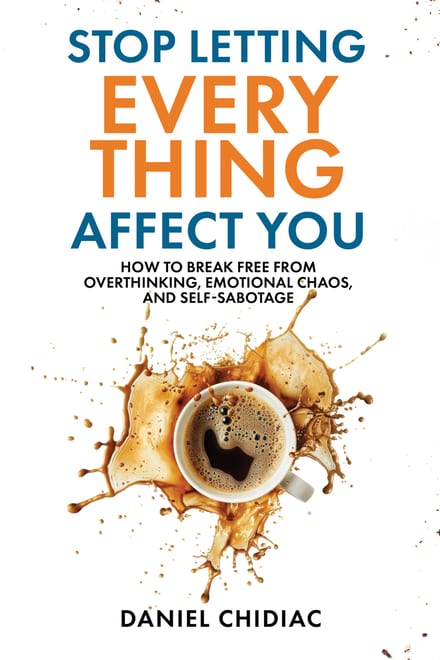
Stop Letting Everything Affect You
How to Break Free from Overthinking, Emotional Chaos, and Self-Sabotage
The key ideas
- Reactivity is a practiced pattern, not a fixed personality trait
- Name emotions precisely to activate your rational brain
- Focus on interpretation and reaction, not uncontrollable events
- Stop absorbing others' feelings as your responsibility
- Set boundaries without justification; use silence against manipulators
- Embrace discomfort of change; seek peace over constant happiness
The summary
The version of you that spirals over a single text, absorbs everyone else’s stress, and replays conversations for hours isn’t your real personality. It’s a pattern you’ve practiced so long it feels like identity. “The reactive mind isn’t who you are — it’s simply what you’ve practiced becoming.” That reframe is the whole premise of Daniel Chidiac’s book: hyper-reactivity is a learned habit, and anything learned can be unlearned.
Some of it starts in your wiring. Research on Highly Sensitive People suggests about 20% of us are born with a more reactive nervous system that feels everything more intensely. Pair that with a childhood where emotions weren’t validated, and you learn to soak up other people’s feelings as if managing them were your job. Your brain becomes hypervigilant — scanning for threats, rehearsing mistakes, inflating small setbacks. It isn’t weakness. It’s a survival strategy that has outlived its usefulness and now works against you.
Why your mind spirals
Your brain has a hard limit on how much it can process at once. When it’s already crowded with unfinished tasks and low-grade worry, a slow cashier or a vague email is enough to trigger a reaction far bigger than the moment deserves. The problem usually isn’t the event; it’s that your mental bandwidth was maxed out before it arrived. As Chidiac puts it, your day isn’t made of big crises but of dozens of small moments each demanding something from you.
Worse, the mind fixates on problems because rumination feels like progress. Anxiety loops form when your brain assumes that rehearsing a worst-case scenario enough times will somehow prevent it. Underneath sits a built-in negativity bias — an old survival feature that prioritizes spotting danger over noticing anything good — and it’s what keeps you stuck. The counter-move is to widen the frame. When you catch yourself spiraling, zoom out and ask whether this will matter a year from now. Most of what consumes a day won’t even register later.
Name it, don’t become it
The single most useful skill in the book is precise labeling. When you name an emotion accurately, you activate the prefrontal cortex, the rational part of the brain that can turn emotional intensity down. So instead of “I am angry,” try “I notice anger arising in me.” That small grammatical distance turns you from someone drowning in the feeling into someone watching it. Chidiac even cites UC Berkeley research suggesting that gratitude practices — including, oddly, thanking your anxiety — fire positive neural circuits that short-circuit the panic.
The same logic applies to control. Stress, he argues, is less about what happens to you than about how much control you feel you have over it. You can’t control traffic, or whether someone texts back, or the choices other people make. But you fully control your interpretation, your reaction, and where you put your energy. Moving your attention from the uncontrollable event to your own response is where a sense of agency comes back.
Their feelings aren’t your job
Empathetic people tend to confuse absorbing pain with offering compassion. You take on everyone’s problems, trying to fix and soothe, until you hit compassion fatigue — a state in which chronic absorbers develop symptoms nearly identical to post-traumatic stress: exhaustion, detachment, a shrinking sense of accomplishment. You become the strong one everybody leans on, and when you finally need support, no one’s there. That, Chidiac says plainly, isn’t kindness; it’s self-abandonment.
Part of what fuels it is that the brain treats social rejection as a survival threat, lighting up the same pain pathways as a physical injury. That drives a compulsive urge to win back approval, which is why people chase the unavailable and obsess over bad situations — they’re trying to restore their own sense of worth. But someone else’s choices, even self-destructive ones, say nothing about your value; they’re responding to their own inner world, not grading you. One-sided relationships hang on because of false hope: you’re not attached to who the person actually is but to the idea of who they could become if they tried. And real change, the research says, only happens when it comes from a person’s own internal motivation — you can’t love anyone into transforming.
Boundaries, silence, and the discomfort of change
Without boundaries, you teach people that your needs don’t count. You’ve been conditioned to think every decision needs an approved reason, so you over-explain — but notice whether anyone ever actually accepted the explanation, or just argued and guilt-tripped until you caved. Growth doesn’t require justification. People who genuinely care won’t rage at your boundaries; manipulators will, often through gaslighting — denying events, shifting blame, making your reaction the problem instead of their behavior. Document what happens if you need proof you’re not imagining it, and use silence, which forces others to sit with their own conduct.
Walking away usually starts not with a blowup but with a quiet certainty that nothing will change; some relationships are simply chapters that have ended. What follows is uncomfortable on purpose. The ego, whose real goal is safety rather than happiness, will flood you with self-doubt to pull you back, but confidence comes from proving you can handle what comes, not from playing it safe. Don’t force forgiveness — peace can come from boundaries and self-respect instead. And stop chasing constant happiness, which is fleeting by nature; real peace comes from accepting the full range of experience and choosing gratitude over resentment.
The bottom line
Your reactivity is a rehearsed pattern, not a life sentence, and you loosen its grip by naming emotions precisely, moving your focus from what you can’t control to how you interpret it, and refusing to carry other people’s chaos as your own. Read this if you’re worn out by overthinking and ready to take your emotional energy back.
Fact check
Popular books repeat findings that later research has complicated. Where Stop Letting Everything Affect You makes a testable claim, here's what the evidence actually shows.
About 20% of people are born highly sensitive, with a nervous system that reacts more intensely to everything.
Differences in environmental sensitivity are real and measurable, but the tidy 20% is not what the data show. A study of 906 adults using the Highly Sensitive Person scale found three groups rather than two — roughly 31% high-sensitive, 40% medium and 29% low — and concluded that sensitivity is a continuous, normally distributed trait rather than a category people are or aren't born into. The high-sensitive group did score higher on neuroticism and emotional reactivity and lower on extraversion, which is the part the book has right.
- Lionetti F, Aron A, Aron EN, Burns GL, Jagiellowicz J, Pluess M. Dandelions, tulips and orchids: evidence for the existence of low-sensitive, medium-sensitive and high-sensitive individuals. Transl Psychiatry. 2018;8(1):24. PubMed
Naming an emotion precisely activates the prefrontal cortex and turns emotional intensity down.
The brain half is solid: labelling an emotion reduced amygdala and other limbic responses to negative images while raising activity in right ventrolateral prefrontal cortex, and the two were inversely correlated. What that buys in felt relief is much less clear. Two experiments (N=80 and N=60) found the opposite of the intuitive prediction — people who named their emotions before reappraising or accepting them reported feeling worse than those who regulated without naming, as if naming crystallised the feeling and made it harder to shift. Labelling is worth doing, but it is not a reliable dial for turning intensity down.
- Lieberman MD, Eisenberger NI, Crockett MJ, Tom SM, Pfeifer JH, Way BM. Putting feelings into words: affect labeling disrupts amygdala activity in response to affective stimuli. Psychol Sci. 2007;18(5):421-428. PubMed
- Nook EC, Satpute AB, Ochsner KN. Emotion Naming Impedes Both Cognitive Reappraisal and Mindful Acceptance Strategies of Emotion Regulation. Affect Sci. 2021;2(2):187-198. PubMed
The brain processes social rejection through the same pain pathways as physical injury.
The 2003 study behind the idea did find the anterior cingulate more active during social exclusion, correlating with self-reported distress, and the shared-circuitry reading followed from that. A later study of 60 people pulled the two apart: pattern classifiers distinguished physical heat pain from its control with 92% accuracy and rejection from its control with 80%, and each classifier performed at chance on the other condition. Inside the dorsal anterior cingulate itself — the region thought to carry pain affect — the pain and rejection patterns were uncorrelated. Rejection hurts, but it appears to run on its own representations rather than borrowing the body's pain system.
People who chronically absorb others' pain develop compassion fatigue, with symptoms nearly identical to post-traumatic stress.
The three symptoms listed — exhaustion, detachment and a shrinking sense of accomplishment — are the components of burnout, not the criteria for post-traumatic stress. A review of 90 studies found that compassion fatigue was borrowed wholesale from crisis counselling and psychotherapy, that it is almost always measured with a scale assessing none of the elements of compassion, and that no study shows the most compassionate carers are the most susceptible. The underlying problem is well documented: cumulative work-related stress does degrade people's physical, emotional and social health. The equation with PTSD is the part that outruns the evidence.
- Sinclair S, Raffin-Bouchal S, Venturato L, Mijovic-Kondejewski J, Smith-MacDonald L. Compassion fatigue: A meta-narrative review of the healthcare literature. Int J Nurs Stud. 2017;69:9-24. PubMed
Frequently asked questions
What is Stop Letting Everything Affect You about?
The version of you that spirals over a single text, absorbs everyone else's stress, and replays conversations for hours isn't your real personality; it's a pattern you've practiced so long it feels like identity. The whole premise is that hyper-reactivity is a learned habit, and anything learned can be unlearned.
What are the key takeaways from Stop Letting Everything Affect You?
When you spiral, widen the frame and ask whether it will matter a year from now. Label emotions precisely, saying "I notice anger arising in me" rather than "I am angry," which engages the rational prefrontal cortex. Move your attention from what you can't control to how you interpret it. Stop absorbing other people's pain to the point of compassion fatigue, and set boundaries without over-explaining, using silence and accepting the discomfort of change instead of chasing constant happiness.
Who should read Stop Letting Everything Affect You?
Anyone worn out by overthinking and ready to take their emotional energy back, especially highly sensitive people who tend to soak up others' feelings.
Is Stop Letting Everything Affect You worth reading?
It pairs a reassuring reframe with concrete techniques, from precise emotional labeling to the year-from-now zoom-out and boundary scripts, and grounds them in research on sensitivity and rejection. If you already practice mindfulness or emotional labeling, parts of it will feel familiar rather than new.