Book summary
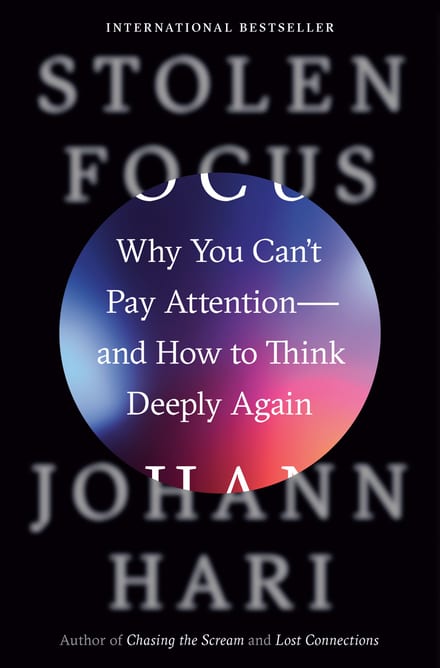
Stolen Focus
Why You Can't Pay Attention and How to Think Deeply Again
The full book runs ~352 pages — roughly 6 hours of reading. You get the key ideas here in 5 minutes.
The key ideas
- Tech giants engineer distraction to maximize screen time and ad revenue
- Sleep deprivation clogs the brain and fractures focus like intoxication
- Stress, poverty, and trauma break attention at its physiological root
- Processed food and pollution fuel brain fog and ADHD
- Redesigned childhood replaces free play with screens and pressure
- Reclaiming focus demands structural change, not personal discipline
The summary
You can’t concentrate, and it isn’t your fault. That’s the claim at the center of Johann Hari’s investigation into why sustained attention has collapsed across whole populations. The usual response — blame yourself for weak willpower, download a blocker app, try harder — aims at the wrong target. Attention didn’t erode because millions of people simultaneously lost their discipline. It eroded because the environment we live in was rebuilt in ways that make deep focus nearly impossible, and reclaiming it is less a personal project than a fight over how that environment gets designed.
Your attention was stolen, not lost
Hari opens on a scene that captures the problem: at Elvis’s mansion, most visitors — including his own godson — stared at their phones instead of the place they’d traveled to see. Present in body, absent in mind. The costs are measurable. It takes an average of twenty-three minutes to fully refocus after an interruption, and what we flatter ourselves as multitasking is really rapid task-switching, which quietly buys us more errors, less creativity, and faster exhaustion. This isn’t a private inconvenience. A society that can’t hold its attention long enough to identify real problems, tell them apart from fantasies, and hold leaders accountable loses the ability to function as a democracy.
The machine built to hook you
A large part of the theft is deliberate. Former Silicon Valley insiders like Tristan Harris, once of Google, and Aza Raskin, who invented infinite scroll, describe an “arms race for attention” in which companies constantly engineer new ways to interrupt and hook you. Infinite scroll, algorithmic feeds, and endless notifications aren’t accidents; they exploit known psychological weak points because the business model runs on eyeball time. You’re tracked, profiled, and fed whatever keeps you engaged — which is why enraging and sensational content wins, true or not. Hari’s structural fix is to ban surveillance capitalism, the practice of tracking users and selling the ability to manipulate them; forced onto subscriptions or public ownership, tech companies would have a reason to serve you rather than farm you. He’s scathing about what he calls “cruel optimism” — the comforting notion that individual hacks like time-boxing can fix a systemic problem, which mostly sets people up to blame themselves when the hacks fall short.
A body too depleted to focus
Attention also fails because the body underneath it is worn down. Chronic sleep deprivation, which our culture treats as a badge of productivity, leaves you impaired in ways that resemble being drunk; parts of the brain briefly nod off while you’re awake, and the nightly process that clears metabolic waste gets cut short, so you’re left, in Hari’s phrase, clogged with toxins and short on the energy your prefrontal cortex needs for judgment. Deep reading is fading too — some 57% of Americans don’t finish a single book in a typical year — and the shift from immersive reading to digital skimming erodes both focus and the empathy that fiction builds by putting you inside other minds. Even mind-wandering, the loose mental drift where new connections form, gets crowded out by constant stimulation. And the raw fuel matters: diets heavy in sugar, refined carbs, and processed food produce the spikes and crashes of brain fog, while pollution from traffic and industry is increasingly tied to neurodevelopmental harm. None of these yield to willpower alone.
Stress, overwork, and a redesigned childhood
Underneath much of it sits stress. When people, and especially children, live with financial insecurity or trauma, the brain shifts into scanning for danger, which makes focus physically hard; research shows that easing financial pressure measurably improves IQ and attention. Hari argues that a great deal of what gets diagnosed as ADHD in children is better understood as a response to damaging environments, and that medicating kids without changing those environments dodges the cause. The modern workplace grinds attention down through sheer exhaustion, but the experiments point the other way: when Microsoft Japan tried a four-day week, it reported a 40% jump in productivity, and Toyota’s shorter days had mechanics producing 114% of their old output while profits rose 25%. France’s “right to disconnect” lets workers wall off after-hours demands. Childhood, meanwhile, has been rebuilt around screens, supervision, and academic pressure, stripping away the free, unstructured play that develops creativity, problem-solving, and intrinsic motivation. Schools fixated on standardized testing drain meaning from learning, while models like Finland’s or the Sudbury Valley School, which lean on play and student-led inquiry, show lower rates of attention problems.
The bottom line
Your focus wasn’t lost to a character flaw; it was dismantled by systems that profit from your distraction and by a culture that exhausts, stresses, and overstimulates you. Getting it back means personal habits where they help, but mostly it means structural change — reining in surveillance capitalism, shortening the workweek, cleaning up food and air, and giving children room to play. The stakes go past personal productivity: solving shared threats like the climate crisis requires exactly the sustained collective attention we’re bleeding away. Read this if you want to understand why you can’t think straight, and why the answer isn’t another app.
Fact check
Popular books repeat findings that later research has complicated. Where Stolen Focus makes a testable claim, here's what the evidence actually shows.
It takes an average of about 23 minutes to fully refocus after an interruption.
The figure traces to a 2005 observational study of 24 information workers, which clocked the average return to an interrupted task at 25 minutes 26 seconds — but that is elapsed time, not recovery time: people worked in an average of 2.26 other tasks before coming back. The same team's follow-up experiment found interrupted tasks were finished faster than uninterrupted ones with no loss of quality, at the cost of higher stress, frustration, time pressure and effort. Interruption carries a real toll, but the evidence puts it in strain rather than in 23 minutes of lost refocusing.
- Mark G, Gonzalez VM, Harris J. No task left behind? Examining the nature of fragmented work. In: Proceedings of the SIGCHI Conference on Human Factors in Computing Systems (CHI '05). ACM; 2005:321-330. Source
- Mark G, Gudith D, Klocke U. The cost of interrupted work: more speed and stress. In: Proceedings of the SIGCHI Conference on Human Factors in Computing Systems (CHI '08). ACM; 2008:107-110. Source
Some 57% of Americans don't finish a single book in a typical year.
The 57% is the share who did read, not the share who didn't. The National Endowment for the Arts' 2017 Survey of Public Participation in the Arts found that 57% of US adults had read at least one book, novel, short story, poem or play in the previous 12 months, and that 53% read a book not required for work or school, with a median of about five books among readers. Pew Research Center's 2021 survey of 1,502 adults puts the share who read no book at all — print, electronic or audio — at 23%.
- National Endowment for the Arts. U.S. Patterns of Arts Participation: A Full Report from the 2017 Survey of Public Participation in the Arts. Washington, DC: National Endowment for the Arts; December 2019:24-25. Source
- Pew Research Center. Who doesn't read books in America? Washington, DC: Pew Research Center; September 21, 2021. Source
Easing financial pressure measurably improves IQ and attention.
Mani and colleagues' 2013 Science paper is the source, and it has had a rough decade. A reanalysis by Wicherts and Scholten that avoided splitting income into rich and poor halves failed to reproduce the laboratory result, tracing the apparent interaction to ceiling effects on short, easy tests. A randomised study that surveyed low-income US households either just before or just after payday found no before-after difference in cognitive-function performance, decision quality, risk-taking or heuristic judgment. The field half of Mani's work — Indian farmers scoring worse before harvest than after — still stands, so the idea is alive, just far less settled than a flat statement of it suggests.
- Mani A, Mullainathan S, Shafir E, Zhao J. Poverty impedes cognitive function. Science. 2013;341(6149):976-980. PubMed
- Wicherts JM, Scholten AZ. Comment on "Poverty impedes cognitive function". Science. 2013;342(6163):1169. PubMed
- Carvalho LS, Meier S, Wang SW. Poverty and economic decision-making: evidence from changes in financial resources at payday. Am Econ Rev. 2016;106(2):260-284. Source
Shortening the working week raises productivity sharply — Microsoft Japan reported a 40% jump and Toyota's shorter days produced 114% of previous output.
The direction holds up better than the numbers. The largest trial to date — 61 UK companies over six months — could not measure productivity at all, because the participating firms track performance too differently to pool; revenue rose 1.4% on average from the start of the trial to its end, and 56 of the 61 companies kept the policy afterwards. A peer-reviewed study of 2,896 employees across 141 organisations in six countries found consistent improvements in burnout, job satisfaction, mental health and physical health, a pattern absent at 12 control companies. The 40% and 114% are self-reported results from individual firms rather than controlled findings, so they carry much less weight than the summary's framing gives them.
- Lewis K, Stronge W, Kellam J, Kikuchi L, et al. The Results Are In: The UK's Four-Day Week Pilot. London: Autonomy; February 2023:5, 28-29. Source
- Fan W, Schor JB, Kelly O, Gu G. Work time reduction via a 4-day workweek finds improvements in workers' well-being. Nat Hum Behav. 2025;9(10):2153-2168. PubMed
Frequently asked questions
What is Stolen Focus about?
The claim at its center is that you can't concentrate and it isn't your fault. Attention collapsed across whole populations not because millions of people simultaneously lost their discipline, but because the environment we live in was rebuilt to make deep focus nearly impossible, which makes reclaiming it more a fight over how that environment gets designed than a personal project.
What are the key takeaways from Stolen Focus?
The book lays out the forces stealing attention: an engineered "arms race for attention" running on surveillance capitalism, with infinite scroll and algorithmic feeds; chronic sleep deprivation and the decline of deep reading; poor diet and pollution; stress, financial insecurity, and overwork; and a childhood rebuilt around screens and testing instead of free play. It's scathing about "cruel optimism," the idea that individual hacks can fix a systemic problem, and points to structural fixes like reining in surveillance capitalism, a shorter workweek, and giving children room to play.
Who should read Stolen Focus?
Anyone who wants to understand why they can't think straight, and why the answer isn't another blocker app.
Is Stolen Focus worth reading?
It reframes a problem most people blame themselves for and backs it with concrete studies and firsthand interviews. The trade-off is that its main fixes are structural and collective rather than things you can do tonight, so readers hunting for a quick personal routine may find the emphasis frustrating.