Book summary
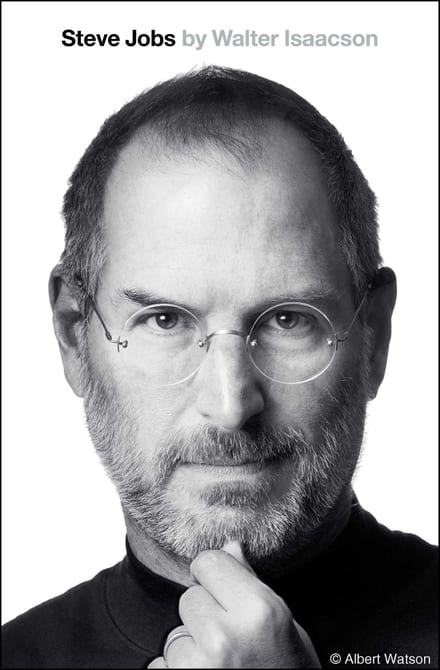
Steve Jobs
The full book runs ~665 pages — roughly 12 hours of reading. You get the key ideas here in 3 minutes.
The key ideas
- Own everything—chips, software, retail—to ship unified products
- Integrate hardware, software, and services into one seamless system
- Refuse compromise, even down to a screw's finish
- Cut the product line to focus on doing few things brilliantly
- Pay a human cost: brutality inseparable from the vision
- Endure exile at NeXT and Pixar before Apple's comeback
The summary
Steve Jobs built Apple on a single, unbending conviction: control everything. Not just the software or the look of a device, but the chips inside it, the operating system, the store where you bought it, even the exact shade of beige on the case. That end-to-end control is what let Apple ship products that felt whole in a way rivals never matched — the iPod wasn’t just a music player but hardware, software, and the iTunes Store working as one. The same refusal to accept anything less than his vision made Jobs brutal to the people building it. He called employees “assholes” and their work “shit,” and could burn days arguing over the roundness of a corner. The genius and the cruelty came from the same place.
The origin: pranks, spirituality, and a borrowed idea
Jobs was born in 1955 to Joanne Schieble and Abdulfattah Jandali; because Schieble’s family disapproved of Jandali, who was Muslim, the baby was given up and adopted by Paul and Clara Jobs of Silicon Valley. His eye for design traced back to two sources — the family’s clean-lined Eichler house and his father’s love of mechanics. In high school he met Steve Wozniak, and they bonded over electronics and pranks, building a “Blue Box” that let people make free long-distance calls and selling nearly a hundred of them.
Jobs dropped out of Reed College but stayed on to take classes that interested him, including a calligraphy course that later shaped the Macintosh’s typography. His curiosity ran to spirituality, LSD, and the arts; a seven-month journey through India deepened his taste for minimalism and his trust in intuition. He could also be ruthless with people who trusted him — at Atari, handed a bonus to reduce the chips in the game Breakout, he brought in Wozniak, told him the reward was $700 so they’d split $350 each, and pocketed most of the actual $5,000. When Wozniak later designed a self-contained personal computer and planned to give it away, as was normal in their Homebrew Computer Club, Jobs talked him into starting a company instead. They named it Apple after a farm Jobs had visited and built the first hundred machines by hand.
Perfectionism, exile, and return
The Apple II was a hit, but Jobs saw it as Wozniak’s machine and wanted one he could call his own — something to “make a dent in the universe.” He seized the Macintosh project from its originator, Jef Raskin, and drove it to success, helped by Ridley Scott’s famous “1984” television commercial. But his behavior had grown unbearable; the board had already installed Mike Scott as CEO partly to manage him, and in 1985 they forced Jobs out of the company he’d co-founded.
His wilderness years mixed failure and fortune. He founded NeXT, where his perfectionism ran wild — $100,000 on a logo, an insistence that the computer be a perfect cube — producing a machine too costly to sell. But he also bought a majority stake in Pixar, which after years of struggle released Tin Toy, won an Academy Award, and set the path toward Toy Story. Away from Apple, Jobs married Laurene Powell, had three children, reconnected with his biological mother and sister, and worked, haltingly, to repair his relationship with Lisa, his daughter with Chrisann Brennan. By 1996 Apple was failing; new CEO Gil Amelio bought NeXT, bringing Jobs back as an advisor. He maneuvered his way to power, forced the board to resign, and took over as CEO again — then cut the product line to a handful of things done well and turned a billion-dollar loss into a $309 million profit within a year.
The digital hub: iPod, iPhone, iPad
With designer Jony Ive, Jobs made the iMac — a playful, translucent-blue machine that became the fastest-selling computer in Apple’s history. He built the Apple Store to control even the experience of buying, opening the first in 2001 with the same obsession over minimalism he brought to the products. Then came the digital hub strategy: a central computer orchestrating all your devices. The iPod led, followed by the iPhone and the iPad, each built with Ive, each mocked as overpriced, and each reshaping its industry anyway. The tight integration of hardware, software, and services worked so well that, shortly before Jobs died, Apple passed Microsoft as the most valuable technology company in the world.
His health was the one thing control couldn’t fix. Diagnosed with cancer in 2003, Jobs refused surgery at first in favor of a vegan diet, acupuncture, herbal remedies, even a psychic. He eventually operated, delayed again when the cancer returned in 2008, and finally underwent a liver transplant. He died in 2011.
The bottom line
Jobs proved that obsessive control over every layer of a product — and the whole ecosystem around it — can create something competitors simply cannot copy, and that the same intensity can make a person miserable to work for. Read this if you want to understand how one man’s character, at its best and its worst, built the most influential technology company of the century.
Frequently asked questions
What is Steve Jobs about?
It's the story of how Jobs built Apple on a single conviction, control everything, from the chips inside a device to the store where you bought it to the exact shade of beige on the case. That end-to-end control let Apple ship products that felt whole, like the iPod uniting hardware, software, and the iTunes Store, while the same refusal to accept less than his vision made him brutal to work for. The genius and the cruelty came from the same place.
What are the key takeaways from Steve Jobs?
The through-line is that obsessive control over every layer of a product and its ecosystem creates something rivals can't copy. The book traces his whole arc: adoption and an early eye for design, the Blue Box built with Wozniak, the calligraphy class that shaped Macintosh typography, his trip through India and taste for minimalism, being forced out of Apple in 1985, the NeXT and Pixar years, his return and the cut to a focused product line, and the digital hub strategy behind the iMac, iPod, iPhone, and iPad. It's just as clear on the human cost and the health he couldn't control.
Who should read Steve Jobs?
Anyone who wants to understand how one man's character, at its best and its worst, built the most influential technology company of the century.
Is Steve Jobs worth reading?
It's candid about both the genius and the cruelty rather than flattering its subject, and it ties Jobs's design obsessions to concrete product decisions. If you're after a tidy leadership how-to rather than a full, unsparing biography, it's more portrait than playbook.