Book summary
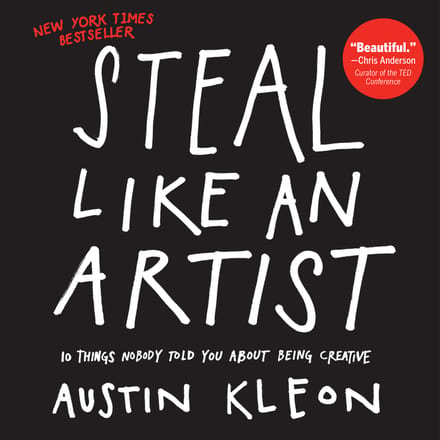
Steal Like an Artist: 10 Things Nobody Told You About Being Creative
The full book runs ~160 pages — roughly 3 hours of reading. You get the key ideas here in 2 minutes.
The key ideas
- Steal from artists you admire; nothing is made from nothing
- Build an artistic family tree and emulate your idols' process
- Embrace your limitations—they're what make your work distinctive
- Keep side projects; they feed your main work and unstick blocks
- Use early obscurity to experiment, then share your work online
- Focus on the process, not the outcome; embrace failure and community
The summary
Nothing gets made from nothing. Every artist you admire built on the people who came before them — Picasso and Dalí were arguably the greatest thieves in history, and the Beatles started life as a cover band. Creativity isn’t about conjuring originality out of thin air; it’s about recombination. So the practical advice is almost embarrassingly direct: pick the people whose work moves you, copy them closely, and pay attention to the exact places where your copy fails. That gap — the part of them you can’t reproduce — is where your own voice lives.
Steal, then find where the copy breaks
Think of your creativity like your DNA. Your genes are uniquely yours, yet every strand came from your ancestors. Art works the same way, which is why Austin Kleon’s first instruction is to build an artistic family tree: find someone you admire, then trace back to whoever influenced them, and keep pulling the thread. Then copy — not plagiarize, but genuinely imitate. Study your heroes so thoroughly that you’re borrowing their process, their habits, even their motivations, not just their surface.
As you do, you’ll run into walls. There will be things about them you simply can’t replicate, and the temptation is to read that as failure. It’s the opposite. Those limitations are your fingerprint — the raw material of a style that’s yours. Kleon calls the process emulation: you build on a hero’s legacy while the parts you can’t copy pull you somewhere new. Nick Cave got his start emulating Leonard Cohen. Conan O’Brien copied David Letterman, who copied Johnny Carson, who copied Jack Benny. Each of them found a distinctive voice by bumping up against the edges of what they couldn’t imitate.
Keep your side projects alive
You might assume that getting serious means dropping your hobbies and side projects to pour everything into the main work. That’s backward. Side projects are the outlet you reach for when the main work stalls; they give you somewhere to play, and that play is often where new ideas come from. Kleon felt hollow after he quit playing guitar to concentrate on his art — and only got happier and more well-rounded once he let himself pick it up again purely for fun. Don’t starve the other parts of yourself. They feed the center.
Use obscurity, then share
When you’re starting out, being unknown is a gift. Nobody’s watching, so there’s no pressure and no expectations — just room to make mistakes and figure out who you are. Once you’re ready, though, sharing is how you get found. Start a blog or a website, post your work where people can see it, and build a following over time. The internet cuts both ways, delivering praise and criticism in the same feed, so don’t let the negativity stop you and don’t waste hours arguing with critics. Take what’s useful from criticism and let the rest fuel you. Keep a praise file to reread on hard days, and hand out praise to others, since positivity tends to breed more of it.
Shape your space and move
Build a workspace that serves every part of your creativity, and don’t do everything on a computer — screens narrow your range, so work with your hands whenever you can. Guard against complacency, too. A change of environment can shake loose perspectives you didn’t know you’d lost; Kleon credits his own stretches living in Texas, England, and Italy with feeding his work.
Stay in the community, love the process
Creativity is a social act. Whether you notice it or not, you belong to a creative community, so treat collaboration, feedback, and even criticism as ways to get better. Take risks and expect to fail — failure is built into the work, and you won’t grow without it — while constantly hunting new sources to steal from and recombine. Above all, keep your perspective healthy: don’t fixate on the result. Fall for the process itself and learn to enjoy the making as much as the finished thing, because the work is the point, not the applause.
The bottom line
Your voice doesn’t come from straining to be original; it emerges when you copy your heroes and discover what you can’t reproduce. Read this if you’re stuck believing creativity demands pure invention, or if you just need permission to start making things.
Frequently asked questions
What is Steal Like an Artist about?
Nothing gets made from nothing, so creativity is recombination rather than conjuring originality out of thin air. The book's practical advice is to copy the people whose work moves you and pay close attention to the exact places your copy fails, because that gap, the part you can't reproduce, is where your own voice lives.
What are the key takeaways from Steal Like an Artist?
Build an artistic family tree and study your heroes deeply, then emulate them until the parts you can't reproduce pull you somewhere new. Keep your side projects and hobbies alive as an outlet, use early obscurity to make mistakes freely and then share your work online, keep a praise file for hard days, shape a workspace and work with your hands, and above all fall for the process instead of fixating on the finished result.
Who should read Steal Like an Artist?
Anyone stuck believing creativity demands pure invention, or who just needs permission to start making things.
Is Steal Like an Artist worth reading?
It reframes creative blocks in a freeing way and backs it with vivid examples, from Nick Cave emulating Leonard Cohen to the Conan O'Brien, David Letterman, Johnny Carson chain. It's short and encouraging, so if you want technical craft instruction rather than mindset and permission, it won't give you that.