Book summary
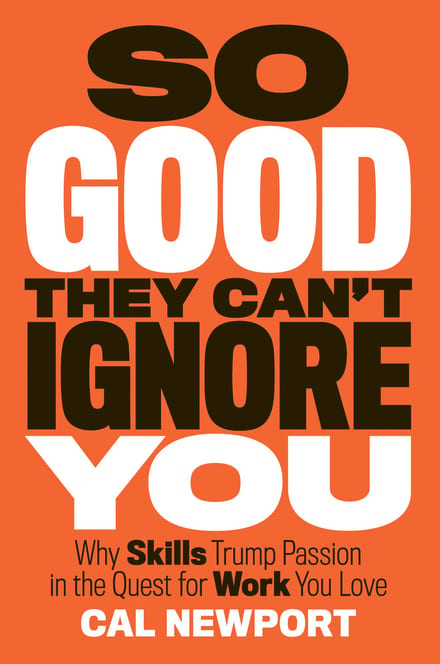
So Good They Can't Ignore You: Why Skills Trump Passion in the Quest for Work You Love
Why Skills Trump Passion in the Quest for Work You Love
The full book runs ~272 pages — roughly 5 hours of reading. You get the key ideas here in 5 minutes.
The key ideas
- Under 4 percent of students' named passions had anything to do with work.
- The craftsman asks what he can offer; the passion mindset asks what he gets.
- Chess grand masters logged 5,000 hours of serious study; plateaued players logged 1,000.
- Control bought without capital collapses; control backed by capital draws resistance.
- Missions appear only at a field's cutting edge, then advance through small bets.
The summary
Thomas left a banking job for a Zen monastery in the Catskills and spent months grinding on the Mu koan until it cracked open one afternoon in the woods. He was now officially a serious student of Zen, the exact life he had daydreamed about. “The reality was, nothing had changed. I was exactly the same person, with the same worries and anxieties.” He sat down and cried.
That is the passion hypothesis failing under ideal conditions: find your calling, chase it, arrive, and discover you brought yourself along.
Steve Jobs did not follow his passion
In the 2005 Stanford address that turned “find what you love” into a generational slogan, Jobs was describing a life he hadn’t lived. A year before Apple existed he was a Reed dropout studying Western history and dance, taking a night shift at Atari because the ad promised “Have fun and make money.” Apple began as a low-risk side scheme to print circuit boards for $25 and sell a hundred at $50, until a local store owner asked for fifty assembled machines instead.
The research is no kinder. Robert Vallerand surveyed 539 Canadian college students: 84 percent had a passion, but the top five were dance, hockey, skiing, reading and swimming, and under 4 percent related to work or school. Amy Wrzesniewski found administrative assistants with identical duties split evenly between calling the work a job, a career or a calling — the best predictor was years on the job.
What you can offer, not what you can get
Asked what he tells young performers, Steve Martin kept giving the answer nobody wants: “Be so good they can’t ignore you.” It took ten years to make his act cohere, a decade of crippling anxiety attacks. Newport calls this the craftsman mindset — attention on what you produce — against the passion mindset, which asks what the job does for you. One set of questions has answers; the other (“Is this really who I am?”) never does.
The logic is economic. Creativity, impact and control are rare and valuable, so you need something rare and valuable to trade for them — career capital. Two New York Times profiles, two days apart in 2009, show both sides. Lisa Feuer quit advertising, put a $4,000 yoga certification on a home equity loan and opened a children’s yoga business; a year later she was on track for $15,000 and texted the reporter from the food-stamp office. Joe Duffy was just as sick of agency life, but built one uncommon skill — brand logos, for Sony and Coca-Cola — and traded it for his own shop and a hundred-acre retreat.
Three traits disqualify a job as a foundation:
- few chances to build rare and valuable skills
- work you consider useless or actively harmful
- colleagues you genuinely dislike
Practice, not playing
Newport and the guitarist Jordan Tice both started at twelve and logged comparable hours; by eighteen Newport knew hundreds of songs and Tice was touring on a record deal. Newport clung to what he already knew. Tice practices just past comfortable, stopping dead on every wrong note.
Chess makes it measurable. Neil Charness surveyed more than four hundred ranked players who had all logged roughly 10,000 hours. The grand masters had spent about 5,000 of those hours in serious study; those stuck at intermediate had spent about 1,000, favoring tournament play — enjoyable, rarely at the right difficulty, slow to tell you anything. Stretch plus fast feedback is what Anders Ericsson named deliberate practice, and almost no knowledge worker does it.
Control, and its two traps
Ryan Voiland bought farmland out of college and now farms seventy organic acres with a subscriber waiting list. What people envy isn’t the sunshine — farmers fight the weather — it’s control, which he spent a decade earning. Jane skipped that part, dropping out of college to live on website income she never built; the blog meant to bankroll it managed three posts in nine months. Autonomy bought without capital doesn’t hold.
The second trap is the opposite problem. Lulu Young automated her employer’s software testing, cashed that value in for a thirty-hour week, turned down a management promotion to join a seven-person startup, then went freelance so she could take a Friday off to fly. Every move met resistance, because she had become worth keeping. Both feel the same from inside. Derek Sivers, who sold CD Baby for $22 million and gave the proceeds away, supplies the test: do what people are willing to pay for. Money isn’t the goal, it’s a neutral read on value.
Missions live at the cutting edge
Pardis Sabeti runs a Harvard lab hunting genes that confer resistance to Lassa fever, malaria and plague. Her mission arrived late: she cycled through math, medicine and infectious disease, finished an MD she no longer needed, and committed only after a 2002 Nature paper proved out her approach. Good missions sit in the “adjacent possible” just past a field’s current edge, so you have to reach that edge first — think small for years, then act big.
Getting from mission to result takes little bets: projects small enough to finish in a month that return real feedback. The archaeologist Kirk French, wanting to popularize his field, digitized an old documentary, shot footage for a new one, then filmed himself chasing a crank call about Knights Templar treasure. That last bet became a Discovery Channel series. It also takes remarkability: a project people want to tell others about, launched where telling is easy.
The bottom line
Passion isn’t the input, it’s the output. Get good at something rare and valuable, spend that capital on control and a mission, and the love follows — working right beats finding the right work. Thomas went back to banking, stopped measuring every task against a fantasy job, and within two years ran a system managing $6 billion. Read it if you’re paralyzed by what you’re meant to do; it’ll convince you that’s the wrong question.
Fact check
Popular books repeat findings that later research has complicated. Where So Good They Can't Ignore You makes a testable claim, here's what the evidence actually shows.
Telling people to find a pre-existing passion is worse advice than telling them to build one.
Across five experiments, O'Keefe, Dweck and Walton found that people who treat interests as fixed things waiting to be discovered were less open to fields outside their existing interests, expected a real passion to supply limitless motivation, and lost interest faster once a new subject got difficult. Their own summary is that urging people to find their passion may lead them to put all their eggs in one basket and then drop that basket when it becomes difficult to carry — the same collapse Newport describes in Thomas at the monastery. The work is experimental and mostly with students, so it shows how the advice changes behaviour rather than tracking career outcomes across decades.
- O'Keefe PA, Dweck CS, Walton GM. Implicit theories of interest: finding your passion or developing it? Psychol Sci. 2018;29(10):1653-1664. PubMed
Chess grand masters logged roughly 5,000 hours of serious solitary study while players who plateaued at intermediate level logged about 1,000.
Charness and colleagues surveyed two large samples of tournament-rated players and found that grand masters had put about 5,000 hours into serious study alone during their first decade of serious play — nearly five times the average reported by intermediate-level players. Serious study alone was the strongest predictor of rating in both samples, ahead of tournament play and formal instruction, which is exactly the distinction the chapter is built on. All the chess activities measured together accounted for about 40% of the variance in skill ratings, so study hours are the biggest measured lever rather than the whole explanation.
- Charness N, Tuffiash M, Krampe R, Reingold E, Vasyukova E. The role of deliberate practice in chess expertise. Appl Cogn Psychol. 2005;19(2):151-165. Source
Deliberate practice — stretching past comfort with fast feedback — is the engine behind expert performance, including in knowledge work.
A meta-analysis by Macnamara, Hambrick and Oswald found deliberate practice accounted for 26% of the variance in performance for games, 21% for music and 18% for sports — but 4% for education and under 1% for professions. A later double-blind replication of the 1993 violinist study the theory rests on failed to reproduce its core result that accumulated practice tracked each skill level, and found teacher-designed practice explained no more variance than practising alone. The mechanism the book carries from chess and guitar into knowledge work is where the evidence is thinnest; practising past comfortable still beats rehearsing what you already know, it just doesn't account for most of who ends up good at a job.
- Macnamara BN, Hambrick DZ, Oswald FL. Deliberate practice and performance in music, games, sports, education, and professions: a meta-analysis. Psychol Sci. 2014;25(8):1608-18. PubMed
- Macnamara BN, Maitra M. The role of deliberate practice in expert performance: revisiting Ericsson, Krampe & Tesch-Römer (1993). R Soc Open Sci. 2019;6(8):190327. PubMed
Control over what you do and how you do it is the trait that most reliably turns a job into work you love.
Humphrey, Nahrgang and Morgeson's meta-analysis of 259 studies covering 219,625 workers found that motivational work characteristics, autonomy among them, explained 34% of the variance in job satisfaction — a large share for one family of variables, and consistent with the book's case for control. But social characteristics such as support from colleagues added a further 17% of incremental variance in job satisfaction and 40% in organisational commitment, on top of what the motivational features already explained. Control is one of the strongest levers on how work feels, not the single decisive one.
- Humphrey SE, Nahrgang JD, Morgeson FP. Integrating motivational, social, and contextual work design features: a meta-analytic summary and theoretical extension of the work design literature. J Appl Psychol. 2007;92(5):1332-56. PubMed
Frequently asked questions
What is So Good They Can't Ignore You about?
It argues that "follow your passion" is bad advice, because most people have no pre-existing career passion waiting to be found. What actually produces work people love is becoming rare and valuable at something, then trading those skills for the traits that make a job great: creativity, control and a mission. Passion is the output of a working life done well, not the input.
What are the key takeaways from So Good They Can't Ignore You?
Four ideas carry the book. Adopt the craftsman mindset — ask what you can offer the world, not what the job does for you — and build career capital, the rare and valuable skills you trade for everything else. Acquire that capital through deliberate practice: stretch just past what's comfortable and take honest feedback. Spend it on control, watching for the two traps (autonomy without capital collapses; autonomy with capital gets resistance from people who now need you). And find a mission at the cutting edge of your field, then advance it with little bets and projects remarkable enough that people want to talk about them.
Who should read So Good They Can't Ignore You?
Anyone stuck on the question of what they're meant to do — students, career switchers, people a few years into a job that feels wrong. It's especially useful if you're tempted to quit and start over in a field where you'd have no skill yet.
Is So Good They Can't Ignore You worth reading?
Yes, if you want the argument and the evidence rather than a program. Newport is honest that this is a manifesto, not a ten-step system, and the case studies — a bluegrass guitarist, a TV writer, a farmer, a Harvard geneticist — do most of the persuading. If you already accept that skills come before passion, the middle chapters will feel like confirmation, and you may want a more tactical book on practice instead.