Book summary
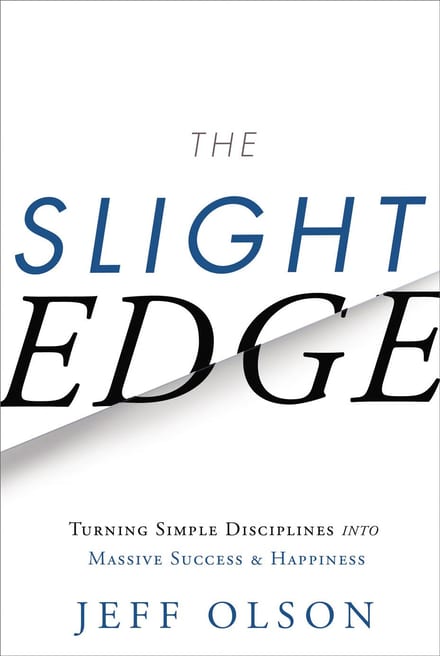
The Slight Edge: Turning Simple Disciplines into Massive Success and Happiness
Turning Simple Disciplines into Massive Success and Happiness
The full book runs ~280 pages — roughly 5 hours of reading. You get the key ideas here in 5 minutes.
The key ideas
- Take the penny that doubles daily, not the million handed over today.
- Every simple discipline is easy to do and just as easy not to do.
- Stop judging by visible results — during the stretch that decides everything there are none.
- Drop the quantum-leap story; breakthroughs are the end of long, dull repetition.
- Fix your philosophy first — attitudes, actions and results all follow from it.
- Show up daily, log the invisible progress, find a real mentor.
The summary
Two young men start from the same place with the same advantages. One ends up cutting grass on Florida golf courses and living near the beach; the other builds companies and gets rich. Jeff Olson opens with that comparison, then reveals the trick: both men are him. Nothing separated them except the decisions he was making on an ordinary Tuesday. That is the slight edge — the choice so small it seems not to count, made and remade until it either carries you up or quietly buries you.
Two curves that start in the same place
Olson draws life as two paths, a success curve and a failure curve. What makes them treacherous is how long they look identical. For a long stretch they run parallel, close enough that almost nobody can see which one they’re standing on. Then they separate, and by the time the gap is visible it is enormous.
He puts the arithmetic behind it with a fable. Two boys are offered a choice: a million dollars right now, or a single penny that doubles every day for a month. One takes the cash, hires advisers, invests carefully, and still manages to lose it all. The other takes the penny — worth almost nothing for weeks — and ends the month a millionaire. Same start, same calendar, opposite endings. The water hyacinth does the same work: a plant that doubles daily and stays invisible in the pond until the moment it covers the surface.
Since results lag, they can’t tell you which curve you’re on. Your posture can. People on the failure curve live in blame; people on the success curve live in responsibility. One group is pulled by the past, the other by the future.
Easy to do, easy not to do
Olson credits Jim Rohn with the line the whole book turns on: the simple things that lead to success are all easy to do, and just as easy not to do.
That is the mechanism, and it’s nastier than it first sounds. Read ten pages. Take the walk. Make the call. Each one is trivially doable, which is precisely why skipping it costs you nothing today. There’s no punishment for skipping it and no visible reward for doing it. Both are true on any single day and both are lies over ten years. Because the feedback never arrives, you get no signal about which curve you’re on, so you drift onto whichever one asks less of you.
His formula is consistently repeated daily actions, plus time, equals unconquerable results. The variable everyone wants to skip is the second one.
The quantum leap is a myth
Olson spends a chapter dismantling the story the culture tells about success — the breakthrough, the big break, the overnight transformation. He doesn’t just call it wrong, he calls it toxic. Quantum leaps are real, he allows; the term describes a particle jumping to a higher energy level. But that jump is what finally happens after energy has been applied over time. What looks like a breakthrough is always the end of a long series of small things done consistently.
The damage is practical. If you expect fast results, their absence in week three reads as proof the method failed — so you quit at exactly the point where it’s working and simply hasn’t surfaced. Olson’s response is to stop trusting your eyes: you can’t judge daily choices on visible evidence, because during the part that decides everything there is none.
Philosophy is the root variable
This is where the book earns its own space rather than restating its premise. Olson’s claim is that the disciplines aren’t the starting point — they’re an output. He runs the chain: your philosophy creates your attitudes, your attitudes create your actions, your actions create your results, your results create your life.
Everyone already knows they should exercise and save; knowledge was never the constraint. It sits upstream, in whether you believe today’s invisible effort is worth spending. Change that and the habits follow on their own. Try to install them without it and you’re running on willpower, which expires.
He also insists the effect doesn’t stop at you. He hands a chapter to his daughter, who describes how his disciplines reshaped her life and how hers now reach other people. Your slight edge radiates outward, in whichever direction you’ve pointed it.
What it asks of you
Olson names seven principles for putting it to work:
- Show up — most people never take the first step.
- Be consistent — daily, not when you feel like it.
- Have a good attitude — it sets the ceiling on your results.
- Be committed for the long haul — the timescale is years.
- Have faith and a burning desire — know specifically what you want, in writing.
- Be willing to pay the price — anything worth having costs something.
- Practice slight edge integrity — what you do when nobody is checking.
Around these he stacks ordinary scaffolding: a simple written plan, a log so invisible progress becomes visible, small wins celebrated, an accountability partner, and a real mentor rather than a hero admired from a distance. His own was the manager of the Albuquerque airport, who set his career moving before Olson noticed.
The bottom line
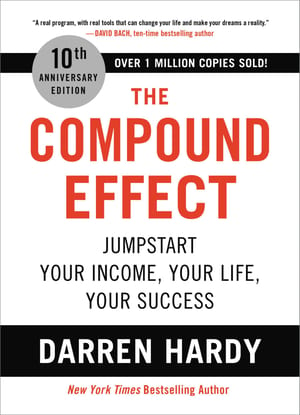
The choices that decide your life are too small to feel important while you’re making them, and their results stay hidden long enough that quitting always feels like the reasonable call — so the only real defense is a philosophy that keeps you going without evidence. If you’ve read The Compound Effect, you’ve met this argument before, though Olson got there first, in 2005, five years ahead of Darren Hardy; his version spends less time on tracking systems and more on why people abandon a method that works. Read it if you already know exactly what to do and keep not doing it.
Fact check
Popular books repeat findings that later research has complicated. Where The Slight Edge makes a testable claim, here's what the evidence actually shows.
Actions too small to feel important on the day — ten pages, the walk, the call — compound over years into a gap between two lives so large it looks like a different starting point.
In the domain where this is best measured the direction holds and the shape doesn't. Pooling 15 cohorts covering 47,471 adults and 3,013 deaths over a median 7.1 years of follow-up, people averaging about 5,800 steps a day had a 40 percent lower risk of dying than those averaging about 3,550 — a difference of roughly a twenty-minute walk. But the curve decelerates instead of doubling: risk kept falling only to about 6,000-8,000 steps a day for adults over 60 and 8,000-10,000 for those under 60, then flattened. Small consistent action buys a great deal, most of it at the low end where Olson says nothing is happening; the penny fable is the wrong picture of how it accrues.
- Paluch AE, Bajpai S, Bassett DR, et al. Daily steps and all-cause mortality: a meta-analysis of 15 international cohorts. Lancet Public Health. 2022;7(3):e219-e228. PubMed
Repeat a simple discipline daily and it stops costing you a decision — the doing becomes automatic.
It does, and Olson deserves credit for not attaching a number, since the popular 21 days has no support. A 2024 review of 20 habit-formation studies covering 2,601 participants found medians of 59 to 66 days to reach automaticity, means of 106 to 154 days, and individual times spanning 4 to 335 days, with habit strength rising reliably from before to after the interventions (SMD 0.69). The real-world study that produced the widely quoted 66-day median reported the same wide spread. What predicts a stronger habit also matches his seven principles: consistent timing, morning practice, and choosing the behavior yourself rather than being handed it.
- Singh B, Murphy A, Maher C, Smith AE. Time to form a habit: a systematic review and meta-analysis of health behaviour habit formation and its determinants. Healthcare (Basel). 2024;12(23):2488. PubMed
- Lally P, van Jaarsveld CHM, Potts HWW, Wardle J. How are habits formed: Modelling habit formation in the real world. Eur J Soc Psychol. 2010;40(6):998-1009. Source
Philosophy is the root variable: change what you believe and the attitudes, actions and results follow on their own.
The chain is real and it leaks at the step that carries Olson's argument. A meta-analysis of 47 experiments that successfully shifted people's intentions found the intention change was medium-to-large (d = 0.66) while the resulting change in actual behavior was only small-to-medium (d = 0.36) — roughly half of what a clean chain would predict. That gap is the intention-behavior problem, and it is exactly the space the ordinary scaffolding he stacks around the philosophy is there to fill: the written plan, the log, the accountability partner. Believing differently is a defensible place to start; it does not carry the behavior by itself.
- Webb TL, Sheeran P. Does changing behavioral intentions engender behavior change? A meta-analysis of the experimental evidence. Psychol Bull. 2006;132(2):249-68. PubMed
Frequently asked questions
What is The Slight Edge about?
It's about the choices so small they seem not to count, made and remade until they either carry you up or quietly bury you. Jeff Olson opens with two young men who start identically and end up in completely different lives, then reveals both are him, separated by nothing but the decisions he made on ordinary days. Life runs on two curves, a success curve and a failure curve, and they look identical for a long time before the gap becomes enormous.
What are the key takeaways from The Slight Edge?
The line the book turns on comes from Jim Rohn: the simple things that lead to success are all easy to do, and just as easy not to do. Read ten pages, take the walk, make the call, each trivially doable and each carrying no punishment for skipping it today, which is exactly why people drift. The formula is consistently repeated daily actions plus time equals unconquerable results, and the penny that doubles for a month beats the million dollars taken up front. Quantum leaps are a myth in the way the culture tells them, since what looks like a breakthrough is the end of a long run of small things. Upstream of all of it sits philosophy: your philosophy creates your attitudes, which create your actions, which create your results, which create your life.
Who should read The Slight Edge?
It's for people who already know exactly what to do and keep not doing it, especially anyone who has abandoned a good method around week three because nothing visible had happened yet.
Is The Slight Edge worth reading?
Its best chapter is the one on philosophy as the root variable, which explains why installing habits on willpower alone fails and why knowledge was never the constraint. If you've read The Compound Effect you've met this argument already, though Olson got there first in 2005, five years ahead of Darren Hardy. His version spends less time on tracking systems and more on why people quit a method that's working.