Book summary
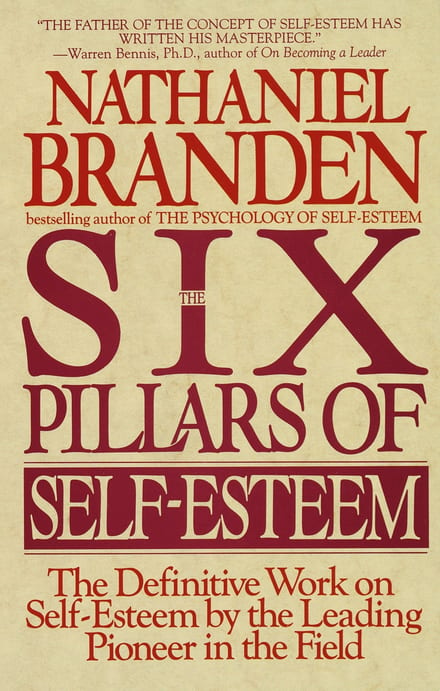
The Six Pillars of Self-Esteem
The full book runs ~341 pages — roughly 6 hours of reading. You get the key ideas here in 5 minutes.
The key ideas
- Build both halves: competence to cope, and worthiness of happiness.
- Skip the affirmations: only what you actually choose can build esteem.
- Practice six things: consciousness, acceptance, responsibility, assertiveness, purpose, integrity.
- Name the goal exactly: thirty minutes on the treadmill, not "do my best".
- Accept that no one is coming — no rescuer, no miracle, no exception.
- Raise your average, not your ceiling: small steps lead to the next one.
The summary
Self-esteem is not a feeling you can talk yourself into. Nathaniel Branden defines it exactly: the disposition to experience yourself as competent to cope with the basic challenges of life and as worthy of happiness. That splits into two parts. Self-efficacy is confidence in the functioning of your mind — in your ability to think, understand, learn, choose, and decide. Self-respect is assurance of your own value, an affirmative attitude toward your right to live and be happy, comfort in asserting your thoughts, wants, and needs. Lose either and self-esteem is impaired. And neither arrives as a gift: its possession over time, Branden writes, represents an achievement.
Why the mind needs it at all
Two facts about our species create the need. First, we survive by thinking — the food on your table and the light you may be reading by are equally products of mind. Second, thinking isn’t automatic. Your heart pumps without your supervision; consciousness doesn’t work that way. You have the option of turning the searchlight brighter or dimmer. We are the one species that can formulate a vision of what values are worth pursuing and then pursue the opposite.
That choice is why self-esteem matters so much. It isn’t a decoration on top of a life; it’s a motivator, and it runs in a feedback loop. Trust your judgment and you’re more likely to think hard, persist, and succeed — which confirms the trust. Distrust it and you go mentally passive, give up sooner, and fail more, which feels like proof. Self-respect works the same way: accept discourtesy and exploitation as natural and some people will treat you at your own estimate.
Praise and success can’t do the job
Branden has no patience for the feel-good wing of the field. Reciting “I am special” every day, gold stars handed out for showing up — none of it builds efficacy or worth, because self-esteem pertains only to what is open to your volitional choice. Not the family you were born into, not your race, not your ancestors’ achievements — those are sources of pseudo self-esteem, not of self-respect.
Worldly success is no better a shortcut. Branden calls the substitute pseudo self-esteem: the illusion of efficacy and worth without the reality, built on values unrelated to what genuine competence requires. You can win every honor and feel you have accomplished nothing. “To attain ‘success’ without attaining positive self-esteem is to be condemned to feeling like an impostor anxiously awaiting exposure.”
The six practices
Because self-esteem is a consequence, you can’t work on it directly — yours or anyone else’s. You work on the source: six practices, all of them operations of consciousness, all of them choices you face every hour.
Living consciously means seeking awareness of everything that bears on your actions, purposes, values, and goals, and then behaving in accordance with what you see. Awareness not translated into action is a betrayal of consciousness. Self-acceptance is the refusal to be in an adversarial relationship with yourself: making real to yourself that you think what you think, feel what you feel, and have done what you have done — then asking, with compassionate interest rather than contempt, why it felt right at the time. Accepting is not liking, and it is not excusing; it is the precondition of change. Self-responsibility is grasping that no one owes you the fulfillment of your wishes. Branden watched clients turn a corner the moment they understood that no one is coming — no rescuer, no miracle. A desire you won’t build a plan for is a daydream.
Self-assertiveness means honoring your wants, needs, and values and finding appropriate ways to express them. Not belligerence, just the willingness to be who you are openly and the refusal to fake your person to be liked. Living purposefully means using your powers for goals you selected, and selecting them specifically — not “do my best” but thirty minutes on the treadmill four times a week. Purposes unrelated to a plan of action exist only as frustrated yearnings. People grasp this more easily at work than at home, which may be why more of them make a success of their work life than of their marriages. Personal integrity is congruence: words and behavior matching. When you act against your own judgment, you lose face in the only courtroom you cannot leave. “Only I will know” is the great self-deception.
Small steps, not perfection
You don’t have to master any of this. Branden asks only that you raise your average level of performance, and he keeps the steps small, because big ones intimidate while small ones lead to the next. His working tool is sentence completion: take a stem — If I bring 5 percent more integrity into my life — and write endings as fast as you can. What his groups produced was mundane and precise. I wouldn’t pad my expense account. I’d tell people when they do things that bother me.
The obstacle is rarely complexity. It’s inertia, and the wish to avoid discomfort. Living consciously obliges you to confront your fears; self-responsibility asks you to relinquish the fantasy of a rescuer. Branden calls the will to do it anyway the seventh pillar, fueled only by the love you have for your own life.
The bottom line
Self-esteem is the reputation you earn with yourself, and it’s earned by what you do — consistently, in small matters as much as large. Feeling good about yourself is a byproduct of acting in ways you can respect, never a replacement for it. Read this if you’ve stacked up achievements or affirmations and still feel like a fraud, or if you’re raising, teaching, or managing people and want to build something in them that will hold.
Fact check
Popular books repeat findings that later research has complicated. Where The Six Pillars of Self-Esteem makes a testable claim, here's what the evidence actually shows.
Self-esteem is a motivator that feeds a real-world loop — trust your judgment and you think harder, persist, and succeed.
The persistence half holds; the achievement half mostly doesn't. Baumeister and colleagues' 2003 review concluded that the benefits of high self-esteem fall into two categories, enhanced initiative and pleasant feelings: it makes people more willing to speak up and it clearly helps persistence after failure, but lab studies generally failed to show that it causes better task performance, and with school results the causality runs the other way — good grades raise self-esteem rather than the reverse. A 12-year cross-lagged study of 1,824 people aged 16 to 97 did find self-esteem acting as a cause rather than a consequence, with medium-sized effects on affect and depression and smaller ones on relationship and job satisfaction — but no effect at all on occupational status. Branden's emphasis on persistence and self-assertiveness survives this better than the implication that esteem produces success.
- Baumeister RF, Campbell JD, Krueger JI, Vohs KD. Does high self-esteem cause better performance, interpersonal success, happiness, or healthier lifestyles? Psychol Sci Public Interest. 2003;4(1):1-44. PubMed
- Orth U, Robins RW, Widaman KF. Life-span development of self-esteem and its effects on important life outcomes. J Pers Soc Psychol. 2012;102(6):1271-88. PubMed
Affirmations and praise build nothing — self-esteem can only come from what is open to your own volitional choice.
This is where Branden parts company with the self-esteem movement he is often filed alongside, and the evidence is on his side. The 2003 review found no evidence that boosting self-esteem through therapeutic interventions or school programs produces benefits, and warned that indiscriminate praise may just as easily promote narcissism; it recommended praise be tied to actual behavior and self-improvement. A pair of experiments on positive self-statements found that participants with low self-esteem who repeated "I'm a lovable person" ended up feeling worse than those who didn't, while high-self-esteem participants felt better only to a limited degree — the affirmation backfired on the people it was aimed at.
- Baumeister RF, Campbell JD, Krueger JI, Vohs KD. Does high self-esteem cause better performance, interpersonal success, happiness, or healthier lifestyles? Psychol Sci Public Interest. 2003;4(1):1-44. PubMed
- Wood JV, Perunovic WQ, Lee JW. Positive self-statements: power for some, peril for others. Psychol Sci. 2009;20(7):860-6. PubMed
Sentence-completion writing — finishing a stem as fast as you can, without editing — produces real change.
Branden's specific exercise has not been trialled on its own, so the fairest test is the broader family of structured writing exercises it belongs to. A meta-analysis of 146 randomized studies of experimental disclosure found a positive and significant average effect, but a small one: r = .075, with the size depending heavily on moderators such as how long and how often people wrote. That is a genuine effect rather than a null one, which is more than most self-help exercises can show — but it is a nudge, not the engine of change, and it sits alongside the behavioral practices Branden treats as the real work.
- Frattaroli J. Experimental disclosure and its moderators: a meta-analysis. Psychol Bull. 2006;132(6):823-65. PubMed
Frequently asked questions
What is The Six Pillars of Self-Esteem about?
Nathaniel Branden defines self-esteem precisely — the disposition to experience yourself as competent to cope with life's basic challenges and as worthy of happiness — and shows that it can't be handed to you. It has two halves: self-efficacy, confidence in your own mind, and self-respect, assurance of your own value. Because self-esteem is a consequence of how you act, you build it by working on the six daily practices that produce it, not on the feeling itself.
What are the key takeaways from The Six Pillars of Self-Esteem?
The six practices are living consciously (seeking awareness and then acting on it), self-acceptance (refusing an adversarial relationship with yourself, which is the precondition of change, not an excuse), self-responsibility (grasping that no one is coming to rescue you), self-assertiveness (honoring your wants and refusing to fake your person to be liked), living purposefully (naming goals specifically — thirty minutes on the treadmill four times a week, not "do my best"), and personal integrity (words and behavior matching, because "only I will know" is the great self-deception). Branden also warns off two shortcuts: affirmations and gold stars build nothing, and worldly success without genuine self-esteem leaves you feeling like an impostor. His working tool is sentence completion — take a stem and write endings as fast as you can — and he asks only that you raise your average level of performance, keeping the steps small.
Who should read The Six Pillars of Self-Esteem?
Read it if you've stacked up achievements or affirmations and still feel like a fraud. It's also for anyone raising, teaching, or managing people who wants to build something in them that will actually hold.
Is The Six Pillars of Self-Esteem worth reading?
It's the rare self-esteem book with no patience for the feel-good wing of the field — Branden insists esteem is earned through what you do, in small matters as much as large, which makes it far more useful than a book of affirmations. The six practices are concrete and the sentence-completion exercise gives you something to do tonight. If you want quick reassurance rather than a standard to live up to, this will feel demanding.