Book summary
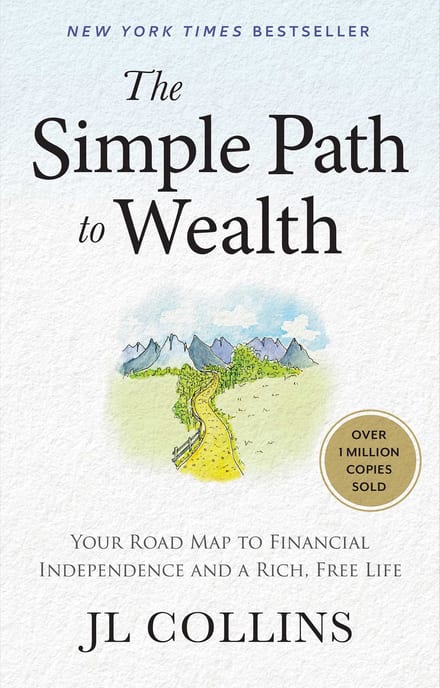
The Simple Path to Wealth
Your Road Map to Financial Independence and a Rich, Free Life
The full book runs ~289 pages — roughly 5 hours of reading. You get the key ideas here in 5 minutes.
The key ideas
- Kill debt first, then invest everything above your spending
- Chase F-you money: freedom to say no
- Own VTSAX, a slice of every U.S. company
- Costs quietly devour returns; a 1% fee eats 25% of income
- The market always rises through rocky rides; never time it
- Live on 4% a year and work becomes optional
The summary
Spend less than you earn. Avoid debt. Invest the surplus in a low-cost total stock market index fund. Then leave it alone and let it compound. That’s the whole thing. Collins wrote it first as a series of letters to his daughter, Jessica, because he wanted her path to money to be smoother than his own, which took decades and plenty of hard knocks. Everything the financial industry sells you — the complex products, the active managers, the confident forecasts — exists to profit the people who create it, not you. Sound investing isn’t complicated. Complexity is the story someone tells to get between you and your money.
Debt is the first thing to kill. Collins compares carrying it to being covered in leeches: take your sharpest knife and start scraping. If your lifestyle matches or exceeds your income, you’re a gilded slave no matter how big the paycheck. The lever that does the real work is your savings rate. Try saving and investing 50% of what you earn — with no debt, he insists, it’s perfectly doable — and something twofold happens: you learn to live on less at the same time as you pile up more to invest. The less you need, the sooner you’re free.
F-you money
Collins borrowed the phrase from James Clavell’s novel Noble House, where a young woman is after enough money to be completely free of the demands of others. It named a goal he’d already been chasing. He first had his at 25: $5,000 saved from two years of work at $10,000 a year. When his boss refused him four months of unpaid leave to bum around Europe, he resigned — and suddenly the “no” became negotiable. He got six weeks and a month of annual vacation going forward. F-you money didn’t just pay for the trip; it bought him room to negotiate, and he swore he’d never be a slave again.
That’s the point Collins keeps circling back to: this was never about retirement. It’s about options, about being able to say no. F-you money can be just enough to step to the side for a while. Financial independence is the fuller version — the day you can live on 4% of your investments a year. He and his wife crossed that line during three years when neither of them worked and their net worth grew anyway.
Why the market always wins
Here’s the belief the whole plan rests on: the market always goes up, and it’s always a wild, rocky ride getting there. Crashes, corrections and pullbacks aren’t the end of the world — they’re normal, expected parts of the process. The two emotions that wreck investors are fear and greed. Fear makes you flee for the exits every time the market drops, which is exactly when you should be holding and buying more.
You cannot time the market. Not you, not the heavily credentialed experts on CNBC — every day some predict a crash while equally credentialed experts predict a boom, and nobody can reliably call the future. So Collins wants his money working as hard as possible, as soon as possible.
The tool is VTSAX, Vanguard’s Total Stock Market Index Fund. Own it and you own a slice of roughly 3,700 companies — virtually every publicly traded firm in the U.S. It’s self-cleansing: as some companies fade, new winners rise to take their place, and you never have to guess which is which. Over 15- to 30-year stretches the index beats 82% to 99% of actively managed funds. Just buying it puts you in the top tier of performance, year after year, for the price of accepting “average.”
Costs are the quiet killer. The average mutual fund charges about 1.25% a year; VTSAX charges .05%. As Bogle put it, performance comes and goes but expenses are always there. Since you’ll eventually live on roughly 4% of your assets, a 1% fee is eating a full 25% of your income. Collins is just as blunt about advisors: too many serve their own interests, and by the time you know enough to pick a good one, you know enough to manage the money yourself.
Two stages and the 4% rule
Your investing life has two stages, and they aren’t tied to your age. In the Wealth Accumulation Stage you’re working, saving and adding money — go aggressive, all stocks. In the Wealth Preservation Stage your earned income has slowed or stopped and the portfolio is called on to support you; adding bonds smooths the ride at the cost of lower long-term returns.
How do you know you have enough? The 4% rule. In 1998, three Trinity University professors tested various withdrawal rates against 30-year periods. At 4% a year from a 50/50 stock/bond portfolio, adjusted for inflation, the money survived 96% of the time — it failed only for people who started withdrawing in 1965 and 1966. Draw 3% or less and you’re about as safe as death and taxes. Put simply: once you can live on 4% of your investments a year, work becomes optional.
The bottom line
Wealth isn’t complicated and it isn’t reserved for people who pick hot stocks — save aggressively, stay out of debt, pour the surplus into one broad, cheap index fund, and let time and compounding do the heavy lifting while you ignore the noise. Read it if you want a plain, no-jargon map to financial independence, whether you’re opening your first brokerage account or trying to undo years of overcomplicated advice.
Fact check
Popular books repeat findings that later research has complicated. Where The Simple Path to Wealth makes a testable claim, here's what the evidence actually shows.
A 4% inflation-adjusted withdrawal from a 50/50 stock-and-bond portfolio survived 30 years about 96% of the time.
Cooley, Hubbard and Walz's published table gives 95% for exactly that case — 41 of the 43 overlapping 30-year windows in US market data from 1926 to 1997 — so the number in the summary is within rounding of what the study found. The catch is the sample: one country's unusually good century, cut into windows that heavily overlap each other. Running the same spending question across 38 developed countries, Anarkulova, Cederburg, O'Doherty and Sias find that a 65-year-old couple willing to accept a 5% chance of running out can withdraw only 2.31% a year.
- Cooley PL, Hubbard CM, Walz DT. Sustainable withdrawal rates from your retirement portfolio. Financial Counseling and Planning. 1999;10(1). Source
- Anarkulova A, Cederburg S, O'Doherty MS, Sias R. The safe withdrawal rate: evidence from a broad sample of developed markets. J Pension Econ Finance. 2025;24(3):464-500. Source
Over 15- to 30-year stretches a total-market index fund beats the overwhelming majority of actively managed funds.
Fama and French's bootstrap analysis found that the aggregate portfolio of active US equity mutual funds sits close to the market portfolio before costs, so fees come through almost intact as lower returns to investors, and few funds earn enough benchmark-adjusted return to cover what they charge. Barras, Scaillet and Wermers separated skill from luck across the same universe and put 75% of funds at zero alpha net of expenses, with a real share of skilled managers before 1996 and almost none left by 2006. The exact percentage moves with the fund category and the window measured, so the 82%-to-99% range is a moving target, but the direction and the reason for it are not in dispute.
The average mutual fund charges about 1.25% a year, against a few hundredths of a percent for a broad index fund.
The simple average expense ratio across all US equity mutual funds was 1.09% in 2025, below the figure the summary quotes. What shareholders actually paid, weighted by the dollars invested, was 0.40% — down from 0.99% in 2000 — because the cheap funds hold most of the money: equity funds in the lowest-cost quartile held 82% of all equity mutual fund net assets at the end of 2025. The cost gap Collins is aiming at is real, and the shift into index funds is a large part of why it has narrowed, but 1.25% overstates what a typical investor pays today by roughly threefold.
- Investment Company Institute. US fund expenses and fees. Chapter 6. In: 2026 Investment Company Fact Book. Washington, DC: Investment Company Institute; 2026. Source
Given a long enough holding period the stock market always goes up, so crashes are just noise to hold through.
The idea that time tames equity risk runs the wrong way in the research. Pástor and Stambaugh found stocks are substantially more volatile over long horizons from an investor's point of view: mean reversion does pull long-horizon variance down, but it is more than offset by the investor's uncertainty about the parameters themselves, which two centuries of data do not resolve. The record the belief rests on is also one country's — applying long-horizon returns from 38 developed nations, a 65-year-old couple accepting a 5% chance of ruin can sustain only 2.31% a year rather than 4%. The practical advice, hold through crashes rather than trade around them, survives this; the word "always" does not.
Frequently asked questions
What is The Simple Path to Wealth about?
Spend less than you earn, avoid debt, invest the surplus in a low-cost total stock market index fund, then leave it alone and let it compound — that's the whole thing. Collins wrote it first as letters to his daughter, and his premise is that the financial industry's complex products exist to profit their creators, not you. Sound investing isn't complicated; complexity is the story someone tells to get between you and your money.
What are the key takeaways from The Simple Path to Wealth?
Kill debt first and let your savings rate do the heavy lifting — aim for 50%, which both teaches you to live on less and piles up money to invest. Build "F-you money" for options and the power to say no, on the way to financial independence. Believe the market always goes up over time though the ride is rocky, don't try to time it, and don't let fear and greed drive you. The tool is VTSAX, a single fund owning nearly every U.S. company, because low costs matter enormously and index funds beat most active managers. And follow the 4% rule: once you can live on 4% of your investments a year, work becomes optional.
Who should read The Simple Path to Wealth?
Anyone who wants a plain, no-jargon map to financial independence — whether you're opening your first brokerage account or undoing years of overcomplicated advice.
Is The Simple Path to Wealth worth reading?
Its strength is exactly its simplicity: one clear, actionable plan backed by the logic of low costs and the 4% rule, delivered warmly and without jargon. It leans heavily on U.S.-specific funds and a single strategy, so readers outside the U.S. or those who want a range of approaches will need to adapt it — but as a starting map it's hard to beat.