Book summary
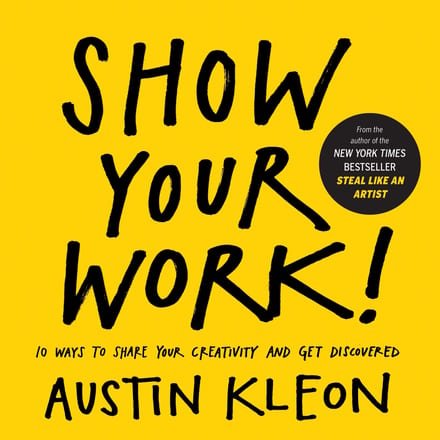
Show Your Work!: 10 Ways to Share Your Creativity and Get Discovered
10 Ways to Share Your Creativity and Get Discovered
The full book runs ~224 pages — roughly 4 hours of reading. You get the key ideas here in 5 minutes.
The key ideas
- Join a scenius: ideas come from scenes, not lone geniuses.
- Document the process, not just the finished work on the wall.
- Share one small thing every day, on a blog you own.
- Tell the story behind the work — it never speaks for itself.
- Teach what you know; it adds to your work, never subtracts.
- Chain-smoke projects: use the end of one to light the next.
The summary
You don’t really find an audience for your work; they find you. Austin Kleon agrees with Steve Martin’s dodge, “Be so good they can’t ignore you,” but only halfway: being good isn’t enough, because to be found you have to be findable. His fix isn’t networking but a habit: consistently posting bits of what you’re working on and learning. If Steal Like an Artist was about stealing influence from other people, this one is “about how to influence others by letting them steal from you.”
You don’t need genius, you need a scenius
The lone genius myth makes creativity an antisocial act performed by a few mostly dead men named Mozart or Picasso. Brian Eno offered a healthier word: scenius. Great ideas are usually birthed by an “ecology of talent,” a whole scene of people “supporting each other, looking at each other’s work, copying from each other, stealing ideas, and contributing ideas.” The useful part is that this version has room for you. Contributing isn’t about how talented you are; it’s about the ideas you share and the conversations you start, and online there’s no bouncer.
So stay an amateur, from the French word for lover. Amateurs have little to lose, so they experiment in public. “The real gap is between doing nothing and doing something,” writes Clay Shirky. Pick something you want to learn, and commit to learning it in front of other people.
Show the process, not just the product
Artists were trained to show the artwork on the wall and hide the art work behind it — the hunt for inspiration, the ideas, the oil on canvas. That made sense when a gallery show was the only way to reach anybody. It doesn’t now.
Chris Hadfield wanted people to see the real side of an astronaut’s life, not just the glamour and science. Commanding the International Space Station, he tweeted, posted photographs of Earth, and filmed videos of himself clipping his nails, brushing his teeth, and doing station maintenance. Kleon’s agent caught the appeal exactly: “Wouldn’t normally watch live video of a couple of guys doing plumbing repair, but IT’S IN SPACE!”
You’re probably not an astronaut, so become a documentarian of what you do: keep a work journal, photograph the work at different stages, scoop up the scraps. Then share one piece a day — what’s inspiring you, a method, a work in progress, what you cut. That beats a portfolio because it shows what you’re doing now, and one filter keeps it from becoming noise: “Don’t show your lunch or your latte; show your work.”
Small things compound. Robin Sloan’s flow — the posts that remind people you exist — turns into stock, the durable work people find years later; many of this book’s ideas began as tweets. Keep it on turf you own: “Absolutely everything good that has happened in my career can be traced back to my blog,” Kleon writes.
Your work doesn’t speak for itself
Artists love that line, but it’s false. For Significant Objects, Joshua Glenn and Rob Walker bought thrift-store trinkets averaging $1.25 apiece, hired writers to invent a story for each, and sold them on eBay using the stories as descriptions: $128.74 of junk fetched $3,612.51. People want to know where a thing came from and who made it, and how they feel about that changes what they think it’s worth.
So storytelling is part of the job, including stories about work that isn’t finished — those are just stories with the endings chopped off. And when a stranger asks what you do, strike the adjectives: you’re not an aspiring photographer, you’re a photographer.
Teach what you know, and be an open node
Barbecue is a secretive business, which makes Aaron Franklin instructive. Franklin Barbecue sells out of meat six days a week with a line around the block, and its pitmaster filmed a crowdfunded YouTube series walking viewers through every step of the process. It created no competitors: the technique is simple but takes years to master, and the tutorials mostly make you gladder to pay. Teaching adds to your work rather than subtracting from it, and you get an education back — Christopher Hitchens called having his books in the world “a free education that goes on for a lifetime.”
The failure mode is what Kleon calls human spam: people who won’t listen to your ideas, only tell you theirs. Be a fan first, because “if you want to be interesting, you have to be interested.”
Take a punch, then stick around
Designer Mike Monteiro says the most valuable thing he learned in art school was how to take a punch; brutal critiques taught him not to take criticism personally. Put out a lot of work and let people take their best shot — the more you absorb, the less it can hurt you. Block the trolls, though the worst one, Kleon admits, lives inside your own head.
Mostly, you have to not quit. Kleon’s method is chain-smoking: use the end of one project to light the next instead of stalling out waiting for feedback. And when a body of work has taught you everything it can, throw it out and begin again as an amateur. Louis C.K. sat on the same hour of material for 15 years until he learned that George Carlin dumped his every year and started from scratch. It set him free.
The bottom line
Sharing your process isn’t marketing bolted onto the work — it’s a byproduct of work you’re already doing, and it’s what makes you findable while you’re busy getting good. Post small pieces daily, tell the story behind them, teach what you learn, and stay in long enough for it to add up. Read this if you make things and hate promoting them.
Fact check
Popular books repeat findings that later research has complicated. Where Show Your Work! makes a testable claim, here's what the evidence actually shows.
Attaching an invented story to a cheap thrift-store object multiplied what buyers were willing to pay for it.
The dollar figures check out. The Significant Objects project's own accounting reports $128.74 of thrift-store junk selling for $3,612.51 in its first round, a 2,706% increase, with two later rounds turning $134.89 into $3,992.93. But it was an art project rather than an experiment: every object was auctioned with a story, so there was no no-story control group, and bidders knew they were buying a piece of a much-publicized project whose descriptions were written by well-known novelists. The underlying effect does appear in cleaner data — across three celebrity estate auctions, how much bidders believed an object had been in physical contact with a well-liked owner predicted higher final bids, and offering to sterilize a celebrity's sweater cut what people said they would pay for it. Head-to-head tests are more modest: a controlled trial of a storytelling video for Australian beef raised trust and quality perceptions among Chinese consumers but had only slight or even negative effects on willingness to pay, on samples of 76 local and 27 foreign respondents.
- Glenn J, Walker R. About the Significant Objects Project. Significant Objects, 2009-2012. Source
- Newman GE, Bloom P. Physical contact influences how much people pay at celebrity auctions. Proc Natl Acad Sci U S A. 2014;111(10):3705-8. PubMed
- Cao S, Foth M, Powell W, McQueenie J. What Are the Effects of Short Video Storytelling in Delivering Blockchain-Credentialed Australian Beef Products to China? Foods. 2021;10(10):2403. PubMed
Frequently asked questions
What is Show Your Work! about?
Austin Kleon's answer to being good at something nobody knows about. Instead of networking or self-promotion, the method is to share small pieces of your process as you go — what you're learning, what's inspiring you, what you cut — so people can find you while you're still getting good. It's the companion to Steal Like an Artist, flipped: that book was about stealing influence from others, this one is about letting others steal from you.
What are the key takeaways from Show Your Work!?
Drop the lone-genius myth and join a "scenius" — Brian Eno's word for the ecology of talent that actually produces great ideas. Document the process rather than only unveiling finished work, and post one small thing a day on turf you own, filtered by the rule "don't show your lunch or your latte; show your work." Tell the story behind what you make, because the work doesn't speak for itself. Teach what you know, be a fan before you ask for fans, learn to take a punch, and use the end of one project to light the next.
Who should read Show Your Work!?
People who make things and hate promoting them. It's for the writer, designer, coder, or artist who suspects being good ought to be enough, and who needs a version of getting discovered that isn't salesmanship.
Is Show Your Work! worth reading?
It's short, concrete, and unusually easy to act on — the examples stick, from Chris Hadfield filming himself brushing his teeth aboard the space station to Aaron Franklin giving away his barbecue technique on YouTube without creating a single competitor. The "share one piece a day" rule is something you can start tonight. If you already blog regularly and think in public, much of it will be familiar; the value is less in novelty than in permission and a workable daily habit.