Book summary
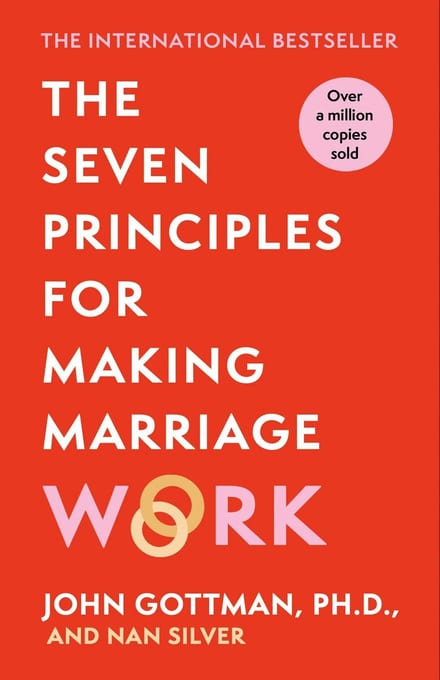
The Seven Principles for Making Marriage Work
A Practical Guide from the Country's Foremost Relationship Expert
The full book runs ~288 pages — roughly 5 hours of reading. You get the key ideas here in 3 minutes.
The key ideas
- Avoid the Four Horsemen: criticism, contempt, defensiveness, stonewalling.
- Maintain love maps: current, detailed knowledge of your partner's inner world.
- Turn toward small bids for connection to build lasting goodwill.
- Accept your partner's influence; sharing power prevents divorce.
- Manage perpetual conflicts with humor instead of trying to win them.
- Surface hidden dreams to break gridlock and build shared meaning.
The summary
You can’t argue your way to a lasting marriage. That’s the surprising finding behind John Gottman’s decades in the lab, where after watching a couple disagree for just five minutes he can predict divorce with 91% accuracy. The couples who last aren’t the ones with the best conflict-resolution skills or the fewest fights. They’re the ones who’ve built a solid friendship underneath the conflict—who know each other, respect each other, and stay connected in ordinary moments. Everything else follows from that.
The signs a marriage is dying
Before the principles, it helps to know what failure looks like, because Gottman’s predictions rest on a handful of corrosive patterns. It starts with a harsh startup—opening a hard conversation with criticism or sarcasm instead of a gentle complaint. Then come what he calls the Four Horsemen: criticism that attacks character rather than behavior, contempt that treats a partner with disgust, defensiveness that plays the victim, and stonewalling that shuts down and offers nothing back. Add flooding, the racing-heart overwhelm that makes calm talk impossible, and repair attempts that keep failing, and the marriage is in real danger. The bleakest sign of all is when a couple starts rewriting their shared history, recasting even happy memories in a sour light.
Friendship is built from small things
The first principle is keeping a “love map”—a detailed, up-to-date picture of your partner’s inner world: their worries, their hopes, who’s annoying them at work, what they want five years from now. When life lurches—a baby, a job change, an illness—couples with strong love maps can support each other because they understand what the change actually means to the other person. The second principle is fondness and admiration. Couples who speak warmly about their past are far more likely to have a happy future; Gottman describes a struggling pair, Rory and Lisa, who reconnected simply by recalling their first date, and held hands as they told the story. The third principle lives in the smallest moments of all: the “bids” for attention we make constantly—sharing a worry, pointing out something funny, asking how a meeting went. Each bid is a chance to turn toward your partner instead of turning away, and couples who reliably turn toward even trivial bids bank the goodwill that carries them through the hard times.
Share power, and manage what you can’t solve
The fourth principle is accepting your partner’s influence. Men who refuse to share power—who brush off their wives’ opinions or decide alone—are far more likely to divorce. Gottman offers a small, sharp exchange: Jack mentions he promised his wife he’d get a car inspected before buying it, and his friend Phil scoffs, “You let your wife tell you what to do about cars?” Jack asks, “Sure, don’t you?” Phil admits he’s divorced, and Jack says, “Well, maybe that’s why.” From there, everything depends on understanding which fights are even winnable. About 69% of a couple’s conflicts are perpetual—rooted in enduring differences of personality, values, or lifestyle. Walter wants sex far more often than Dana; Tony wants to raise the kids Catholic, Jessica wants them Jewish. You cannot resolve these by wearing the other person down; you can only manage them with humor and respect for the difference underneath. The remaining third are solvable, situational problems that yield to softened startups, repair attempts, self-soothing, and compromise—but only once each partner feels genuinely understood, because nobody accepts advice from someone who doesn’t seem to get them.
From gridlock to shared meaning
When a perpetual conflict hardens into a wall neither person will climb, that’s gridlock, and it usually means a hidden dream is at stake—a longing to stay near aging parents, a hunger for adventure, a value one partner can’t quite put into words. The way through isn’t to solve the surface problem but to surface the dreams beneath it, listen without judgment, and find ways to honor them even if the disagreement remains. Combat becomes conversation. The strongest couples go one step further and build shared meaning: their own private culture of rituals, roles, and goals, and an ongoing habit of honoring each other’s dreams even when they don’t match. None of this takes a retreat or a therapist. Gottman argues you can transform a marriage with about five hours a week—brief daily check-ins, a stress-reducing talk after work, small gestures of affection, and one weekly date.
The bottom line
A marriage lasts on friendship, not fighting skill: knowing your partner deeply, answering their small bids for connection, letting their opinion move you, and living gracefully with the differences you’ll never resolve. Read this if you want a research-backed way to strengthen your own marriage, or simply to understand why some couples endure while others quietly fall apart.
Fact check
Popular books repeat findings that later research has complicated. Where The Seven Principles for Making Marriage Work makes a testable claim, here's what the evidence actually shows.
Gottman can predict which couples will divorce with about 91% accuracy after watching five minutes of them arguing.
The accuracy figures come from statistical models fitted to the same small samples they were then used to describe — the 1992 study that established the pattern followed 73 couples. When Heyman and Smith Slep re-ran divorce-prediction analyses with proper crossvalidation, accuracy and predictive value dropped sharply once the model met couples it had not been built on. The behavioral patterns Gottman identified are real; the headline number describes past data rather than a demonstrated forecasting rate.
The Four Horsemen — criticism, contempt, defensiveness and stonewalling — mark a marriage headed for divorce.
The direction is right: following 73 couples across four years, Gottman and Levenson found that "nonregulated" couples — more negative affect and expression, more defensiveness, more stubbornness and withdrawal, less positive emotion — were at markedly higher risk of separating. But conflict behavior is a weaker and less one-way signal than the Four Horsemen framing implies. Observing newlyweds across four sessions at nine-month intervals, Lavner, Karney and Bradbury found communication and satisfaction each predicted the other, with neither path strong — couples partly argue badly because they are already unhappy.
- Gottman JM, Levenson RW. Marital processes predictive of later dissolution: behavior, physiology, and health. J Pers Soc Psychol. 1992;63(2):221-33. PubMed
- Lavner JA, Karney BR, Bradbury TN. Does couples' communication predict marital satisfaction, or does marital satisfaction predict communication? J Marriage Fam. 2016;78(3):680-694. PubMed
Husbands who refuse to accept their wives' influence are far more likely to end up divorced.
The finding traces to a single 1998 study of newlywed couples in Gottman's own lab, where rejecting a wife's influence separated the marriages that lasted from those that did not. It has not been independently replicated, and it carries the same statistical caveat as the rest of that program: the variable was picked out of the data it explains, and crossvalidated re-analysis of these divorce-prediction models shows accuracy falling steeply on couples the model has not seen. Sensible advice, preliminary evidence.
Frequently asked questions
What is The Seven Principles for Making Marriage Work about?
You can't argue your way to a lasting marriage. After watching couples in his lab, Gottman can predict divorce from a five-minute disagreement with 91% accuracy — and the couples who last aren't those with the best conflict skills but those who've built a solid friendship underneath the conflict. They know each other, respect each other, and stay connected in ordinary moments, and everything else follows from that.
What are the key takeaways from The Seven Principles for Making Marriage Work?
Warning signs predict failure — the harsh startup, the Four Horsemen (criticism, contempt, defensiveness, stonewalling), flooding, and rewriting shared history in a sour light. The principles build friendship: keep an up-to-date "love map" of your partner's inner world, nurture fondness and admiration, and turn toward their small bids for attention. Accept your partner's influence rather than refusing to share power. Recognize that about 69% of conflicts are perpetual and can only be managed with humor and respect, not solved; and when one hardens into gridlock, surface the hidden dream beneath it and build shared meaning. It takes roughly five hours a week, not a therapist.
Who should read The Seven Principles for Making Marriage Work?
Anyone who wants a research-backed way to strengthen their own marriage — or simply to understand why some couples endure while others quietly fall apart.
Is The Seven Principles for Making Marriage Work worth reading?
It's built on decades of actual lab data rather than opinion, and its tools — love maps, turning toward bids, the weekly five hours — are concrete and doable. The advice centers on committed long-term partnerships, so it's most useful to couples ready to put in ordinary, consistent effort rather than anyone hoping for a quick fix.